Mdluli Siyabonga B, Ramoroka Morongwa E, Yussuf Sodiq T, Modibane Kwena D, John-Denk Vivian S, Iwuoha Emmanuel I
Sensor Laboratories (SensorLab), University of the Western Cape, Robert Sobukwe Road, Bellville, Cape Town 7535, South Africa.
Department of Chemistry, School of Physical and Mineral Science, University of Limpopo, Sovenga, Polokwane 0727, South Africa.
Polymers (Basel). 2022 Feb 13;14(4):716. doi: 10.3390/polym14040716.
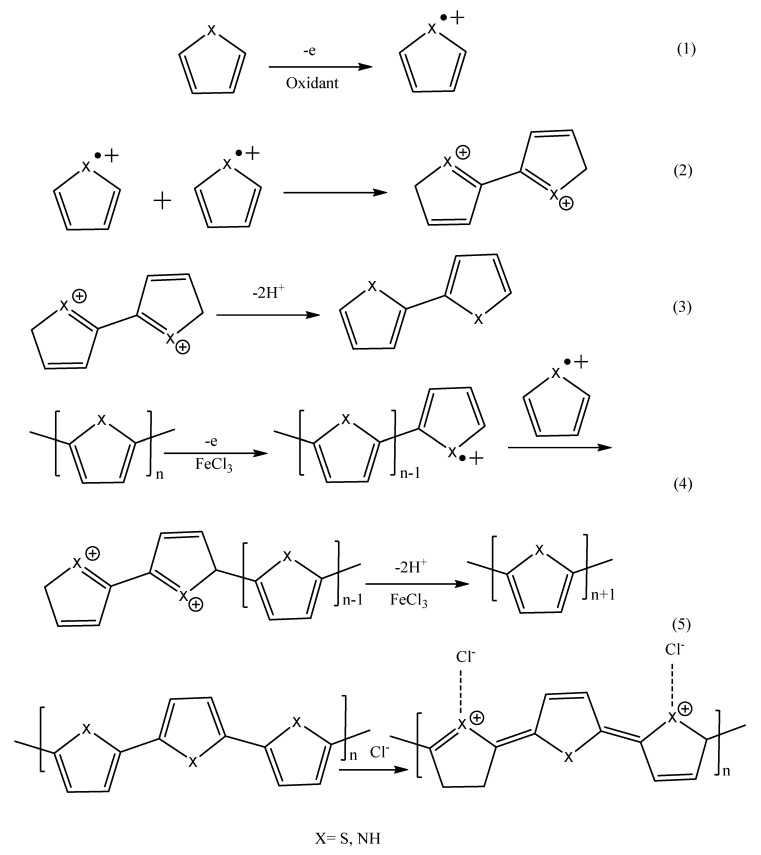
The evolution and emergence of organic solar cells and hybrid organic-silicon heterojunction solar cells have been deemed as promising sustainable future technologies, owing to the use of -conjugated polymers. In this regard, the scope of this review article presents a comprehensive summary of the applications of -conjugated polymers as hole transporting layers (HTLs) or emitters in both organic solar cells and organic-silicon hybrid heterojunction solar cells. The different techniques used to synthesize these polymers are discussed in detail, including their electronic band structure and doping mechanisms. The general architecture and principle of operating heterojunction solar cells is addressed. In both discussed solar cell types, incorporation of -conjugated polymers as HTLs have seen a dramatic increase in efficiencies attained by these devices, owing to the high transmittance in the visible to near-infrared region, reduced carrier recombination, high conductivity, and high hole mobilities possessed by the p-type polymeric materials. However, these cells suffer from long-term stability due to photo-oxidation and parasitic absorptions at the anode interface that results in total degradation of the polymeric p-type materials. Although great progress has been seen in the incorporation of conjugated polymers in the various solar cell types, there is still a long way to go for cells incorporating polymeric materials to realize commercialization and large-scale industrial production due to the shortcomings in the stability of the polymers. This review therefore discusses the progress in using polymeric materials as HTLs in organic solar cells and hybrid organic-silicon heterojunction solar cells with the intention to provide insight on the quest of producing highly efficient but less expensive solar cells.
由于使用了π共轭聚合物,有机太阳能电池和有机-硅混合异质结太阳能电池的发展与出现被视为未来有前景的可持续技术。在这方面,本文综述的范围全面总结了π共轭聚合物在有机太阳能电池和有机-硅混合异质结太阳能电池中作为空穴传输层(HTLs)或发射体的应用。详细讨论了用于合成这些聚合物的不同技术,包括它们的电子能带结构和掺杂机制。阐述了异质结太阳能电池的一般结构和工作原理。在这两种讨论的太阳能电池类型中,由于p型聚合物材料在可见光到近红外区域的高透过率、减少的载流子复合、高导电性和高空穴迁移率,将π共轭聚合物用作HTLs使这些器件的效率有了显著提高。然而,由于光氧化和阳极界面处的寄生吸收导致p型聚合物材料完全降解,这些电池存在长期稳定性问题。尽管在将共轭聚合物纳入各种太阳能电池类型方面取得了很大进展,但由于聚合物稳定性方面的缺点,含有聚合物材料的电池要实现商业化和大规模工业生产仍有很长的路要走。因此,本综述讨论了在有机太阳能电池和有机-硅混合异质结太阳能电池中使用聚合物材料作为HTLs的进展,旨在为生产高效但成本较低的太阳能电池提供见解。