Department of Biology, Boston College, Chestnut Hill, MA 02467, USA.
Viruses. 2022 Feb 17;14(2):409. doi: 10.3390/v14020409.
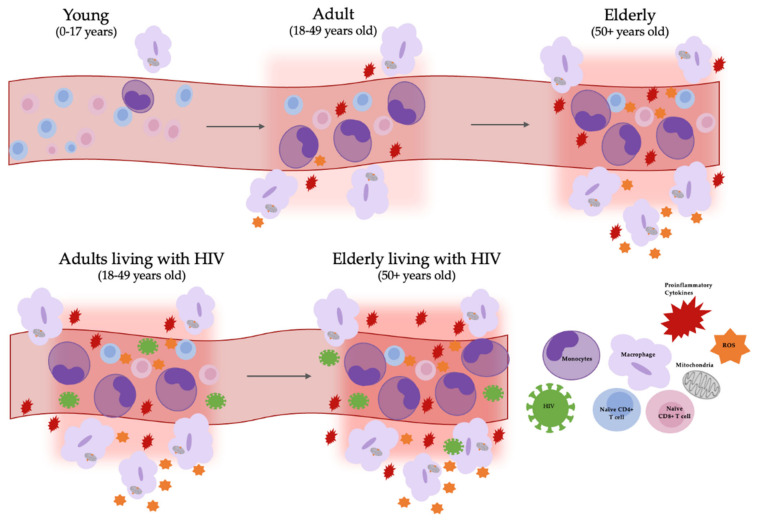
Before the antiretroviral therapy (ART) era, people living with HIV (PLWH) experienced complications due to AIDS more so than aging. With ART and the extended lifespan of PLWH, HIV comorbidities also include aging-most likely due to accelerated aging-as well as a cardiovascular, neurocognitive disorders, lung and kidney disease, and malignancies. The broad evidence suggests that HIV with ART is associated with accentuated aging, and that the age-related comorbidities occur earlier, due in part to chronic immune activation, co-infections, and possibly the effects of ART alone. Normally the immune system undergoes alterations of lymphocyte and monocyte populations with aging, that include diminished naïve T- and B-lymphocyte numbers, a reliance on memory lymphocytes, and a skewed production of myeloid cells leading to age-related inflammation, termed "inflamm-aging". Specifically, absolute numbers and relative proportions of monocytes and monocyte subpopulations are skewed with age along with myeloid mitochondrial dysfunction, resulting in increased accumulation of reactive oxygen species (ROS). Additionally, an increase in biomarkers of myeloid activation (IL-6, sCD14, and sCD163) occurs with chronic HIV infection and with age, and may contribute to immunosenescence. Chronic HIV infection accelerates aging; meanwhile, ART treatment may slow age-related acceleration, but is not sufficient to stop aging or age-related comorbidities. Overall, a better understanding of the mechanisms behind accentuated aging with HIV and the effects of myeloid activation and turnover is needed for future therapies.
在抗逆转录病毒疗法(ART)时代之前,HIV 感染者(PLWH)因艾滋病而出现并发症的情况比因衰老而出现并发症的情况更为常见。随着 ART 的出现和 PLWH 寿命的延长,HIV 合并症也包括衰老——可能是由于加速衰老——以及心血管疾病、神经认知障碍、肺部和肾脏疾病以及恶性肿瘤。广泛的证据表明,接受 ART 治疗的 HIV 与加速衰老有关,并且与年龄相关的合并症出现得更早,部分原因是慢性免疫激活、合并感染,以及可能单独受到 ART 的影响。通常,免疫系统会随着衰老而发生淋巴细胞和单核细胞群体的改变,包括幼稚 T 细胞和 B 细胞数量减少、依赖记忆淋巴细胞以及髓样细胞产生的倾斜,导致与年龄相关的炎症,称为“炎性衰老”。具体来说,单核细胞及其亚群的绝对数量和相对比例会随着年龄的增长而倾斜,同时伴有髓样线粒体功能障碍,导致活性氧(ROS)的积累增加。此外,慢性 HIV 感染和衰老会导致髓样细胞激活的生物标志物(IL-6、sCD14 和 sCD163)增加,这可能导致免疫衰老。慢性 HIV 感染会加速衰老;同时,ART 治疗可能会减缓与年龄相关的加速,但不足以阻止衰老或与年龄相关的合并症。总的来说,需要更好地了解 HIV 加速衰老背后的机制以及髓样细胞激活和更新的影响,以便为未来的治疗提供依据。