Molecular Surgery Program, Department of Ophthalmology, Byers Eye Institute, Stanford University, Palo Alto, CA, USA.
Medical Scientist Training Program and Graduate Program in Molecular Medicine, University of Iowa, Iowa City, IA, USA.
Nat Commun. 2022 Feb 25;13(1):1053. doi: 10.1038/s41467-022-28674-1.
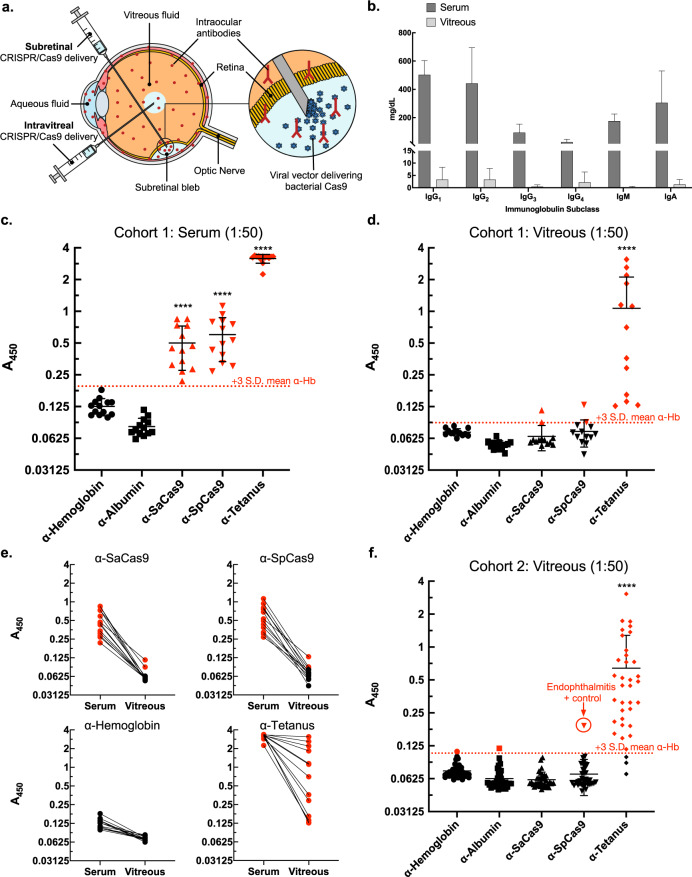
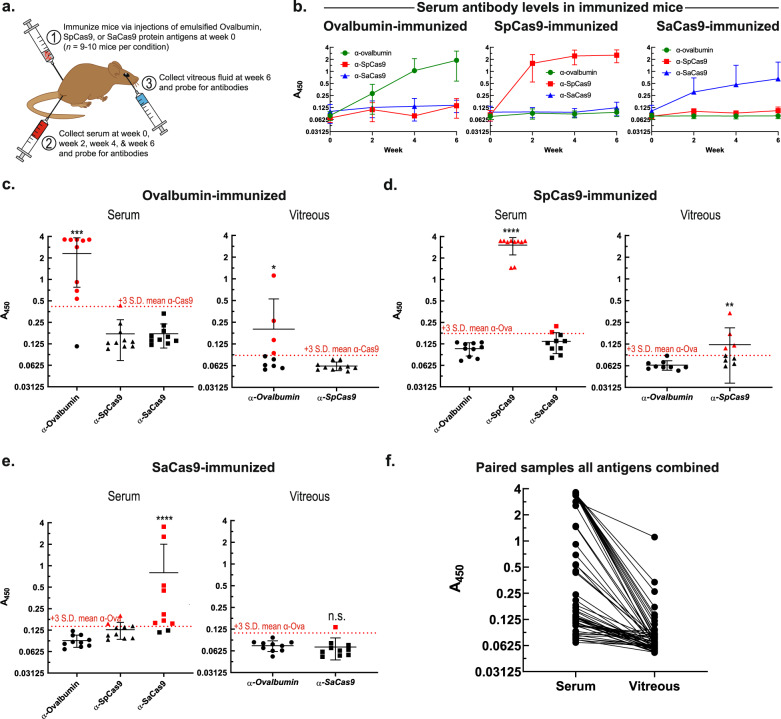
Preexisting immunity against Cas9 proteins in humans represents a safety risk for CRISPR-Cas9 technologies. However, it is unclear to what extent preexisting Cas9 immunity is relevant to the eye as it is targeted for early in vivo CRISPR-Cas9 clinical trials. While the eye lacks T-cells, it contains antibodies, cytokines, and resident immune cells. Although precise mechanisms are unclear, intraocular inflammation remains a major cause of vision loss. Here, we used immunoglobulin isotyping and ELISA platforms to profile antibodies in serum and vitreous fluid biopsies from human adult subjects and Cas9-immunized mice. We observed high prevalence of preexisting Cas9-reactive antibodies in serum but not in the eye. However, we detected intraocular antibodies reactive to S. pyogenes-derived Cas9 after S. pyogenes intraocular infection. Our data suggest that serum antibody concentration may determine whether specific intraocular antibodies develop, but preexisting immunity to Cas9 may represent a lower risk in human eyes than systemically.
人类体内预先存在的 Cas9 蛋白免疫反应对 CRISPR-Cas9 技术构成了安全风险。然而,目前尚不清楚预先存在的 Cas9 免疫反应在多大程度上与眼睛有关,因为它是早期体内 CRISPR-Cas9 临床试验的目标。虽然眼睛中没有 T 细胞,但它含有抗体、细胞因子和固有免疫细胞。尽管确切的机制尚不清楚,但眼内炎症仍然是视力丧失的主要原因。在这里,我们使用免疫球蛋白分型和 ELISA 平台来分析来自成年人类受试者和 Cas9 免疫小鼠的血清和玻璃体液活检中的抗体。我们观察到血清中 Cas9 反应性抗体的高患病率,但在眼睛中没有。然而,我们在化脓性链球菌眼内感染后检测到对来源于化脓性链球菌的 Cas9 具有反应性的眼内抗体。我们的数据表明,血清抗体浓度可能决定是否会产生特定的眼内抗体,但与全身性 Cas9 相比,人类眼睛中的预先存在的 Cas9 免疫可能代表较低的风险。