Non-communicable Diseases Research Division, Wits Health Consortium (PTY) Ltd, Johannesburg, South Africa.
Division of Medical Oncology, Department of Medicine, Faculty of Health Sciences, University of the Witwatersrand, Johannesburg, South Africa.
Int J Cancer. 2022 Jul 15;151(2):209-221. doi: 10.1002/ijc.33981. Epub 2022 Mar 4.
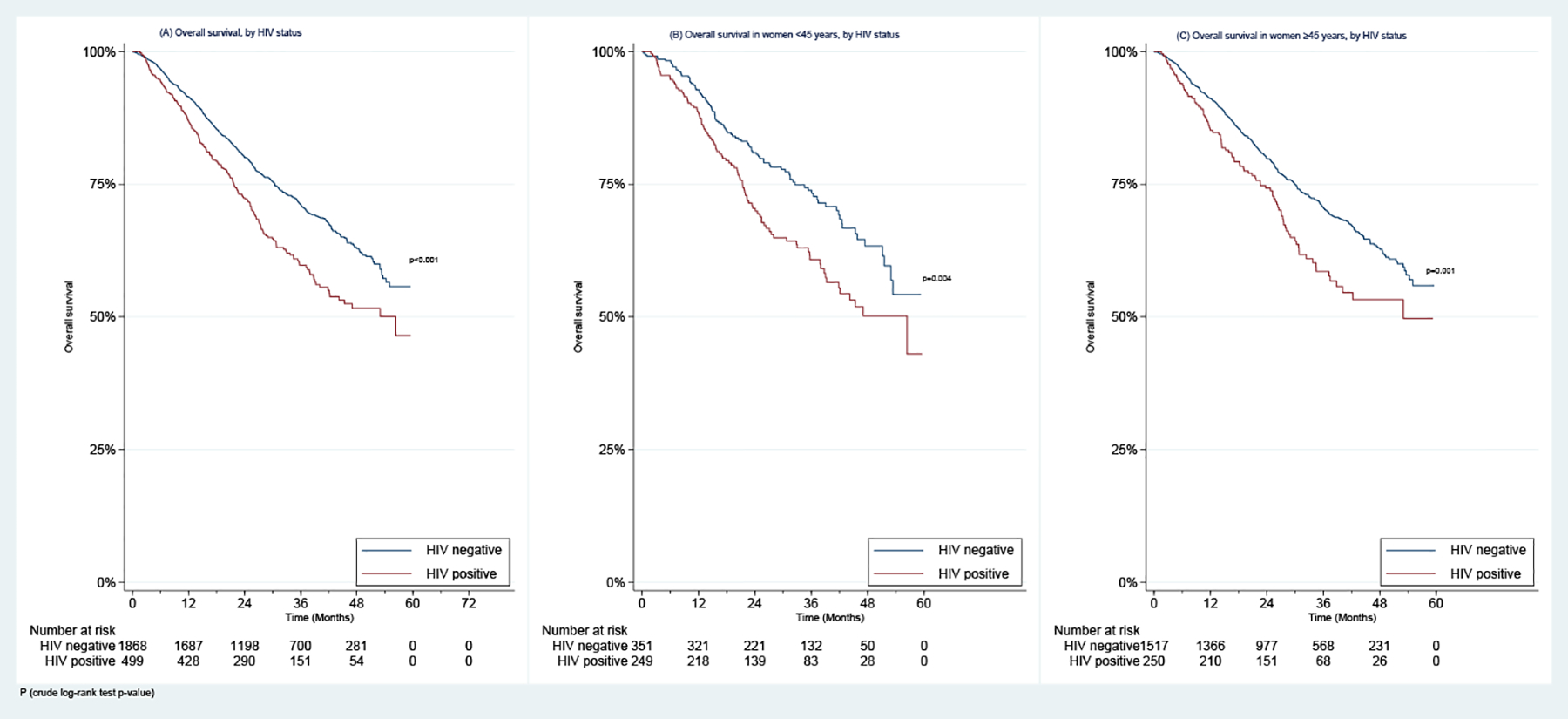
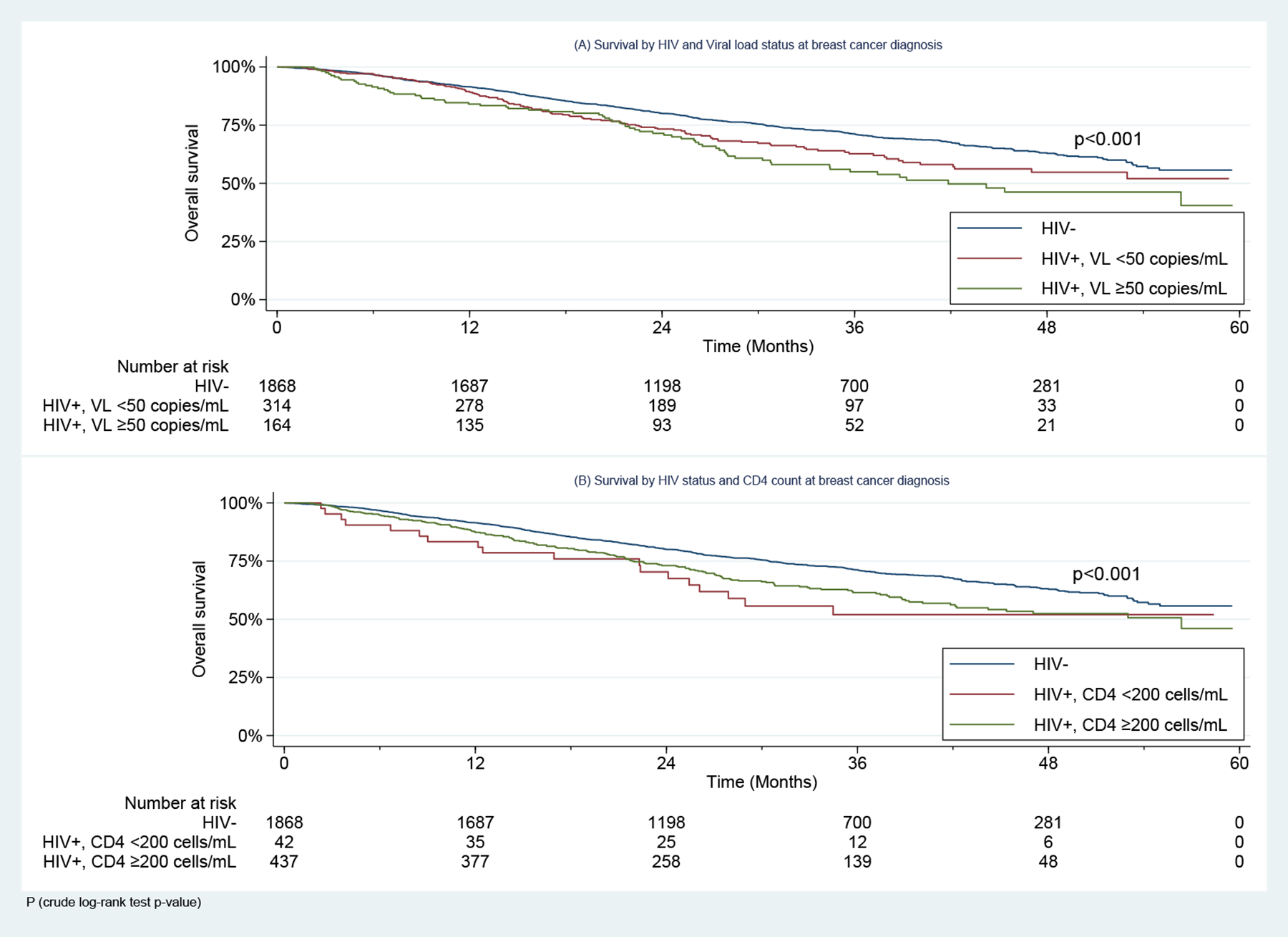
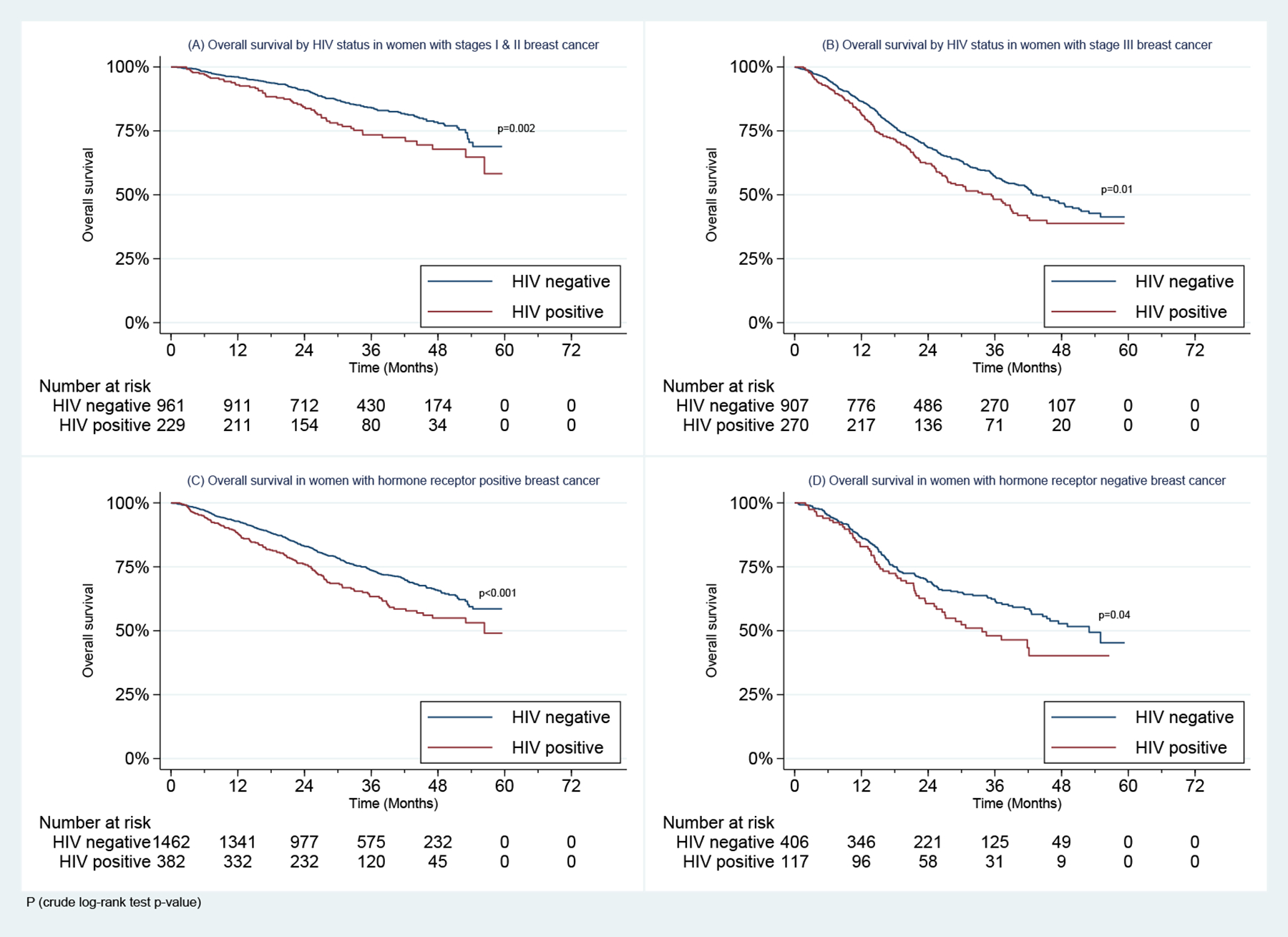
In some countries of sub-Saharan Africa, the prevalence of HIV exceeds 20%; in South Africa, 20.4% of people are living with HIV. We examined the impact of HIV infection on the overall survival (OS) of women with nonmetastatic breast cancer (BC) enrolled in the South African Breast Cancer and HIV Outcomes (SABCHO) study. We recruited women with newly diagnosed BC at six public hospitals from 1 July 2015 to 30 June 2019. Among women with stages I-III BC, we compared those with and without HIV infection on sociodemographic, clinical, and treatment factors. We analyzed the impact of HIV on OS using multivariable Cox proportional hazard models. Of 2367 women with stages I-III BC, 499 (21.1%) had HIV and 1868 (78.9%) did not. With a median follow-up of 29 months, 2-year OS was poorer among women living with HIV (WLWH) than among HIV-uninfected women (72.4% vs 80.1%, P < .001; adjusted hazard ratio (aHR) 1.49, 95% confidence interval (CI) = 1.22-1.83). This finding was consistent across age groups ≥45 years and <45 years, stage I-II BC and stage III BC, and ER/PR status (all P < .03). Both WLWH with <50 viral load copies/mL and WLWH with ≥50 viral load copies/mL had poorer survival than HIV-uninfected BC patients [aHR: 1.35 (1.09-1.66) and 1.54 (1.20-2.00), respectively], as did WLWH who had ≥200 CD4+ cells/mL at diagnosis [aHR: 1.39 (1.15-1.67)]. Because receipt of antiretroviral therapy has become widespread, WLWH is surviving long enough to develop BC; more research is needed on the causes of their poor survival.
在撒哈拉以南非洲的一些国家,艾滋病毒的流行率超过 20%;在南非,有 20.4%的人携带艾滋病毒。我们研究了艾滋病毒感染对参加南非乳腺癌和艾滋病毒结局(SABCHO)研究的非转移性乳腺癌(BC)女性的总生存(OS)的影响。我们于 2015 年 7 月 1 日至 2019 年 6 月 30 日从六家公立医院招募新诊断为 BC 的女性。在 I-III 期 BC 女性中,我们比较了有和无 HIV 感染的女性在社会人口统计学、临床和治疗因素方面的差异。我们使用多变量 Cox 比例风险模型分析了 HIV 对 OS 的影响。在 2367 名 I-III 期 BC 女性中,499 名(21.1%)患有 HIV,1868 名(78.9%)没有。中位随访 29 个月后,HIV 阳性(WHW)患者的 2 年 OS 低于 HIV 阴性患者(72.4% vs 80.1%,P<.001;调整后的危险比[aHR] 1.49,95%置信区间[CI]为 1.22-1.83)。这一发现在≥45 岁和<45 岁、I-II 期 BC 和 III 期 BC 以及 ER/PR 状态的年龄组中均一致(均 P<.03)。病毒载量<50 拷贝/mL 和≥50 拷贝/mL 的 WHW 的生存情况均比 HIV 阴性 BC 患者差[aHR:1.35(1.09-1.66)和 1.54(1.20-2.00)],诊断时 CD4+细胞≥200 个/μL 的 WHW 也是如此[aHR:1.39(1.15-1.67)]。由于抗逆转录病毒治疗的广泛应用,WHW 存活时间足够长,以至于发展为 BC;需要进一步研究其生存状况不佳的原因。