ISARIC Global Support Centre, International Severe Acute Respiratory and Emerging Infection Consortium, Centre for Tropical Medicine and Global Health, Nuffield Department of Medicine, University of Oxford, New Richards Building, Old Road Campus, Roosevelt Drive, Oxford OX3 7FZ, UK.
Visiting Fellow, Institute for Innovation and Public Purpose, University College London, London, UK.
Mol Ther. 2022 May 4;30(5):1801-1809. doi: 10.1016/j.ymthe.2022.02.022. Epub 2022 Feb 23.
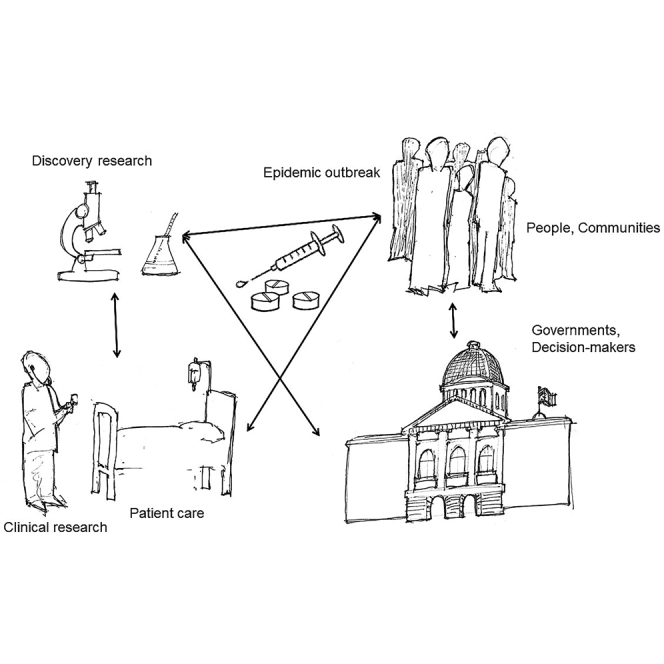
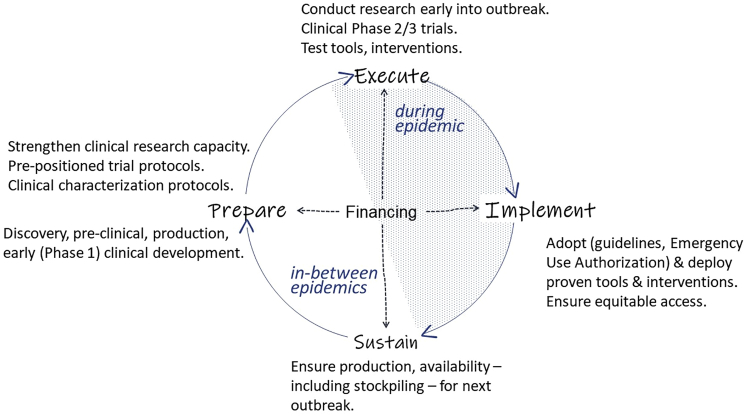
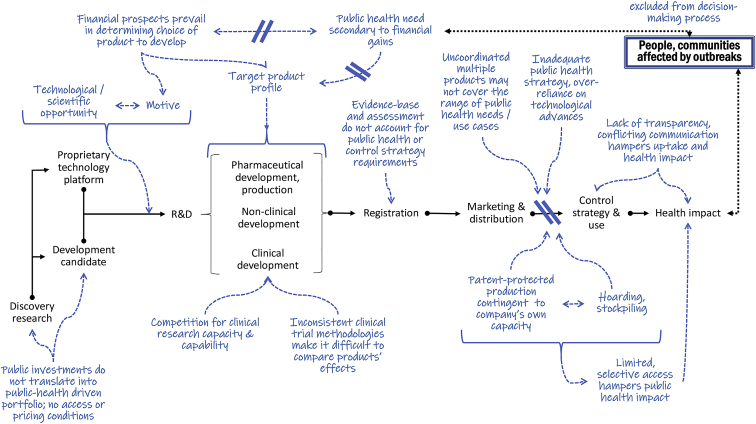
Lessons drawn from successes and failures with coronavirus disease 2019 (COVID-19) and Ebola virus disease (EVD) should help shaping a robust health innovation system for infectious disease epidemics. Epidemic response research and development (R&D) can be mobilized quickly for public health priorities and yield medicinal products within months. However, to resolve epidemics, technological advances must be equitably accessible and deployed, and these examples expose the limitations of a supply-driven, fragmented R&D ecosystem relying primarily on the private sector to deliver health products. Efficient epidemic response requires a coordinated public health-focused, end-to-end R&D ecosystem for the development, registration, availability, and use of pharmaceutical products. Because pivotal clinical trials can only be conducted during outbreaks, significant preparation must be done beforehand: strengthening clinical research capacity and developing pre-positioned trial protocols and clinical characterization protocols, as well as conducting discovery and pre-clinical research, manufacturing, and early clinical testing of candidate products. This will allow for speedy execution of clinical research early into an outbreak and delivering products within a short time. Effective interventions should be adopted and deployed ensuring equitable access during the ongoing outbreak. Measures to make products available where and when needed must be integrated throughout the R&D value chain.
从 2019 年冠状病毒病(COVID-19)和埃博拉病毒病(EVD)的成功和失败中吸取的经验教训,应该有助于为传染病大流行塑造一个强大的卫生创新体系。可以迅速调动传染病应对研究与开发(R&D),以便优先考虑公共卫生,并在数月内生产出医药产品。然而,要解决传染病问题,就必须公平地获取和部署技术进步,而这些例子暴露了主要依赖私营部门提供卫生产品的供应驱动、分散的 R&D 生态系统的局限性。高效的疫情应对需要一个协调的以公共卫生为重点的、端到端的 R&D 生态系统,用于药品的开发、注册、供应和使用。由于关键性临床试验只能在疫情爆发期间进行,因此必须事先做好充分准备:加强临床研究能力,制定预先定位的试验方案和临床特征化方案,以及进行发现和临床前研究、制造和候选产品的早期临床测试。这将允许在疫情爆发早期迅速进行临床研究,并在短时间内交付产品。在疫情持续期间,应采用和部署有效的干预措施,确保公平获取。在整个 R&D 价值链中,必须整合使产品在需要的时间和地点可用的措施。