Estonian Genome Centre, Institute of Genomics, University of Tartu, Tartu 51010, Estonia.
Institute of Clinical Medicine, Faculty of Medicine, University of Oslo, Oslo, Norway.
Hum Mol Genet. 2022 Sep 29;31(19):3377-3391. doi: 10.1093/hmg/ddac050.
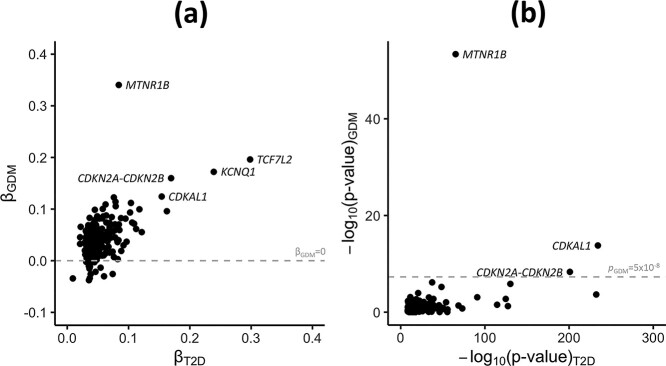
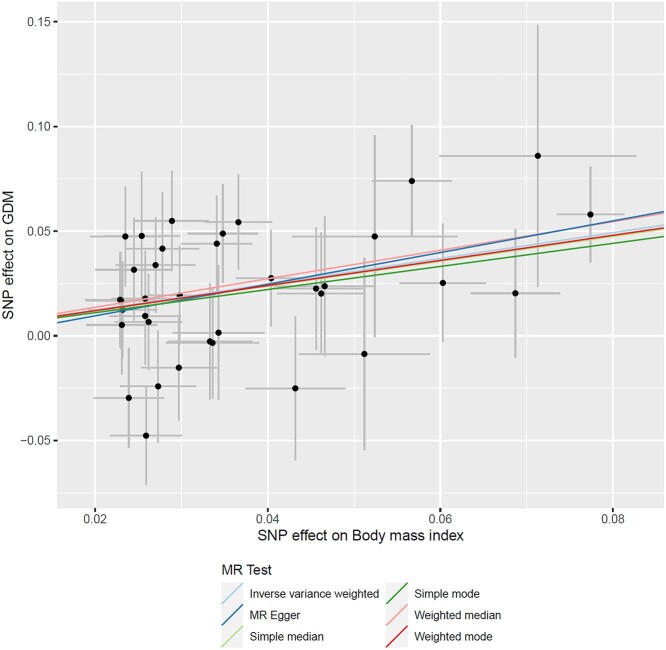
Gestational diabetes mellitus (GDM) is associated with increased risk of pregnancy complications and adverse perinatal outcomes. GDM often reoccurs and is associated with increased risk of subsequent diagnosis of type 2 diabetes (T2D). To improve our understanding of the aetiological factors and molecular processes driving the occurrence of GDM, including the extent to which these overlap with T2D pathophysiology, the GENetics of Diabetes In Pregnancy Consortium assembled genome-wide association studies of diverse ancestry in a total of 5485 women with GDM and 347 856 without GDM. Through multi-ancestry meta-analysis, we identified five loci with genome-wide significant association (P < 5 × 10⁻⁸) with GDM, mapping to/near MTNR1B (P = 4.3 × 10-54), TCF7L2 (P = 4.0 × 10⁻¹⁶), CDKAL1 (P = 1.6 × 10⁻¹⁴), CDKN2A-CDKN2B (P = 4.1 × 10⁻⁹) and HKDC1 (P = 2.9 × 10⁻⁸). Multiple lines of evidence pointed to the shared pathophysiology of GDM and T2D: (i) four of the five GDM loci (not HKDC1) have been previously reported at genome-wide significance for T2D; (ii) significant enrichment for associations with GDM at previously reported T2D loci; (iii) strong genetic correlation between GDM and T2D and (iv) enrichment of GDM associations mapping to genomic annotations in diabetes-relevant tissues and transcription factor binding sites. Mendelian randomization analyses demonstrated significant causal association (5% false discovery rate) of higher body mass index on increased GDM risk. Our results provide support for the hypothesis that GDM and T2D are part of the same underlying pathology but that, as exemplified by the HKDC1 locus, there are genetic determinants of GDM that are specific to glucose regulation in pregnancy.
妊娠期糖尿病(GDM)与妊娠并发症和围产期不良结局的风险增加有关。GDM 常反复发作,并与随后诊断为 2 型糖尿病(T2D)的风险增加有关。为了更好地了解导致 GDM 发生的病因和分子过程,包括这些过程与 T2D 病理生理学的重叠程度,妊娠期糖尿病遗传学联盟(GENetics of Diabetes In Pregnancy Consortium)在总共 5485 名患有 GDM 的女性和 347856 名没有 GDM 的女性中,进行了不同种族的全基因组关联研究。通过多种族荟萃分析,我们在 GDM 中鉴定出五个具有全基因组显著关联的位点(P < 5 × 10⁻⁸),这些位点位于/附近 MTNR1B(P = 4.3 × 10-54)、TCF7L2(P = 4.0 × 10⁻¹⁶)、CDKAL1(P = 1.6 × 10⁻¹⁴)、CDKN2A-CDKN2B(P = 4.1 × 10⁻⁹)和 HKDC1(P = 2.9 × 10⁻⁸)。多条证据表明 GDM 和 T2D 具有共同的病理生理学:(i)五个 GDM 位点中的四个(不包括 HKDC1)先前在全基因组范围内与 T2D 相关;(ii)先前报道的 T2D 位点与 GDM 的关联具有显著的富集;(iii)GDM 和 T2D 之间具有很强的遗传相关性;(iv)GDM 关联映射到与糖尿病相关组织和转录因子结合位点的基因组注释中存在富集。孟德尔随机化分析表明,较高的体重指数与 GDM 风险增加存在显著的因果关系(5%的假发现率)。我们的研究结果支持这样的假设,即 GDM 和 T2D 是同一潜在病理的一部分,但正如 HKDC1 位点所示,也存在特定于妊娠期间葡萄糖调节的 GDM 遗传决定因素。