Tam Claudia Ha-Ting, Wang Ying, Wang Chi Chiu, Yuen Lai Yuk, Lim Cadmon King-Poo, Leng Junhong, Wu Ling, Ng Alex Chi-Wai, Hou Yong, Tsoi Kit Ying, Wang Hui, Ozaki Risa, Li Albert Martin, Wang Qingqing, Chan Juliana Chung-Ngor, Ye Yan Chou, Tam Wing Hung, Yang Xilin, Ma Ronald Ching-Wan
Department of Medicine and Therapeutics, Prince of Wales Hospital, The Chinese University of Hong Kong, Hong Kong, China.
Hong Kong Institute of Diabetes and Obesity, The Chinese University of Hong Kong, Hong Kong, China.
Diabetes Metab J. 2025 Jan;49(1):128-143. doi: 10.4093/dmj.2024.0139. Epub 2024 Sep 20.
The genetic basis for hyperglycaemia in pregnancy remain unclear. This study aimed to uncover the genetic determinants of gestational diabetes mellitus (GDM) and investigate their applications.
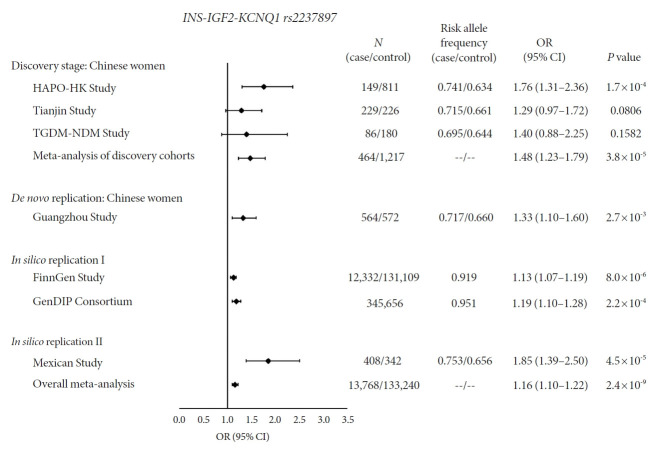
We performed a meta-analysis of genome-wide association studies (GWAS) for GDM in Chinese women (464 cases and 1,217 controls), followed by de novo replications in an independent Chinese cohort (564 cases and 572 controls) and in silico replication in European (12,332 cases and 131,109 controls) and multi-ethnic populations (5,485 cases and 347,856 controls). A polygenic risk score (PRS) was derived based on the identified variants.
Using the genome-wide scan and candidate gene approaches, we identified four susceptibility loci for GDM. These included three previously reported loci for GDM and type 2 diabetes mellitus (T2DM) at MTNR1B (rs7945617, odds ratio [OR], 1.64; 95% confidence interval [CI], 1.38 to 1.96), CDKAL1 (rs7754840, OR, 1.33; 95% CI, 1.13 to 1.58), and INS-IGF2-KCNQ1 (rs2237897, OR, 1.48; 95% CI, 1.23 to 1.79), as well as a novel genome-wide significant locus near TBR1-SLC4A10 (rs117781972, OR, 2.05; 95% CI, 1.61 to 2.62; Pmeta=7.6×10⁻⁹), which has not been previously reported in GWAS for T2DM or glycaemic traits. Moreover, we found that women with a high PRS (top quintile) had over threefold (95% CI, 2.30 to 4.09; Pmeta=3.1×10⁻¹⁴) and 71% (95% CI, 1.08 to 2.71; P=0.0220) higher risk for GDM and abnormal glucose tolerance post-pregnancy, respectively, compared to other individuals.
Our results indicate that the genetic architecture of glucose metabolism exhibits both similarities and differences between the pregnant and non-pregnant states. Integrating genetic information can facilitate identification of pregnant women at a higher risk of developing GDM or later diabetes.
孕期高血糖的遗传基础仍不清楚。本研究旨在揭示妊娠期糖尿病(GDM)的遗传决定因素并探讨其应用。
我们对中国女性GDM的全基因组关联研究(GWAS)进行了荟萃分析(464例病例和1217例对照),随后在一个独立的中国队列(564例病例和572例对照)中进行了从头复制,并在欧洲人群(12332例病例和131109例对照)和多民族人群(5485例病例和347856例对照)中进行了电子复制。基于鉴定出的变异推导了多基因风险评分(PRS)。
通过全基因组扫描和候选基因方法,我们鉴定出4个GDM易感位点。其中包括MTNR1B(rs7945617,优势比[OR],1.64;95%置信区间[CI],1.38至1.96)、CDKAL1(rs7754840,OR,1.33;95%CI,1.13至1.58)和INS-IGF2-KCNQ1(rs2237897,OR,1.48;95%CI,1.23至1.79)这3个先前报道的GDM和2型糖尿病(T2DM)位点,以及TBR1-SLC4A10附近一个新的全基因组显著位点(rs117781972,OR,2.05;95%CI,1.61至2.62;Pmeta=7.6×10⁻⁹),该位点在T2DM或血糖性状的GWAS中尚未有报道。此外,我们发现与其他个体相比,PRS高(最高五分位数)的女性患GDM和产后糖耐量异常的风险分别高出三倍多(95%CI,2.30至4.09;Pmeta=3.1×10⁻¹⁴)和71%(95%CI,1.08至2.71;P=0.0220)。
我们的结果表明,葡萄糖代谢的遗传结构在怀孕和非怀孕状态之间既有相似之处也有不同之处。整合遗传信息有助于识别患GDM或后期糖尿病风险较高的孕妇。