Ranisavljev Marijana, Kuzmanovic Jovan, Todorovic Nikola, Roklicer Roberto, Dokmanac Milorad, Baic Mario, Stajer Valdemar, Ostojic Sergej M, Drid Patrik
Faculty of Sport and Physical Education, University of Novi Sad, Novi Sad, Serbia.
Belgrade Sports Academy, Belgrade, Serbia.
Front Physiol. 2022 Feb 9;13:842992. doi: 10.3389/fphys.2022.842992. eCollection 2022.
Grappling is a wrestling style that combines different techniques such as freestyle wrestling, jiu-jitsu, judo, sambo, and others. As with other combat sports, it requires categorizing the athletes in weight classes, which leads to the use of certain methods to lose body weight in a short amount of time which poses a serious threat to athletes' health and wellbeing. Therefore, the objective of this study was to investigate the most widespread rapid weight loss (RWL) methods and sources of influence used by grappling athletes.
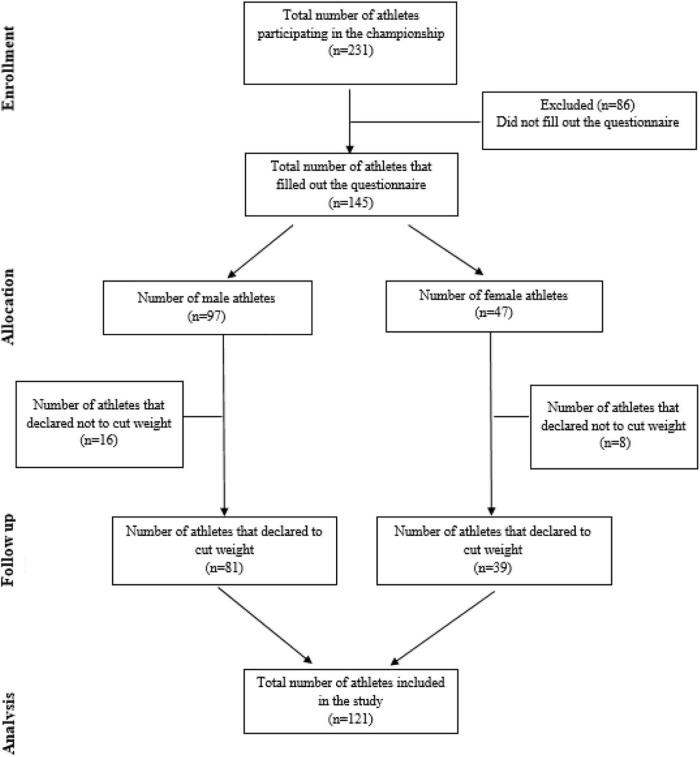
A total of 145 athletes took part in the study by voluntarily filling out a questionnaire regarding their weight loss techniques and methods. They were divided into two groups, male (27.7 ± 5.2 years, 1.76 ± 0.13 m, and 82.1 ± 20 kg) and female (27.33 ± 6.3 years, 1.65 ± 0.08 m, and 64.3 ± 10.4 kg), for further statistical analysis. After calculating descriptive statistics for all the variables, a -test was conducted for gender differences in weight loss and weight regain, and a chi-square test measured the diversity in techniques and source of influence.
Out of 145 participants, 120 athletes (85.2%) reported engaging in rapid weight loss prior to weigh-in. Coaches (52.4 and 59%) and teammates (42.6 and 22.1%) seemed to be the most influential on their rapid weight-loss strategies, whereas physicians (17.1 and 17.9%) and parents (23.2 and 23.1%) were the least influential. A statistical difference between men and women ( = 0.05) was found when teammates were a source of influence (42.6 and 21.1%, respectively). Regarding the methods used, both groups practiced gradual dieting (85.4 and 79.5%) as the most prevalent, followed by increased exercise (79 and 66.6%) and sauna (78.7 and 66.6%). Moreover, men trained in plastic suits significantly more often than women (67.1 vs. 41%, = 0.01).
Rapid weight loss is detrimental to athletes' health and wellbeing. Hence, it is crucial to find and implement methods that will control and ultimately limit its use in combat sports. Physicians and nutritionists need to be closely linked with the staff, collaborate and supervise the weight cutting.
格斗是一种摔跤形式,融合了自由式摔跤、柔术、柔道、桑博等不同技术。与其他格斗运动一样,它需要对运动员进行体重分级,这导致运动员采用某些方法在短时间内减轻体重,对运动员的健康和福祉构成严重威胁。因此,本研究的目的是调查格斗运动员最普遍使用的快速减重(RWL)方法及其影响来源。
共有145名运动员自愿填写了一份关于他们减重技术和方法的问卷,参与了本研究。他们被分为两组,男性(27.7±5.2岁,身高1.76±0.13米,体重82.1±20千克)和女性(27.33±6.3岁,身高l.65±0.08米,体重64.3±10.4千克),以便进行进一步的统计分析。在计算所有变量的描述性统计量之后,对减重和体重恢复方面的性别差异进行了t检验,并用卡方检验来衡量技术和影响来源的多样性。
在145名参与者中,120名运动员(85.2%)报告在称重前进行过快速减重。教练(分别为52.4%和59%)和队友(分别为42.6%和22.1%)似乎对他们的快速减重策略影响最大,而医生(分别为17.1%和17.9%)和家长(分别为23.2%和23.1%)的影响最小。当队友作为影响来源时,发现男性和女性之间存在统计学差异(P=0.05)(分别为42.6%和21.1%)。关于所采用的方法,两组都将逐渐节食(分别为85.4%和79.5%)作为最普遍的方法,其次是增加运动量(分别为79%和66.6%)和蒸桑拿(分别为78.7%和66.6%)。此外,男性穿着塑胶服训练的频率明显高于女性(67.1%对41%,P=0.01)。
快速减重对运动员的健康和福祉有害。因此,找到并实施能够控制并最终限制其在格斗运动中使用的方法至关重要。医生和营养师需要与工作人员密切联系,合作并监督减重过程。