Rashid Rao Muhammad, Pitafi Abdul Hameed, Qureshi Muhammad Asif, Sharma Anshuman
Department of Management Studies, Bahria University, Karachi, Pakistan.
Department of Management Studies, Muhammad Ali Jinnah University, Karachi, Pakistan.
Front Psychol. 2022 Feb 9;13:772028. doi: 10.3389/fpsyg.2022.772028. eCollection 2022.
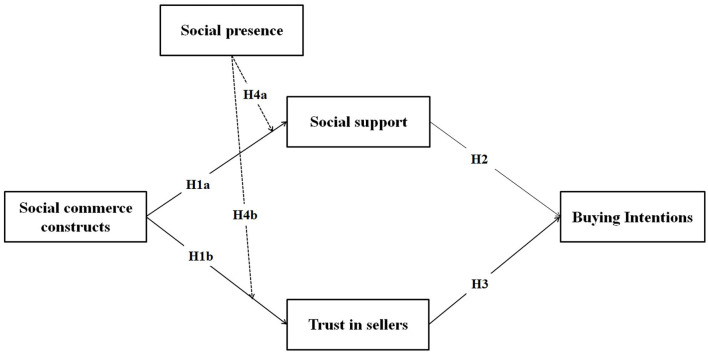
Social interactions through social commerce platforms empower consumers to share their personal experiences with others, but its role becomes more significant for societal protection during COVID-19. Numerous scholars have studied e-commerce extensively, but there is a lack of studies to identify social commerce characteristics to attract potential consumers during COVID-19. This study aims to examine the role of social commerce constructs by integrating social presence as a moderator in the model to explain consumers online shopping intentions in a Pakistani context, where lack of trust on the reliability and validity of comments from other consumers being considered the growing concern toward the success of social commerce. The quantitative data were collected from the respondents living in different cities of Pakistan. Most of the hypothesis supported and demonstrate the positive response from the Pakistani consumers having experience in shopping through social commerce platforms. The findings of this study will help scholars and managers to understand the attitude of Pakistani consumers.
通过社交商务平台进行的社交互动使消费者能够与他人分享个人经历,但在新冠疫情期间,其对社会保护的作用变得更加重要。众多学者对电子商务进行了广泛研究,但缺乏针对新冠疫情期间识别社交商务特征以吸引潜在消费者的研究。本研究旨在通过将社会临场感作为模型中的调节变量来检验社交商务构念的作用,以解释巴基斯坦背景下消费者的在线购物意图,在该背景下,对其他消费者评论的可靠性和有效性缺乏信任被视为社交商务成功面临的日益严重的问题。定量数据是从居住在巴基斯坦不同城市的受访者那里收集的。大多数假设得到支持,并表明有通过社交商务平台购物经验的巴基斯坦消费者给出了积极回应。本研究的结果将有助于学者和管理者了解巴基斯坦消费者的态度。