Department of Cardiology, Renmin Hospital of Wuhan University, Wuhan, China.
Department of Cardiology, Huanggang Central Hospital, Huanggang, China.
Front Endocrinol (Lausanne). 2022 Feb 9;13:830347. doi: 10.3389/fendo.2022.830347. eCollection 2022.
Emerging evidence suggests an association between remnant cholesterol (RC) and vascular damage and hypertension. However, this association has not been explored in a large-scale population in China, and a temporal relationship between RC and hypertension also needs to be investigated.
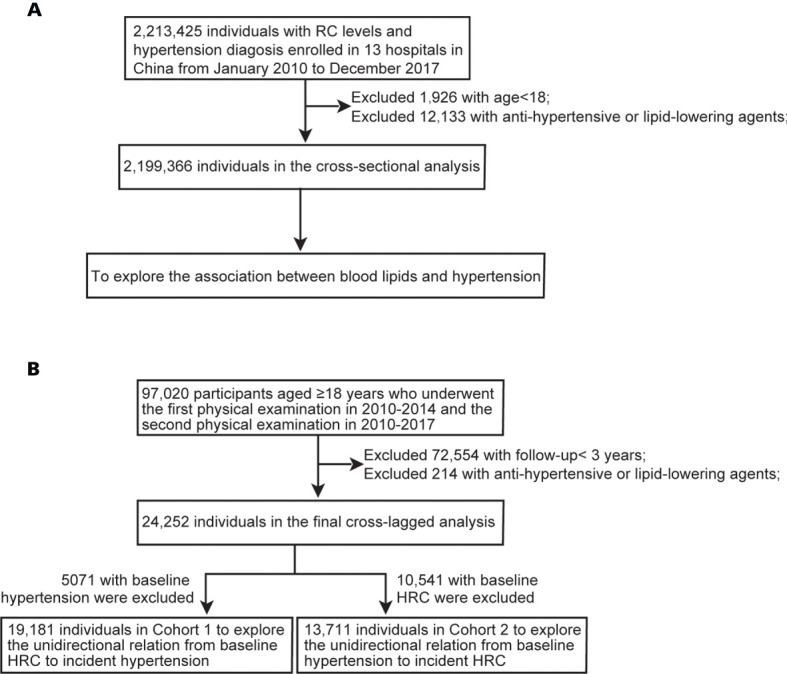
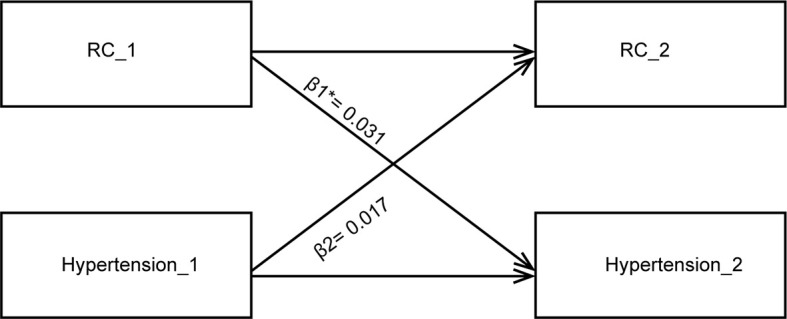
We conducted a retrospective cross-sectional study in 2,199,366 individuals and a longitudinal study in 24,252 individuals with repeated measurements of lipid profile and blood pressure in at least a 3-year follow-up. The logistic model was used to explore the association between lipid components and hypertension in the cross-sectional analysis. The Cox model was used to analyze the association between high RC (HRC) at baseline and the subsequent incidence of hypertension or the association between hypertension at baseline and incidence of HRC. The cross-lagged panel model was applied to analyze the temporal relationship between RC and hypertension.
RC level as a continuous variable had the highest correlation with hypertension among lipid profiles, including RC, low-density lipoprotein cholesterol, total cholesterol, non-high-density lipoprotein cholesterol, and triglycerides, with an odds ratio of 1.59 (95% confidence interval: 1.58-1.59). In the longitudinal cohort, HRC at baseline was associated with incident hypertension. We further explored the temporal relationship between RC and hypertension using the cross-lagged analysis, and the results showed that RC increase preceded the development of hypertension, rather than vice versa.
RC had an unexpected high correlation with the prevalence and incidence of hypertension. Moreover, RC increase might precede the development of hypertension, suggesting the potential role of RC in the development of hypertension.
新出现的证据表明,残余胆固醇(RC)与血管损伤和高血压之间存在关联。然而,这种关联在中国的大规模人群中尚未得到探索,RC 与高血压之间的时间关系也需要进行研究。
我们在 2199366 名个体中进行了回顾性横断面研究,并在 24252 名个体中进行了纵向研究,这些个体至少有 3 年的血脂谱和血压重复测量随访。使用逻辑模型在横断面分析中探讨脂质成分与高血压之间的关系。使用 Cox 模型分析基线时高 RC(HRC)与随后高血压的发生或基线时高血压与 HRC 发生率之间的关系。应用交叉滞后面板模型分析 RC 和高血压之间的时间关系。
RC 水平作为一个连续变量,与脂质谱中包括 RC、低密度脂蛋白胆固醇、总胆固醇、非高密度脂蛋白胆固醇和甘油三酯在内的所有其他脂质成分相比,与高血压的相关性最高,比值比为 1.59(95%置信区间:1.58-1.59)。在纵向队列中,基线时的 HRC 与新发高血压相关。我们进一步使用交叉滞后分析探索了 RC 和高血压之间的时间关系,结果表明 RC 的增加先于高血压的发生,而不是相反。
RC 与高血压的患病率和发病率有着出人意料的高度相关性。此外,RC 的增加可能先于高血压的发生,这表明 RC 在高血压的发展中可能起作用。