Choukou Mohamed-Amine, Sanchez-Ramirez Diana C, Pol Margriet, Uddin Mohy, Monnin Caroline, Syed-Abdul Shabbir
Department of Occupational Therapy, College of Rehabilitation Sciences, Rady Faculty of Health Sciences, University of Manitoba, Canada.
Centre on Aging, University of Manitoba, Canada.
Digit Health. 2022 Feb 10;8:20552076221076927. doi: 10.1177/20552076221076927. eCollection 2022 Jan-Dec.
People from lower and middle socioeconomic classes and vulnerable populations are among the worst affected by the COVID-19 pandemic, thus exacerbating disparities and the digital divide.
To draw a portrait of e-services as a digital approach to support digital health literacy in vulnerable populations amid the COVID-19 infodemic, and identify the barriers and facilitators for their implementation.
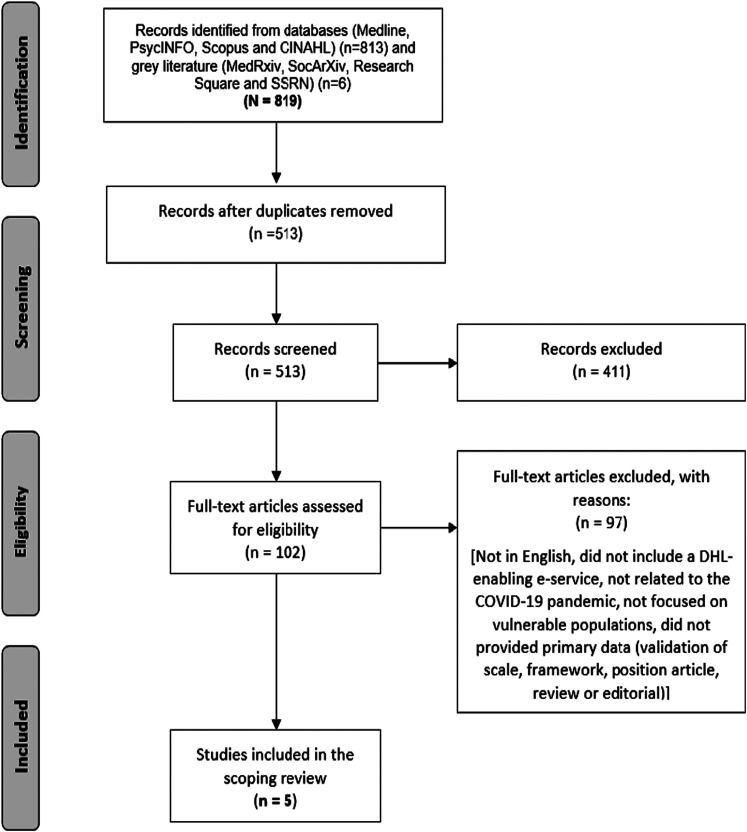
A scoping review was performed to gather published literature with a broad range of study designs and grey literature without exclusions based on country of publication. A search was created in Medline (Ovid) in March 2021 and translated to Medline, PsycINFO, Scopus and CINAHL with Full Text (EBSCOhost). The combined literature search generated 819 manuscripts. To be included, manuscripts had to be written in English, and present information on digital intervention(s) (e.g. social media) used to enable or increase digital health literacy among vulnerable populations during the COVID-19 pandemic (e.g. older adults, Indigenous people living on reserve).
Five articles were included in the study. Various digital health literacy-enabling e-services have been implemented in different vulnerable populations. Identified e-services aimed to increase disease knowledge, digital health literacy and social media usage, help in coping with changes in routines and practices, decrease fear and anxiety, increase digital knowledge and skills, decrease health literacy barriers and increase technology acceptance in specific groups. Many facilitators of digital health literacy-enabling e-services implementation were identified in expectant mothers and their families, older adults and people with low-income. Barriers such as low literacy limited to no knowledge about the viruses, medium of contamination, treatment options played an important role in distracting and believing in misinformation and disinformation. Poor health literacy was the only barrier found, which may hinder the understanding of individual health needs, illness processes and treatments for people with HIV/AIDS.
The literature on the topic is scarce, sparse and immature. We did not find any literature on digital health literacy in Indigenous people, though we targeted this vulnerable population. Although only a few papers were included, two types of health conditions were covered by the literature on digital health literacy-enabling e-services, namely chronic conditions and conditions that are new to the patients. Digital health literacy can help improve prevention and adherence to a healthy lifestyle, improve capacity building and enable users to take the best advantage of the options available, thus strengthening the patient's involvement in health decisions and empowerment, and finally improving health outcomes. Therefore, there is an urgent need to pursue research on digital health literacy and develop digital platforms to help solve current and future COVID-19-related health needs.
社会经济中下层阶级及弱势群体受新冠疫情影响最为严重,这加剧了不平等和数字鸿沟。
描绘电子服务的概况,作为在新冠疫情信息疫情期间支持弱势群体数字健康素养的一种数字方法,并确定其实施的障碍和促进因素。
进行了一项范围综述,以收集各种研究设计的已发表文献以及灰色文献,不基于出版国家进行排除。2021年3月在Medline(Ovid)中进行了检索,并将其翻译为Medline、PsycINFO、Scopus和CINAHL全文数据库(EBSCOhost)。综合文献检索共生成819篇手稿。要纳入研究,手稿必须用英文撰写,并提供关于在新冠疫情期间(如老年人、居住在保留地的原住民)用于促进或提高弱势群体数字健康素养的数字干预措施(如社交媒体)的信息。
该研究纳入了五篇文章。已在不同弱势群体中实施了各种促进数字健康素养的电子服务。确定的电子服务旨在增加疾病知识、数字健康素养和社交媒体使用,帮助应对日常生活和行为的变化,减少恐惧和焦虑,增加数字知识和技能,减少健康素养障碍,并提高特定群体对技术的接受度。在孕妇及其家庭、老年人和低收入人群中确定了许多促进数字健康素养电子服务实施的因素。诸如识字率低、对病毒、传播途径、治疗选择了解有限或一无所知等障碍在分散注意力以及相信错误信息和虚假信息方面发挥了重要作用。健康素养差是唯一发现的障碍,这可能会阻碍艾滋病毒/艾滋病患者对个人健康需求、疾病过程和治疗方法的理解。
关于该主题的文献稀少、零散且不成熟。尽管我们将原住民这一弱势群体作为目标,但未找到任何关于他们数字健康素养的文献。虽然仅纳入了少数几篇论文,但关于促进数字健康素养的电子服务的文献涵盖了两种健康状况,即慢性病和患者新患疾病。数字健康素养有助于改善预防和坚持健康生活方式,提高能力建设,并使用户能够充分利用现有选项,从而加强患者对健康决策的参与和自主权,最终改善健康结果。因此,迫切需要开展关于数字健康素养的研究,并开发数字平台以帮助解决当前和未来与新冠疫情相关的健康需求。
