Nguyen Linh Hoang Thuy, Vo Man Thi Hue, Tran Lien Thi Mai, Dadaczynski Kevin, Okan Orkan, Murray Linda, Van Vo Thang
Institute for Community Health Research, University of Medicine and Pharmacy, Hue University, Hue, Vietnam.
Faculty of Public Health, University of Medicine and Pharmacy, Hue University, Hue, Vietnam.
Front Digit Health. 2021 Sep 27;3:739476. doi: 10.3389/fdgth.2021.739476. eCollection 2021.
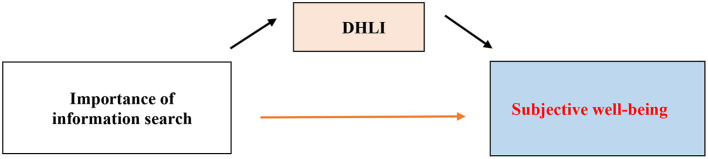
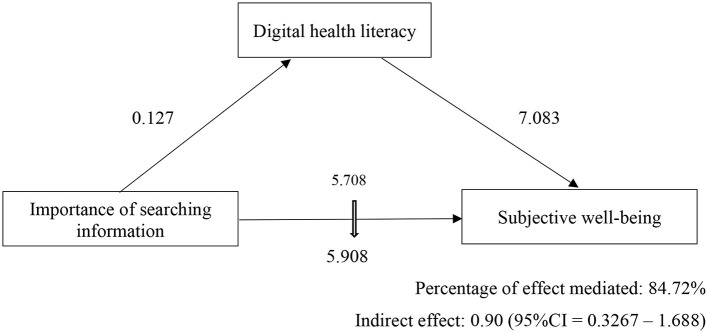
Digital health literacy (DHL) has recently been proposed as a means of enabling healthy decisions for protective behavior, preventive measures, and adherence with COVID-19 policies and recommendations especially in the era of the "infodemic". This study aimed to (1) identify COVID-19 related DHL and its association with online information seeking; (2) to elucidate COVID-19 related DHL as a mediator predictor between the importance of online information search and its association with subjective well-being among Vietnamese university students. A cross-sectional web-based survey was used to elicit the responses of Vietnamese students over 2 consecutive weeks (from April 25 to May 9, 2020, = 1,003, 70.1% female students, mean age 21.4 ± 3.1). The online survey questionnaire collected data on the sociodemographic characteristics of participants, DHL about COVID-19, information seeking behavior, and subjective well-being. Mediation analysis was conducted using the importance of searching COVID-19 related information as independent variables, subjective well-being as a dependent variable, and DHL as a mediator variable. Among 1,003 students, the mean (SD) of DHL related to COVID-19 was 2.87 ± 0.32. In the survey, 87.2% of the students reported sufficient well-being, while almost 13% reported low or very low well-being. The findings also indicated that search engines were the most popular platform for information seeking by Vietnamese students (95.3%) and 92.8% of participants had searched for information related to the current spread of COVID-19. Not searching for hygiene regulation as part of infection control and an average level of information satisfaction were associated with limited DHL ( < 0.05). The importance of online information searching related to COVID-19 increased the subjective well-being of students significantly and limited DHL ( < 0.05). DHL was found to mediate the relationship between the importance of online information searching and the subjective well-being of students. The finding provides insight into DHL about COVID-19 among university students, and their ability to find, understand, appraise, and use online health related information during lockdown throughout the first COVID-19 pandemic wave. DHL should be highlighted as a mediating factor that enhances the positive effect of the importance of information seeking on psychological well-being. However, further studies are needed to better define the mediating role of DHL across other factors.
数字健康素养(DHL)最近被提议作为一种手段,用于促使人们在保护行为、预防措施以及遵守新冠疫情政策和建议方面做出健康决策,尤其是在“信息疫情”时代。本研究旨在:(1)确定与新冠疫情相关的数字健康素养及其与在线信息搜索的关联;(2)阐明与新冠疫情相关的数字健康素养作为一个中介预测因子,在越南大学生在线信息搜索的重要性及其与主观幸福感之间的关联。采用基于网络的横断面调查,连续两周收集越南学生的回复(自2020年4月25日至5月9日,n = 1003,女生占70.1%,平均年龄21.4 ± 3.1岁)。在线调查问卷收集了参与者的社会人口学特征、与新冠疫情相关的数字健康素养、信息搜索行为以及主观幸福感的数据。以搜索新冠疫情相关信息的重要性作为自变量,主观幸福感作为因变量,数字健康素养作为中介变量,进行中介分析。在1003名学生中,与新冠疫情相关的数字健康素养的均值(标准差)为2.87 ± 0.32。在调查中,87.2%的学生报告主观幸福感充足,而近13%的学生报告主观幸福感较低或非常低。研究结果还表明,搜索引擎是越南学生最常用的信息搜索平台(95.3%),92.8%的参与者搜索过与当前新冠疫情传播相关的信息。未搜索作为感染控制一部分的卫生规定以及信息满意度处于平均水平,与有限的数字健康素养相关(P < 0.05)。与新冠疫情相关的在线信息搜索的重要性显著提高了学生的主观幸福感,而数字健康素养有限(P < 0.05)。研究发现数字健康素养在在线信息搜索的重要性与学生的主观幸福感之间起到中介作用。这一发现为了解大学生中与新冠疫情相关的数字健康素养,以及他们在新冠疫情第一波大流行封锁期间查找、理解、评估和使用在线健康相关信息的能力提供了见解。数字健康素养应被突出作为一个中介因素,它增强了信息搜索的重要性对心理健康的积极影响。然而,需要进一步研究以更好地界定数字健康素养在其他因素中的中介作用。