Mao Lifen, Yin Rulan, Cai Jianzheng, Niu Mei'e, Xu Lan, Sui Wenjie, Shi Xiaoqing
Department of Nursing, The First Affiliated Hospital of Soochow University, Suzhou, China.
Department of Rheumatology, The First Affiliated Hospital of Soochow University, Suzhou, China.
Front Med (Lausanne). 2022 Feb 9;8:740559. doi: 10.3389/fmed.2021.740559. eCollection 2021.
This meta-analysis aimed to explore the effect of successful aging (SA) on all-cause mortality risk in older people to provide a theoretical basis for promoting SA.
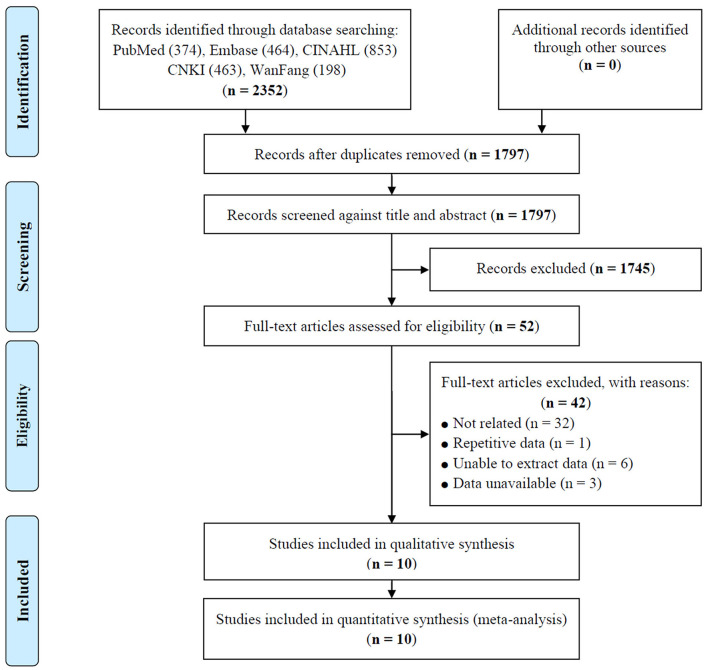
PubMed, Embase, CINAHL, CNKI, and WanFang databases (inception to March 4, 2021) were searched for cohort studies to evaluate the relationship between SA and mortality in older people. A random-effects model was used to synthesis hazard ratio and 95% confidence intervals. Quality assessment was performed using the Newcastle-Ottawa scale. All statistical analyses were conducted in STATA 16.0.
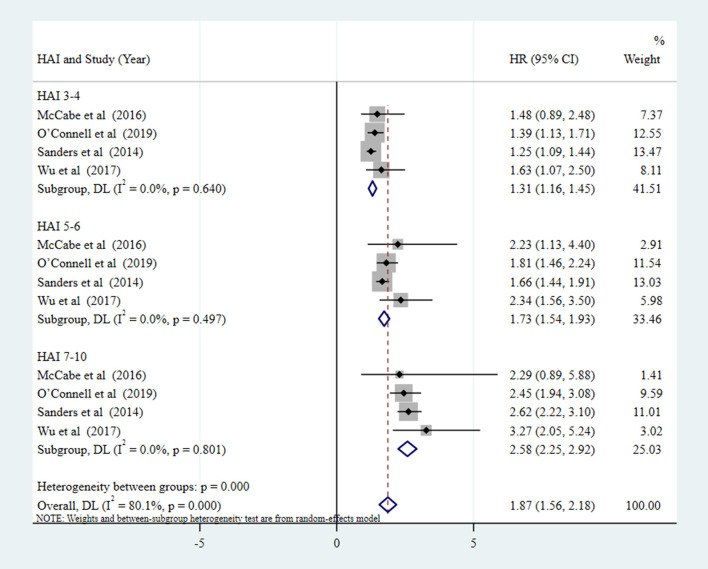
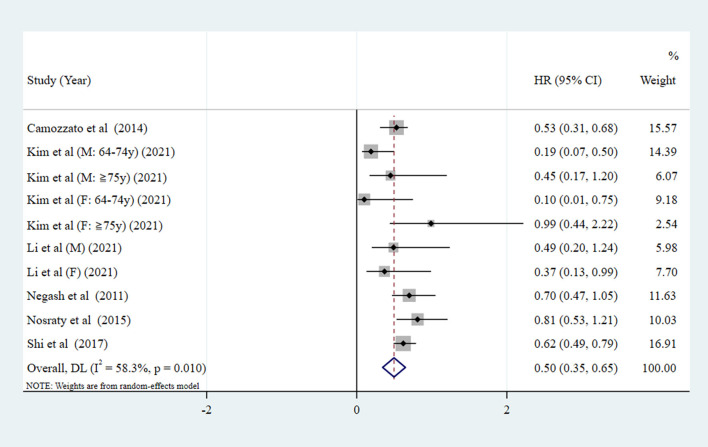
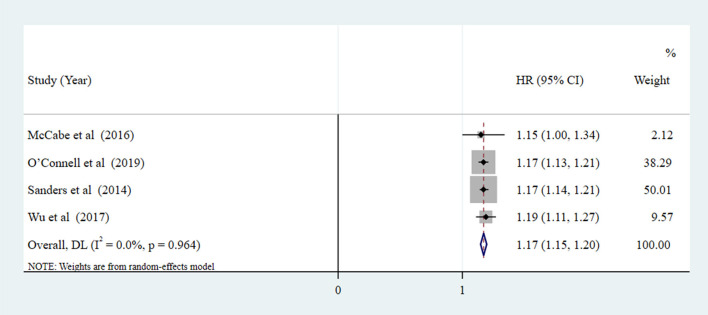
In total, 21,158 older adults from 10 studies were included in the current systematic review and meta-analysis. The SA group tended to have 50% lower risk of all-cause mortality than the non-SA group (pooled hazard ratio = 0.50, 95% confidence intervals: 0.35-0.65, < 0.001; = 58.3%). The risk of all-cause mortality in older people increased by 17% for each unit increment in the healthy aging index (HAI) ( = 0%, = 0.964). Compared with the reference group (HAI 0-2), older people with HAI 3-4, HAI 5-6, and HAI 7-10 had 1.31-fold, 1.73-fold, and 2.58-fold greater risk of all-cause mortality, respectively. Subgroup analysis did not reveal possible sources of heterogeneity.
This meta-analysis suggests that older adults with SA reduced the risk of all-cause mortality by 50%. However, few interventional studies have been conducted. Therefore, healthcare providers must be aware of the relationship between SA and mortality risk and actively develop intervention methods for helping old people achieve SA.
本荟萃分析旨在探讨成功老龄化(SA)对老年人全因死亡风险的影响,为促进成功老龄化提供理论依据。
检索PubMed、Embase、CINAHL、中国知网和万方数据库(建库至2021年3月4日),查找队列研究,以评估成功老龄化与老年人死亡率之间的关系。采用随机效应模型合并风险比和95%置信区间。使用纽卡斯尔-渥太华量表进行质量评估。所有统计分析均在STATA 16.0中进行。
本系统评价和荟萃分析共纳入来自10项研究的21,158名老年人。成功老龄化组全因死亡风险比非成功老龄化组低50%(合并风险比=0.50,95%置信区间:0.35-0.65,P<0.001;I²=58.3%)。健康老龄化指数(HAI)每增加一个单位,老年人全因死亡风险增加17%(P=0%,I²=0.964)。与参照组(HAI 0-2)相比,HAI 3-4、HAI 5-6和HAI 7-10的老年人全因死亡风险分别高1.31倍、1.73倍和2.58倍。亚组分析未发现可能的异质性来源。
本荟萃分析表明,成功老龄化的老年人全因死亡风险降低了50%。然而,很少有干预性研究。因此,医疗保健提供者必须了解成功老龄化与死亡风险之间的关系,并积极开发帮助老年人实现成功老龄化的干预方法。