Research Lab Section 5, Asama Chemical Co. Ltd., Tokyo 103-0001, Japan.
Fukai Pharmacy, Asahikawa, Hokkaido 078-8243, Japan.
J Immunol Res. 2022 Feb 18;2022:6839356. doi: 10.1155/2022/6839356. eCollection 2022.
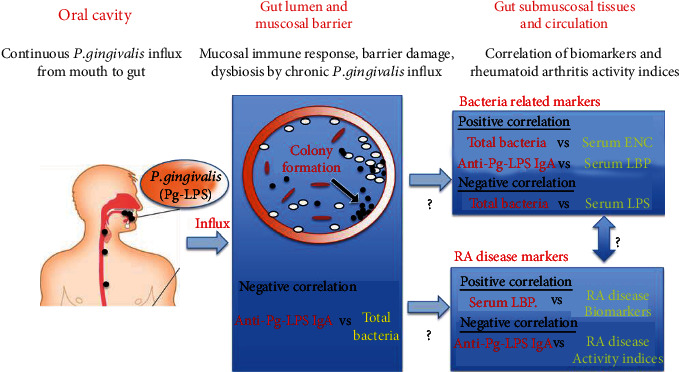
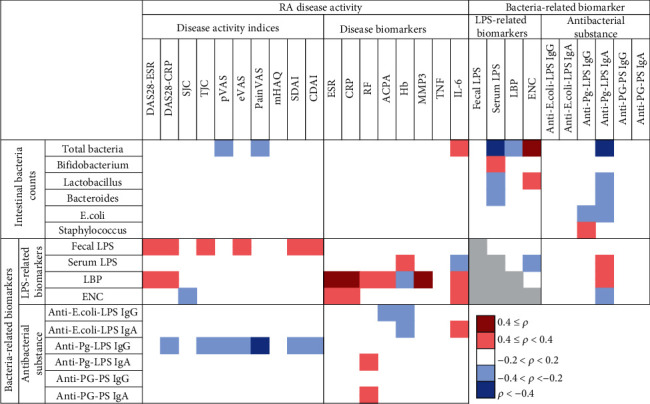
Intestinal bacterial compositions of rheumatoid arthritis (RA) patients have been reported to be different from those of healthy people. Dysbiosis, imbalance of the microbiota, is widely known to cause gut barrier damage, resulting in an influx of bacteria and their substances into host bloodstreams in animal studies. However, few studies have investigated the effect of bacterial substances on the pathophysiology of RA. In this study, eighty-seven active RA patients who had inadequate responses to conventional synthetic disease-modifying antirheumatic drugs or severe comorbidities were analyzed for correlations between many factors such as disease activities, disease biomarkers, intestinal bacterial counts, fecal and serum lipopolysaccharide (LPS), LPS-binding protein (LBP), endotoxin neutralizing capacity (ENC), and serum antibacterial substance IgG and IgA antibody levels by multiple regression analysis with consideration for demographic factors such as age, sex, smoking, and methotrexate treatment. Serum LBP levels, fecal LPS levels, total bacteria counts, serum anti-LPS from (Pg-LPS) IgG antibody levels, and serum anti-Pg-LPS IgA antibody levels were selected for multiple regression analysis using Spearman's correlation analysis. Serum LBP levels were correlated with disease biomarker levels, such as erythrocyte sedimentation rate ( < 0.001), C-reactive protein ( < 0.001), matrix metalloproteinase-3 ( < 0.001), and IL-6 ( = 0.001), and were inversely correlated with hemoglobin ( = 0.005). Anti-Pg-LPS IgG antibody levels were inversely correlated with activity indices such as patient global assessments using visual analogue scale (VAS) ( = 0.002) and painVAS ( < 0.001). Total bacteria counts were correlated with ENC ( < 0.001), and inversely correlated with serum LPS ( < 0.001) and anti-Pg-LPS IgA antibody levels ( < 0.001). These results suggest that substances from oral and gut microbiota may influence disease activity in RA patients.
类风湿关节炎(RA)患者的肠道细菌组成与健康人不同。众所周知,肠道微生物群失调,即微生物失衡,会导致肠道屏障受损,从而使细菌及其物质在动物研究中涌入宿主血液。然而,很少有研究调查细菌物质对 RA 病理生理学的影响。在这项研究中,对 87 名患有常规合成疾病修饰抗风湿药物治疗反应不足或严重合并症的活动性 RA 患者进行了分析,通过多元回归分析,考虑了年龄、性别、吸烟和甲氨蝶呤治疗等人口统计学因素,分析了疾病活动度、疾病生物标志物、肠道细菌计数、粪便和血清脂多糖(LPS)、LPS 结合蛋白(LBP)、内毒素中和能力(ENC)以及血清抗菌物质 IgG 和 IgA 抗体水平之间的相关性。采用 Spearman 相关性分析,对血清 LBP 水平、粪便 LPS 水平、总细菌计数、血清抗 LPS 抗体水平(Pg-LPS)IgG 抗体水平和血清抗 Pg-LPS IgA 抗体水平进行多元回归分析。血清 LBP 水平与红细胞沉降率( < 0.001)、C 反应蛋白( < 0.001)、基质金属蛋白酶-3( < 0.001)和 IL-6( = 0.001)等疾病生物标志物水平相关,与血红蛋白呈负相关( = 0.005)。抗 Pg-LPS IgG 抗体水平与患者整体评估的视觉模拟量表(VAS)( = 0.002)和疼痛 VAS( < 0.001)等活动指数呈负相关。总细菌计数与 ENC 呈正相关( < 0.001),与血清 LPS( < 0.001)和抗 Pg-LPS IgA 抗体水平( < 0.001)呈负相关。这些结果表明,口腔和肠道微生物群的物质可能会影响 RA 患者的疾病活动度。