Department of Hematology, Affiliated People's Hospital of Jiangsu University, 8 Dianli Rd., Zhenjiang, 212002, Jiangsu, People's Republic of China.
Zhenjiang Clinical Research Center of Hematology, Zhenjiang, 212002, Jiangsu, People's Republic of China.
BMC Med Genomics. 2022 Feb 28;15(1):38. doi: 10.1186/s12920-022-01193-0.
Recently, an increasing number of studies have reported that sperm-associated antigen (SPAG) proteins play crucial roles in solid tumorigenesis, and may serve as potentially helpful biomarkers for cancer diagnosis and prognosis. However, very few studies systematically investigated the expression of SPAG family members and their clinical significance in acute myeloid leukemia (AML).
The expression of SPAGs and their prognostic significance in AML were determined by a systematic analysis on data gathered from public databases, and the results were validated in clinical samples.
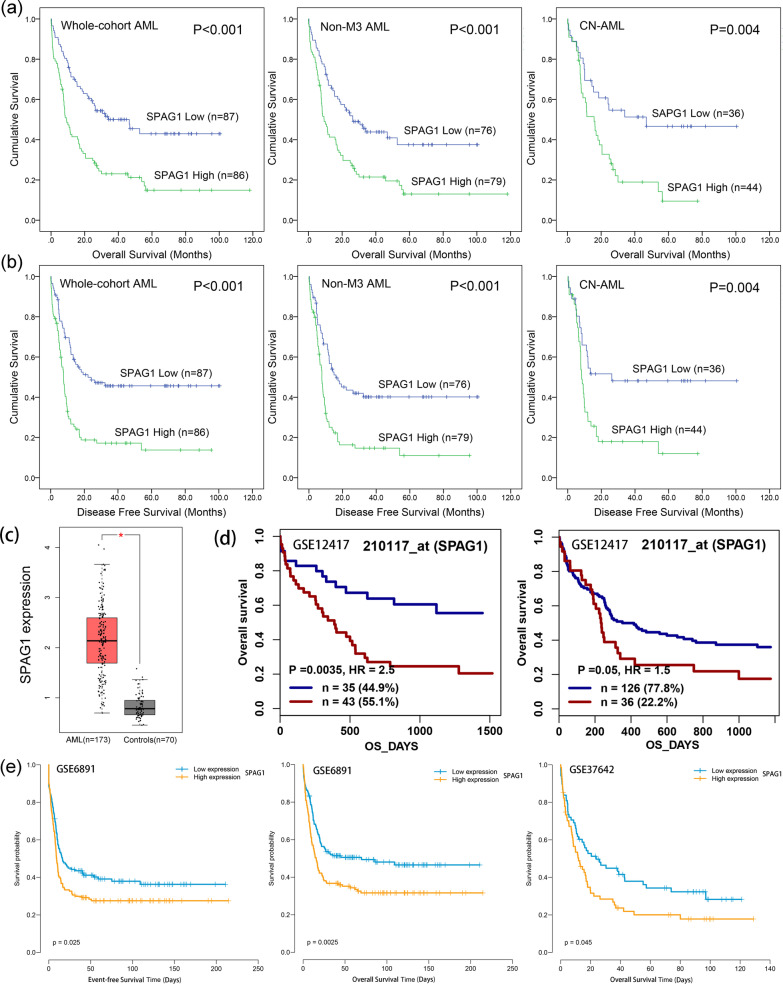
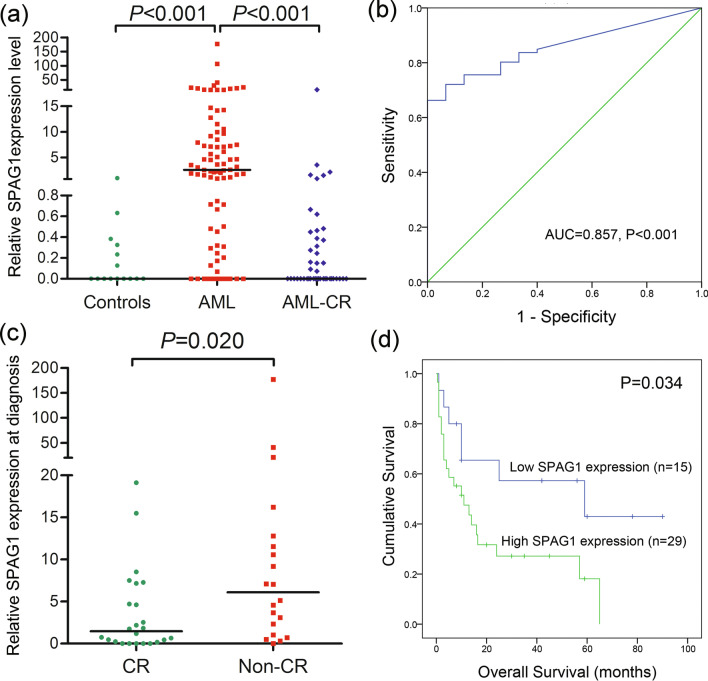
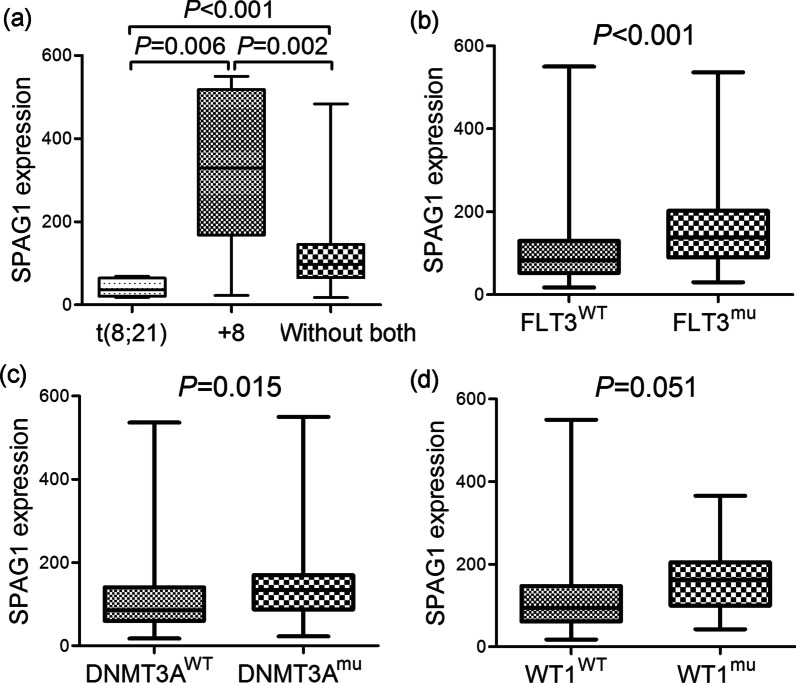
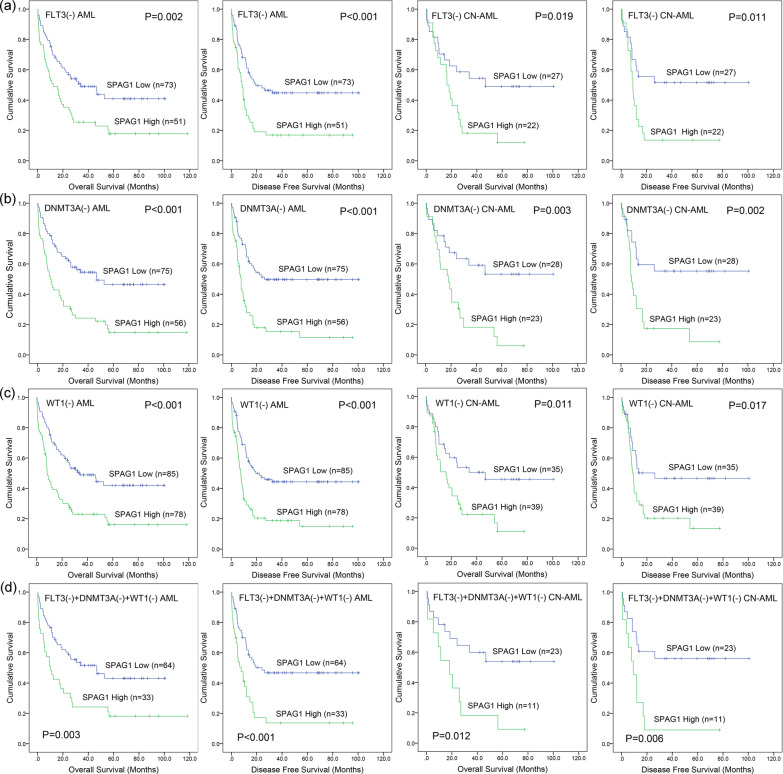
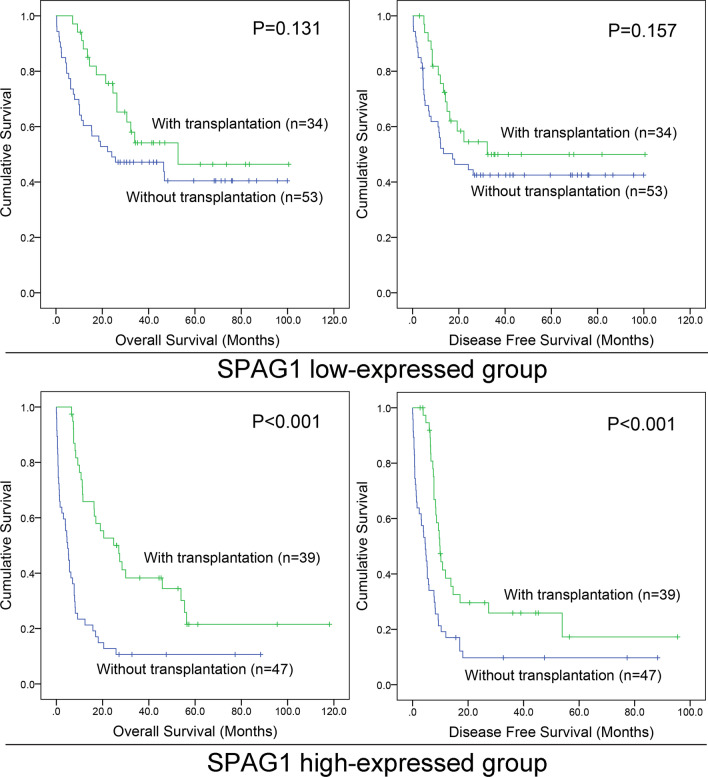
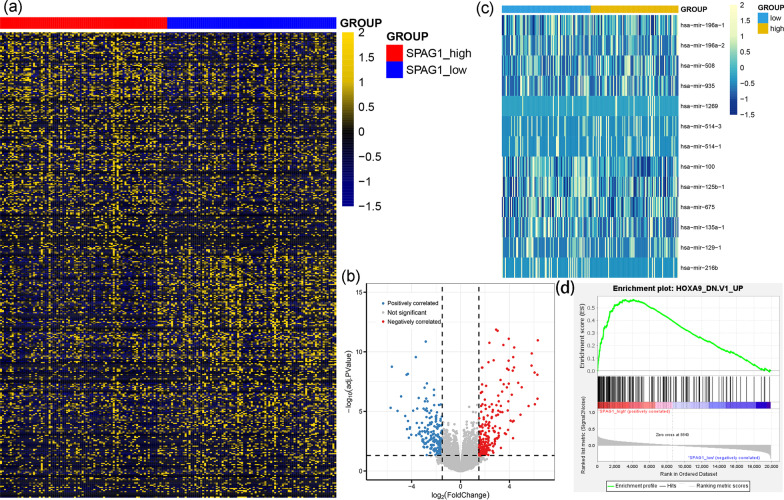
Using public data, we identified only increased SPAG1 expression negatively associated with survival in AML by Cox regression (P < 0.001) and Kaplan-Meier analysis (P < 0.001). The prognostic value of SPAG1 expression was further confirmed in other independent cohorts. Clinically, higher SPAG1 expression was significantly correlated with white blood cell counts (P = 0.014) and French-American-British (FAB) subtypes (P = 0.024). Moreover, higher SPAG1 expression was more common in + 8 patients (P = 0.034), rarely found with t(8;21) (P = 0.014), and correlated with FLT3 (P < 0.001) and DNMT3A mutations (P = 0.001). Despite these associations, multivariate analysis confirmed the independent prognostic value of SPAG1 expression in AML (P < 0.001). Notably, AML patients with higher SPAG1 expression may benefit from hematopoietic stem cell transplantation (HSCT), whereas patients with lower SPAG1 expression appeared less likely to benefit. Finally, we further validated that SPAG1 expression was significantly increased in newly diagnosed AML patients compared with normal controls (P < 0.001) and with AML patients who achieved complete remission (P < 0.001). Additionally, SPAG1 expression could act as a potentially helpful biomarker for the diagnosis and prognosis of AML (P < 0.001 and = 0.034, respectively).
Our findings demonstrated that SPAG1 overexpression may serve as an independent prognostic biomarker and may guide the choice between HSCT and chemotherapy in patients with AML.
最近,越来越多的研究报告称,精子相关抗原(SPAG)蛋白在实体肿瘤发生中起着至关重要的作用,并且可能作为癌症诊断和预后的有帮助的潜在生物标志物。然而,很少有研究系统地研究 SPAG 家族成员的表达及其在急性髓系白血病(AML)中的临床意义。
通过系统分析公共数据库中收集的数据,确定 SPAG 在 AML 中的表达及其预后意义,并在临床样本中进行验证。
使用公共数据,我们通过 Cox 回归(P < 0.001)和 Kaplan-Meier 分析(P < 0.001)确定仅 SPAG1 表达增加与 AML 患者的生存呈负相关。SPAG1 表达的预后价值在其他独立队列中进一步得到证实。临床上,较高的 SPAG1 表达与白细胞计数(P = 0.014)和 French-American-British(FAB)亚型(P = 0.024)显著相关。此外,较高的 SPAG1 表达在+8 例患者中更为常见(P = 0.034),在 t(8;21)中很少见(P = 0.014),与 FLT3(P < 0.001)和 DNMT3A 突变(P = 0.001)相关。尽管存在这些关联,但多变量分析证实 SPAG1 表达在 AML 中具有独立的预后价值(P < 0.001)。值得注意的是,具有较高 SPAG1 表达的 AML 患者可能受益于造血干细胞移植(HSCT),而表达较低 SPAG1 的患者似乎不太可能受益。最后,我们进一步验证了与正常对照(P < 0.001)和完全缓解的 AML 患者(P < 0.001)相比,新诊断的 AML 患者中 SPAG1 的表达显著增加。此外,SPAG1 表达可作为 AML 诊断和预后的潜在有用生物标志物(P < 0.001 和 P = 0.034)。
我们的研究结果表明,SPAG1 过表达可能作为独立的预后生物标志物,并可能指导 AML 患者在 HSCT 和化疗之间的选择。