Lund University.
Baylor College of Medicine.
Behav Ther. 2022 Mar;53(2):240-254. doi: 10.1016/j.beth.2021.08.001. Epub 2021 Aug 20.
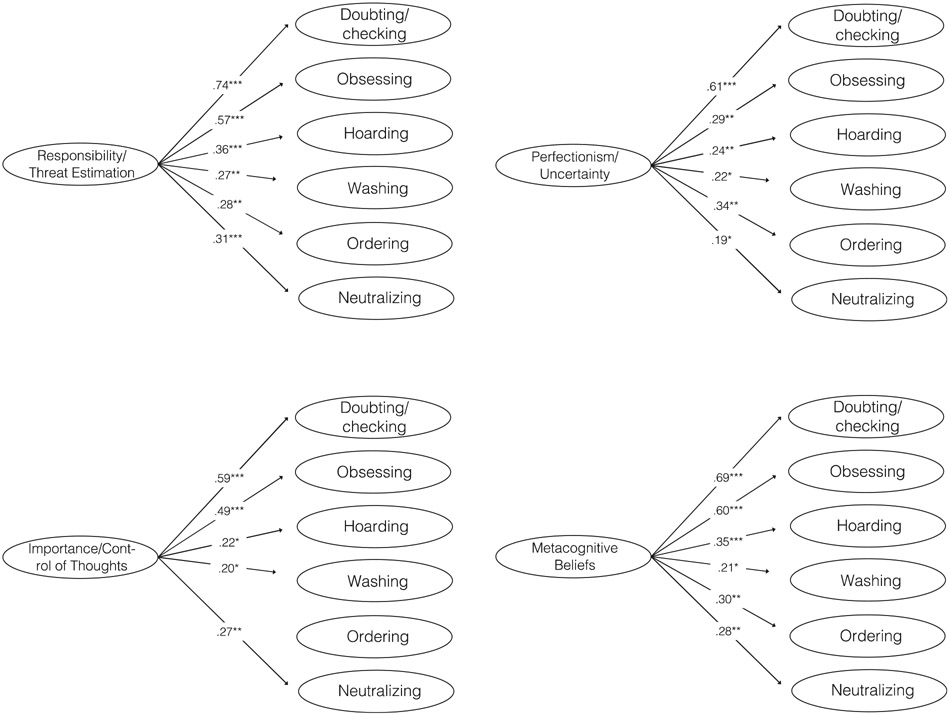
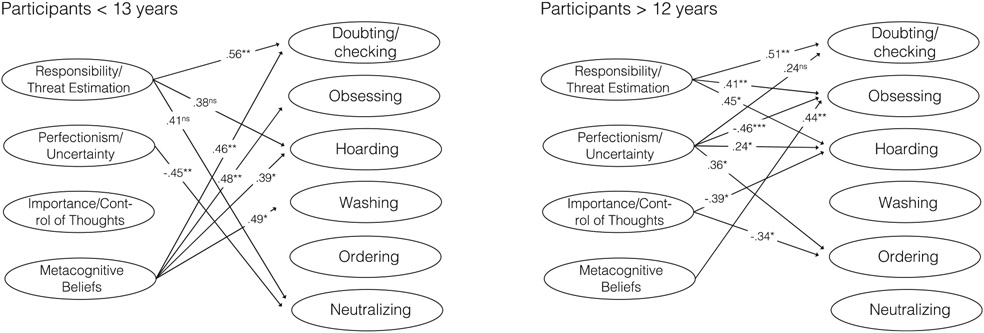
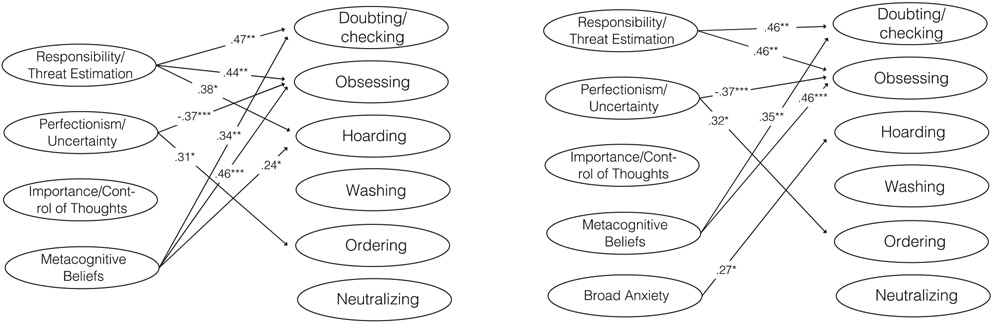
The cognitive model of obsessive-compulsive disorder (OCD) posits that dysfunctional cognitive beliefs are crucial to the onset and maintenance of OCD; however, the relationship between these cognitive beliefs and the heterogeneity of OCD symptoms in children and adolescents remains unknown. We examined how the major belief domains of the cognitive model (inflated responsibility/threat estimation, perfectionism/intolerance of uncertainty, importance/control of thoughts) and dysfunctional metacognitions were related to OCD symptoms across the following dimensions: doubting/checking, obsessing, hoarding, washing, ordering, and neutralization. Self-report ratings from 137 treatment-seeking youth with OCD were analyzed. When cognitive beliefs and symptom dimensions were analyzed in tandem, inflated responsibility/threat estimation and dysfunctional metacognitions were uniquely related to doubting/checking, obsessing, and hoarding and perfectionism/intolerance of uncertainty to ordering. Cognitive beliefs explained a large proportion of variation in doubting/checking (61%) and obsessing (46%), but much less so in ordering (15%), hoarding (14%), neutralization (8%), and washing (3%). Similar relations between cognitive beliefs and symptom dimensions were present in children and adolescents. Cognitive beliefs appear to be relevant for pediatric OCD related to harm, responsibility, and checking, but they do not map clearly onto contamination and symmetry-related symptoms. Implications for OCD etiology and treatment are discussed.
强迫症(OCD)的认知模型假设,功能失调的认知信念对 OCD 的发生和维持至关重要;然而,这些认知信念与儿童和青少年 OCD 症状的异质性之间的关系尚不清楚。我们研究了认知模型的主要信念领域(夸大责任/威胁评估、完美主义/不确定性容忍度、思想的重要性/控制)和功能失调的元认知如何与 OCD 症状在以下维度上相关:怀疑/检查、强迫思维、囤积、洗涤、排序和中和。分析了 137 名寻求治疗的 OCD 青少年的自我报告评分。当同时分析认知信念和症状维度时,夸大责任/威胁评估和功能失调的元认知与怀疑/检查、强迫思维和囤积有关,而完美主义/不确定性容忍度与排序有关。认知信念可以解释怀疑/检查(61%)和强迫思维(46%)的很大一部分变异,但对排序(15%)、囤积(14%)、中和(8%)和洗涤(3%)的解释程度要小得多。在儿童和青少年中,认知信念与症状维度之间存在类似的关系。认知信念似乎与与伤害、责任和检查有关的儿科 OCD 有关,但它们与污染和对称相关的症状并没有明确对应。讨论了 OCD 病因和治疗的意义。