Vergara Rodrigo C, Zitko Pedro, Slachevsky Andrea, San Martin Consuelo, Delgado Carolina
Departamento de Kinesiología Facultad de Artes y Educación Física Universidad Metropolitana de Ciencias de la Educación Santiago Chile.
Health Service & Population Research Department IoPPN King's College London London UK.
Alzheimers Dement (Amst). 2022 Feb 23;14(1):e12273. doi: 10.1002/dad2.12273. eCollection 2022.
Projected dementia incidence in Latin America and the Caribbean for the next decades is overwhelming. Access to local data, stratified by sex, is imperative for planning precise dementia-prevention strategies.
We analyzed the individual and overall weighted population attributable fraction (PAF) of nine modifiable risk factors for dementia, in dementia-free subjects ≥45-years-old, using the 2016-2017 Chilean National Health Survey.
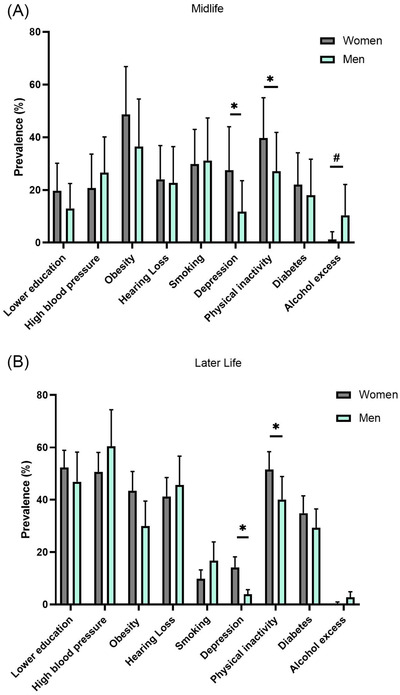
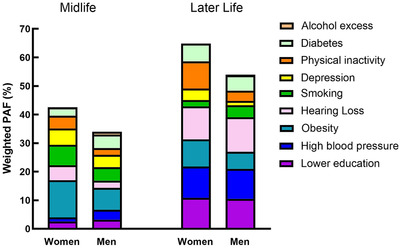
The overall weighted PAF for modifiable risk factors was 45.8% (42.2% to 49.3%). Variables with the highest PAF were lower education, high blood pressure, hearing loss, and obesity. Women showed a greater overall weighted PAF: 50.7% (45.3% to -56.1%), compared to men: 40.2% (35.4% to 45.0%), driven by a higher PAF for physical inactivity and depression in women.
The PAF for modifiable risk factors for dementia in Chile is higher than in previous world reports, due to a greater prevalence of cardiovascular risk factors. Women have a higher potential for dementia prevention.
The proportion of dementia associated to modifiable risk factors in Chile is 45.8%.The main modifiable risk factors are high blood pressure, obesity, and hearing loss.Women had a greater prevalence of physical inactivity and depression than men.Chile had a greater prevalence of metabolic risk factors than other world regions.
预计在未来几十年中,拉丁美洲和加勒比地区的痴呆症发病率将居高不下。获取按性别分层的当地数据对于制定精确的痴呆症预防策略至关重要。
我们使用2016 - 2017年智利全国健康调查,分析了年龄≥45岁无痴呆症受试者中九种可改变的痴呆症风险因素的个体和总体加权人群归因分数(PAF)。
可改变风险因素的总体加权PAF为45.8%(42.2%至49.3%)。PAF最高的变量是低教育水平、高血压、听力损失和肥胖。女性的总体加权PAF更高:50.7%(45.3%至56.1%),而男性为40.2%(35.4%至45.0%),这是由于女性中身体活动不足和抑郁的PAF较高所致。
由于心血管危险因素的患病率更高,智利可改变的痴呆症风险因素的PAF高于以往的世界报告。女性在预防痴呆症方面有更高的潜力。
智利与可改变风险因素相关的痴呆症比例为45.8%。主要的可改变风险因素是高血压、肥胖和听力损失。女性身体活动不足和抑郁的患病率高于男性。智利代谢危险因素的患病率高于世界其他地区。