Dermatology Department, Hospital Clínic de Barcelona, Universitat de Barcelona, Barcelona, Spain.
Dermik Clínica Dermatológica Multidisciplinar, Barcelona, Spain.
Photodermatol Photoimmunol Photomed. 2022 Nov;38(6):515-521. doi: 10.1111/phpp.12783. Epub 2022 Mar 8.
BACKGROUND/PURPOSE: Melasma is a frequent photoexacerbated hyperpigmentary disorder, which can significantly impact on the quality of life. We sought to review the pathogenesis of melasma, and the role of photoprotection in the prevention and treatment of this disorder.
We conducted a narrative review of the literature. We performed literature searches with PubMed from January 1990 to December 2021 using the keywords "melasma," "pathogenesis," "ultraviolet radiation," "visible light," "photoprotection," and "sunscreens."
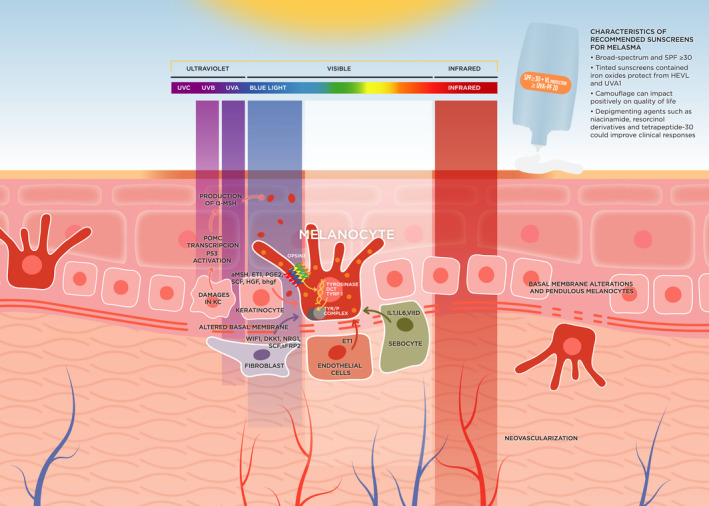
The physiopathology of melasma includes a complex interaction between genetics, sex hormones, and sun exposure. Visible light, in particular high-energy visible light (HEVL), and long-wave UVA (UVA1) play a key role in melasma pathophysiology, and recent research suggests that melasma shares many features with photoaging disorders. Melasma disproportionately affects dark-skinned individuals. Some 30% to 50% of South Americans and Asians, among other ethnicities, can present with melasma. Dark-skinned patients take fewer photoprotective measures. Also, the majority of melasma patients do not adequately follow photoprotection recommendations, including the application of sunscreen. Intensive use of a broad-spectrum sunscreen can prevent melasma in high-risk individuals, can lessen melasma severity (associated or not with depigmenting agents), and can reduce relapses.
Due to the physiopathology of melasma, sunscreens should be broad-spectrum with high sun protection factor, and provide high protection against UVA1 and VL. Sunscreens should be cosmetically acceptable and leave no white residue. Tinted sunscreens are an excellent choice, as pigments can protect from HEVL and UVA1, and may provide camouflage, but they must offer colors that match the skin tone of each patient.
背景/目的:黄褐斑是一种常见的光加重性色素沉着障碍,可显著影响生活质量。我们旨在综述黄褐斑的发病机制,以及光防护在预防和治疗该疾病中的作用。
我们对文献进行了叙述性综述。我们使用关键词“黄褐斑”、“发病机制”、“紫外线辐射”、“可见光”、“光防护”和“防晒霜”,在 PubMed 上进行了从 1990 年 1 月至 2021 年 12 月的文献检索。
黄褐斑的病理生理学包括遗传、性激素和阳光暴露之间的复杂相互作用。可见光,特别是高能可见光(HEVL)和长波 UVA(UVA1),在黄褐斑病理生理学中起着关键作用,最近的研究表明,黄褐斑与光老化疾病有许多共同特征。黄褐斑不成比例地影响深色皮肤的个体。大约 30%至 50%的南美人、亚洲人等其他种族的人可能患有黄褐斑。深色皮肤患者采取的光防护措施较少。此外,大多数黄褐斑患者不能充分遵循光防护建议,包括使用防晒霜。在高风险人群中,密集使用广谱防晒霜可以预防黄褐斑,减轻黄褐斑的严重程度(与或不与脱色剂相关),并减少复发。
由于黄褐斑的病理生理学,防晒霜应具有广谱、高防晒因子,并能提供对 UVA1 和 VL 的高度保护。防晒霜应具有良好的美容效果,且不留白色残留物。有色防晒霜是一个很好的选择,因为颜料可以防护 HEVL 和 UVA1,并且可能提供伪装效果,但它们必须提供与每位患者肤色匹配的颜色。