Laboratory of Stem Cells and Tissue Regeneration, Department of Biotechnology, College of Life Sciences and Biotechnology, Korea University, Seoul, Korea.
Clin Mol Hepatol. 2022 Oct;28(4):706-724. doi: 10.3350/cmh.2021.0390. Epub 2022 Mar 2.
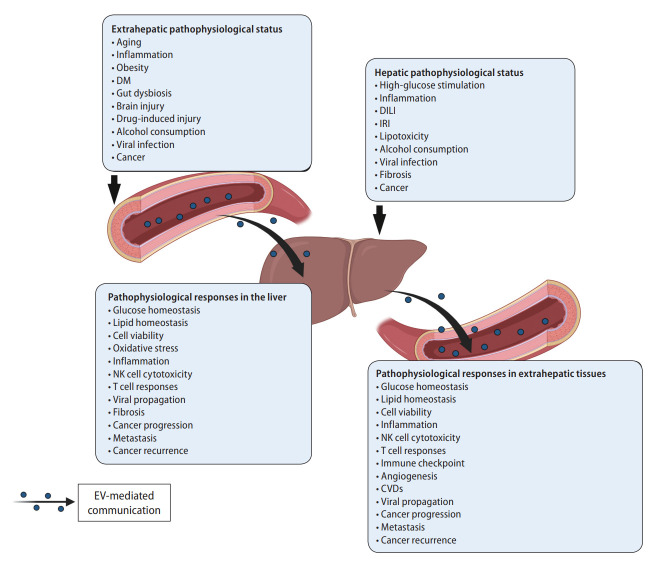
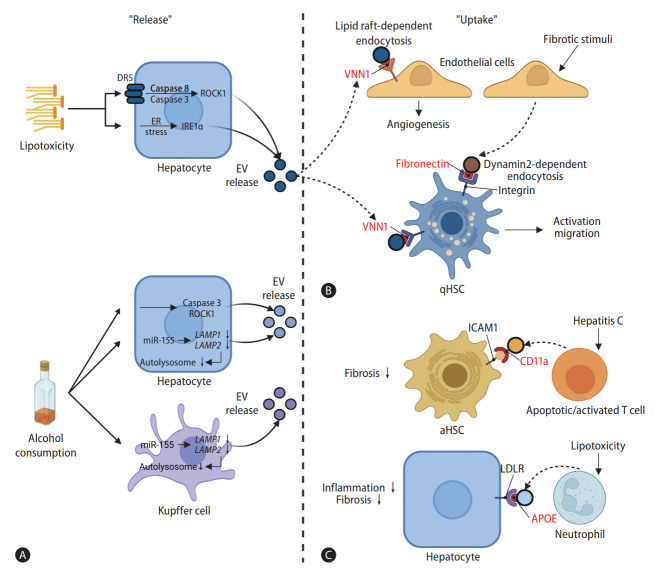
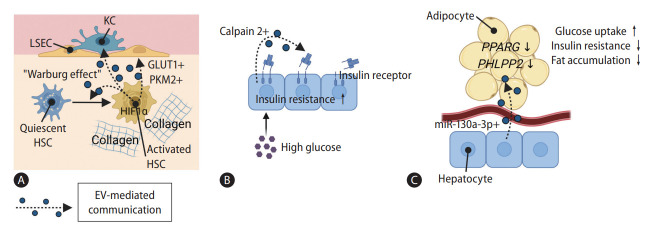
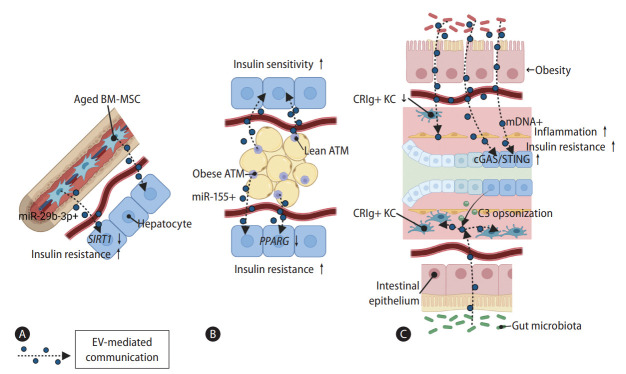
Extracellular vesicles (EVs) are membrane-enclosed particles released from almost all cell types. EVs mediate intercellular communication by delivering their surface and luminal cargoes, including nucleic acids, proteins, and lipids, which reflect the pathophysiological conditions of their cellular origins. Hepatocytes and hepatic non-parenchymal cells utilize EVs to regulate a wide spectrum of biological events inside the liver and transfer them to distant organs through systemic circulation. The liver also receives EVs from multiple organs and integrates these extrahepatic signals that participate in pathophysiological processes. EVs have recently attracted growing attention for their crucial roles in maintaining and regulating hepatic homeostasis. This review summarizes the roles of EVs in intrahepatic and interorgan communications under different pathophysiological conditions of the liver, with a focus on chronic liver diseases including nonalcoholic steatohepatitis, alcoholic hepatitis, viral hepatitis, liver fibrosis, and hepatocellular carcinoma. This review also discusses recent progress for potential therapeutic applications of EVs by targeting or enhancing EV-mediated cellular communication for the treatment of liver diseases.
细胞外囊泡 (EVs) 是几乎所有细胞类型释放的膜封闭颗粒。EVs 通过传递其表面和腔内容物(包括核酸、蛋白质和脂质)来介导细胞间通讯,这些内容物反映了其细胞起源的病理生理状况。肝细胞和肝非实质细胞利用 EVs 来调节肝脏内的广泛生物事件,并通过体循环将其转移到远处的器官。肝脏还从多个器官接收 EVs,并整合这些参与病理生理过程的肝外信号。EVs 因其在维持和调节肝内稳态中的关键作用而引起了越来越多的关注。
这篇综述总结了 EVs 在不同肝脏病理生理条件下的肝内和器官间通讯中的作用,重点讨论了慢性肝病,包括非酒精性脂肪性肝炎、酒精性肝炎、病毒性肝炎、肝纤维化和肝细胞癌。这篇综述还讨论了通过靶向或增强 EV 介导的细胞通讯来治疗肝脏疾病的 EV 治疗应用的最新进展。