The Generation R Study Group, Erasmus MC, University Medical Center Rotterdam, Rotterdam, The Netherlands.
Department of Pediatrics, Erasmus MC, University Medical Center Rotterdam, Rotterdam, The Netherlands.
Epigenetics. 2022 Nov;17(11):1419-1431. doi: 10.1080/15592294.2022.2038412. Epub 2022 Mar 2.
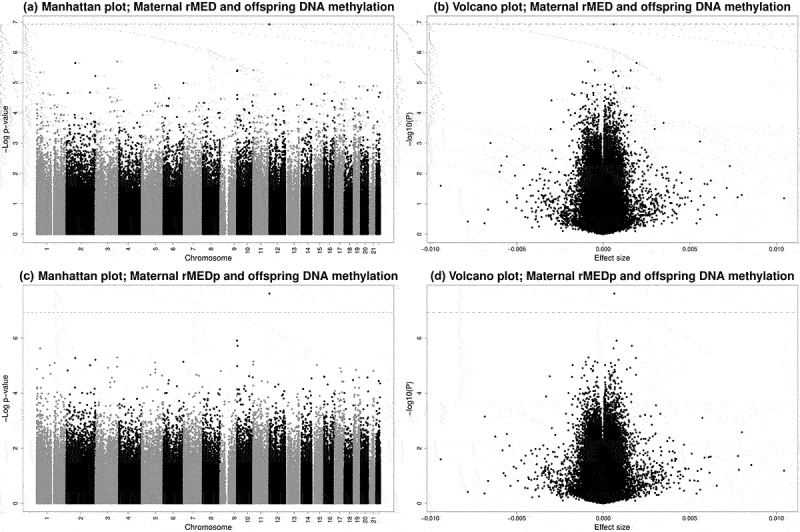
Higher adherence to the Mediterranean diet during pregnancy is related to a lower risk of preterm birth and to better offspring cardiometabolic health. DNA methylation may be an underlying biological mechanism. We evaluated whether maternal adherence to the Mediterranean diet was associated with offspring cord blood DNA methylation.We meta-analysed epigenome-wide association studies (EWAS) of maternal adherence to the Mediterranean diet during pregnancy and offspring cord blood DNA methylation in 2802 mother-child pairs from five cohorts. We calculated the relative Mediterranean diet (rMED) score with range 0-18 and an adjusted rMED excluding alcohol (rMEDp, range 0-16). DNA methylation was measured using Illumina 450K arrays. We used robust linear regression modelling adjusted for child sex, maternal education, age, smoking, body mass index, energy intake, batch, and cell types. We performed several functional analyses and examined the persistence of differential DNA methylation into childhood (4.5-7.8 y).rMEDp was associated with cord blood DNA methylation at cg23757341 (0.064% increase in DNA methylation per 1-point increase in the rMEDp score, SE = 0.011, = 2.41 × 10). This cytosine-phosphate-guanine (CpG) site maps to , associated with adipogenesis and glycaemic phenotypes. We did not identify associations with childhood gene expression, nor did we find enriched biological pathways. The association did not persist into childhood.In this meta-analysis, maternal adherence to the Mediterranean diet (excluding alcohol) during pregnancy was associated with cord blood DNA methylation level at cg23757341. Potential mediation of DNA methylation in associations with offspring health requires further study.
孕期地中海饮食依从度越高,早产风险越低,后代心脏代谢健康状况越好。DNA 甲基化可能是其潜在的生物学机制。我们评估了孕妇地中海饮食依从度与脐带血 DNA 甲基化之间的关系。我们对来自五个队列的 2802 对母婴进行了地中海饮食依从度与脐带血 DNA 甲基化的全基因组关联研究(EWAS)的荟萃分析。我们计算了相对地中海饮食(rMED)评分(范围 0-18)和排除酒精的调整后 rMED(rMEDp,范围 0-16)。使用 Illumina 450K 芯片测量 DNA 甲基化。我们使用稳健线性回归模型进行了调整,包括儿童性别、母亲教育、年龄、吸烟、体重指数、能量摄入、批次和细胞类型。我们进行了几种功能分析,并研究了差异 DNA 甲基化在儿童期(4.5-7.8 岁)的持续存在情况。rMEDp 与脐带血 DNA 甲基化在 cg23757341 处相关(rMEDp 评分每增加 1 分,DNA 甲基化增加 0.064%,SE=0.011, =2.41×10)。该胞嘧啶-磷酸-鸟嘌呤(CpG)位点映射到,与脂肪生成和血糖表型相关。我们没有发现与儿童期基因表达相关的关联,也没有发现富集的生物学途径。该关联在儿童期并不持续。在这项荟萃分析中,孕期地中海饮食(不含酒精)的依从度与脐带血 cg23757341 处的 DNA 甲基化水平相关。需要进一步研究 DNA 甲基化在与后代健康关联中的潜在中介作用。