Agrawal Varun O, Gadekar Anup P, Vaidya Narendra
Joint Replacement and Trauma Department, Lokmanya Hospital, 484/6, Shiv Darshan Rd, Mitra Mandal Colony, Parvati Paytha, Pune, Maharashtra, 411009, India.
Department of Arthroplasty, Lokmanya Hospital, 484/6, Shiv Darshan Rd, Mitra Mandal Colony, Parvati Paytha, Pune, Maharashtra, 411009, India.
Arthroplasty. 2022 Jan 5;4(1):6. doi: 10.1186/s42836-021-00103-6.
Our study aims to determine the effectiveness of robotic technology for total knee arthroplasty in the successful restoration of the joint line of the knee with respect to that of a normal human anatomical knee. The restoration of the joint line is an important technical goal on which the postoperative outcomes and the success of the surgery depend.
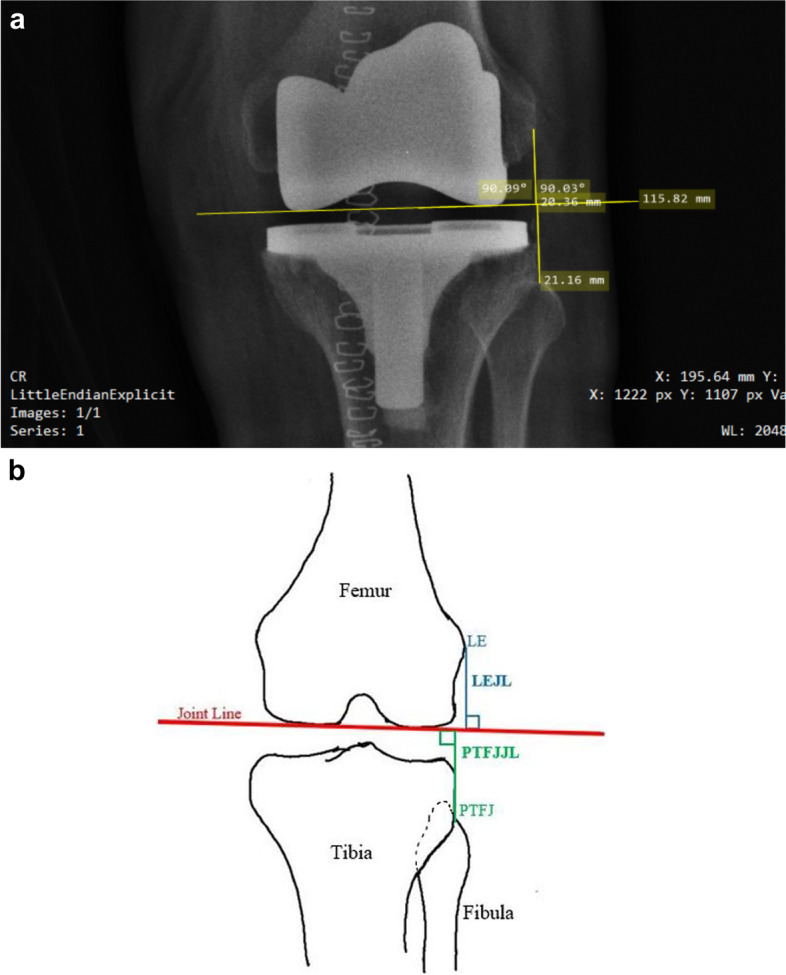
Sixty-four postoperative plain anteroposterior radiographs of 60 patients, who received total knee arthroplasty by using the robotic technology were analyzed and compared with 66 similar radiographs of 60 patients who received the conventional method. The distances of the lateral epicondyle to the joint line (LEJL) and proximal tibiofibular joint to the joint line (PTFJJL) were calculated and analyzed.
We found that the mean value of LEJL minus PTFJJL in the robotic group was 0.334 ± 0.115 (mean ± SD), while in the conventional group, it was 2.304 ± 0.308. The difference between the two groups was statistically significant. The mean ratio (LEJL:PTFJJL) in the robotic group was also equal to 1.017 ± 0.042.
From these findings it could be concluded that the robotic technology significantly increases the accuracy of the total knee arthroplasty and, compared to the conventional method, achieves an almost anatomical position of the joint line.
我们的研究旨在确定机器人技术在全膝关节置换术中成功恢复膝关节关节线(相对于正常人体解剖膝关节的关节线)方面的有效性。关节线的恢复是一个重要的技术目标,手术的术后结果和成功与否取决于此。
分析了60例使用机器人技术进行全膝关节置换术的患者的64张术后前后位X线平片,并与60例采用传统方法的患者的66张类似X线平片进行比较。计算并分析了外侧髁到关节线的距离(LEJL)和近端胫腓关节到关节线的距离(PTFJJL)。
我们发现机器人组中LEJL减去PTFJJL的平均值为0.334±0.115(平均值±标准差),而传统组为2.304±0.308。两组之间的差异具有统计学意义。机器人组的平均比率(LEJL:PTFJJL)也等于1.017±0.042。
从这些发现可以得出结论,机器人技术显著提高了全膝关节置换术的准确性,并且与传统方法相比,实现了关节线几乎解剖学的位置。