The Arctic University Museum of Norway, UiT-The Arctic University of Norway, 9006 Tromsø, Norway.
Department of Biosciences and Nutrition, Karolinska Institute, 14183 Huddinge, Sweden.
RNA. 2022 Jun;28(6):781-785. doi: 10.1261/rna.079098.122. Epub 2022 Mar 2.
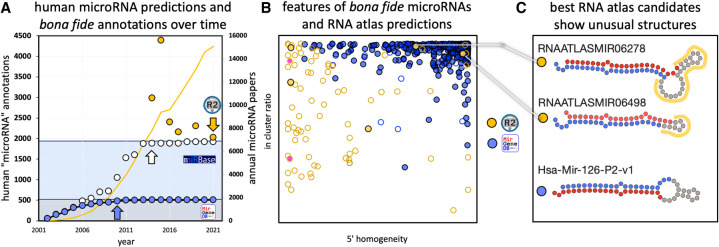
Over the last few years, the number of microRNAs in the human genome has become a controversially debated issue. Several publications reported thousands of putative novel microRNAs not included in the curated microRNA gene database MirGeneDB and the repository miRBase. Recently, by using sequencing of ∼300 human tissues and cell lines, the human RNA atlas, an expanded inventory of human RNA annotations, was published, reporting thousands of putative microRNAs. We, the developers of established microRNA prediction tools and hosts of MirGeneDB, raise concerns about the frequently applied prediction and functional validation strategies, briefly discussing the drawbacks of false positive detections. By means of quantifying well-established biogenesis-derived features, we show that the reported novel microRNAs essentially represent false-positives and argue that the human microRNA complement, at about 550 microRNA genes, is already near complete. Output of available tools must be curated as false predictions will misguide scientists looking for biomarkers or therapeutic targets.
在过去的几年中,人类基因组中的 microRNA 数量成为了一个备受争议的问题。一些出版物报道了数千种推测的新 microRNA,这些 microRNA 不包括在经过精心编辑的 microRNA 基因数据库 MirGeneDB 和存储库 miRBase 中。最近,通过对大约 300 个人体组织和细胞系进行测序,人类 RNA 图谱(一个扩展的人类 RNA 注释清单)被发布,报告了数千种推测的 microRNA。我们作为已建立的 microRNA 预测工具的开发者和 MirGeneDB 的宿主,对经常应用的预测和功能验证策略表示关注,简要讨论了假阳性检测的缺点。通过量化成熟的生物发生衍生特征,我们表明报告的新 microRNA 本质上代表假阳性,并认为人类 microRNA 补充物(约 550 个 microRNA 基因)已经接近完整。可用工具的输出必须进行编辑,因为错误的预测将误导寻找生物标志物或治疗靶点的科学家。