Chen Zujian, Yu Tianwei, Cabay Robert J, Jin Yi, Mahjabeen Ishrat, Luan Xianghong, Huang Lei, Dai Yang, Zhou Xiaofeng
Center for Molecular Biology of Oral Diseases, Department of Periodontics, College of Dentistry, University of Illinois at Chicago, Chicago, IL, USA.
Department of Biostatistics and Bioinformatics, Rollins School of Public Health, Emory University, Atlanta, GA, USA.
Biomark Cancer. 2017 Nov 7;9:1179299X1700900001. doi: 10.1177/1179299X1700900001. eCollection 2017.
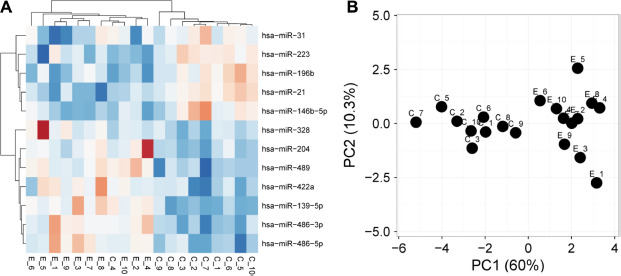
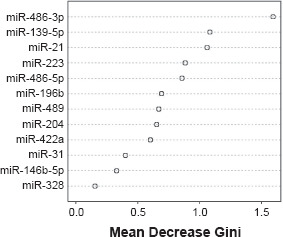
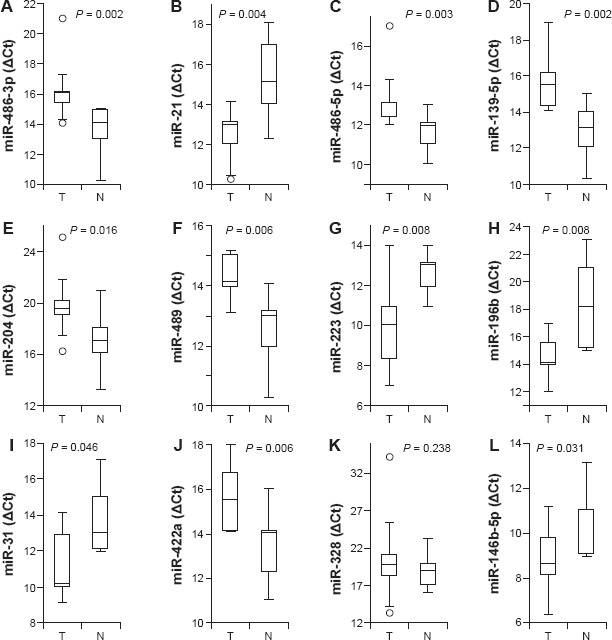
Oral tongue squamous cell carcinoma (TSCC) is a complex disease with extensive genetic and epigenetic defects, including microRNA deregulation. The aims of the present study were to test the feasibility of performing the microRNA profiling analysis on archived TSCC specimens and to assess the potential diagnostic utility of the identified microRNA biomarkers for the detection of TSCC. TaqMan array-based microRNA profiling analysis was performed on 10 archived TSCC samples and their matching normal tissues. A panel of 12 differentially expressed microRNAs was identified. Eight of these differentially expressed microRNAs were validated in an independent sample set. A random forest (RF) classification model was built with miR-486-3p, miR-139-5p, and miR-21, and it was able to detect TSCC with a sensitivity of 100% and a specificity of 86.7% (overall error rate = 6.7%). As such, this study demonstrated the utility of the archived clinical specimens for microRNA biomarker discovery. The feasibility of using microRNA biomarkers (miR-486-3p, miR-139-5p, and miR-21) for the detection of TSCC was confirmed.
口腔舌鳞状细胞癌(TSCC)是一种具有广泛遗传和表观遗传缺陷(包括微小RNA失调)的复杂疾病。本研究的目的是测试对存档的TSCC标本进行微小RNA谱分析的可行性,并评估所鉴定的微小RNA生物标志物对TSCC检测的潜在诊断效用。对10份存档的TSCC样本及其匹配的正常组织进行了基于TaqMan阵列的微小RNA谱分析。鉴定出一组12种差异表达的微小RNA。其中8种差异表达的微小RNA在一个独立样本集中得到验证。用miR-486-3p、miR-139-5p和miR-21构建了随机森林(RF)分类模型,该模型检测TSCC的灵敏度为100%,特异性为86.7%(总错误率=6.7%)。因此,本研究证明了存档临床标本在微小RNA生物标志物发现中的效用。证实了使用微小RNA生物标志物(miR-486-3p、miR-139-5p和miR-21)检测TSCC的可行性。