Maruyama Tessho, Nishihara Kazuhide, Umikawa Masato, Arasaki Akira, Nakasone Toshiyuki, Nimura Fumikazu, Matayoshi Akira, Takei Kimiko, Nakachi Saori, Kariya Ken-Ichi, Yoshimi Naoki
Department of Oral and Maxillofacial Functional Rehabilitation, Graduate School of Medicine, University of the Ryukyus, Nishihara, Okinawa 903-0215, Japan.
Department of Oral and Maxillofacial Surgery, University Hospital of the Ryukyus, Nishihara, Okinawa 903-0215, Japan.
Oncol Lett. 2018 Feb;15(2):2349-2363. doi: 10.3892/ol.2017.7562. Epub 2017 Dec 8.
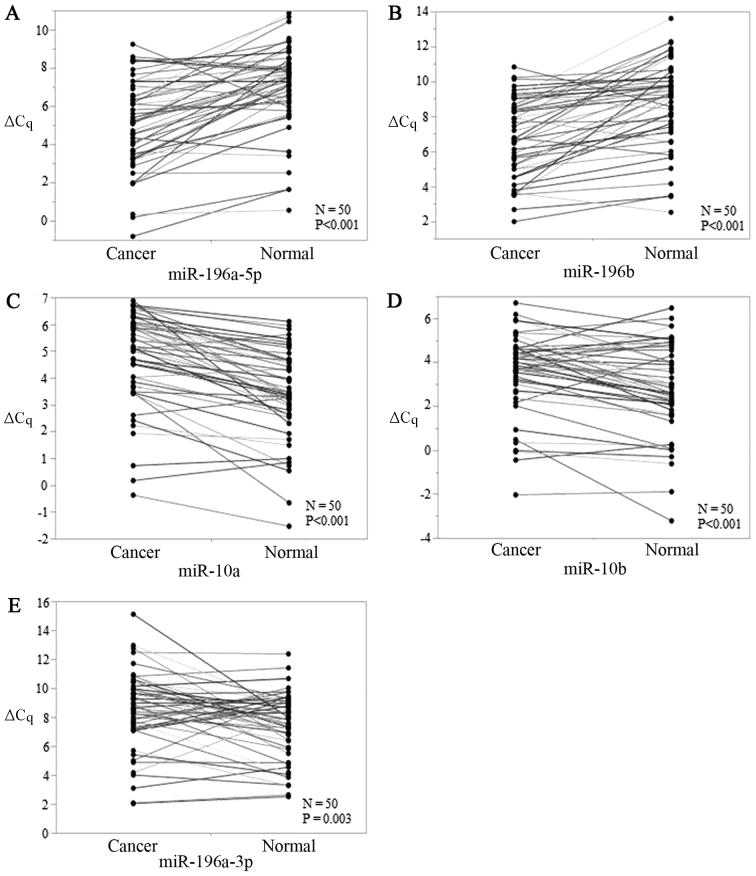
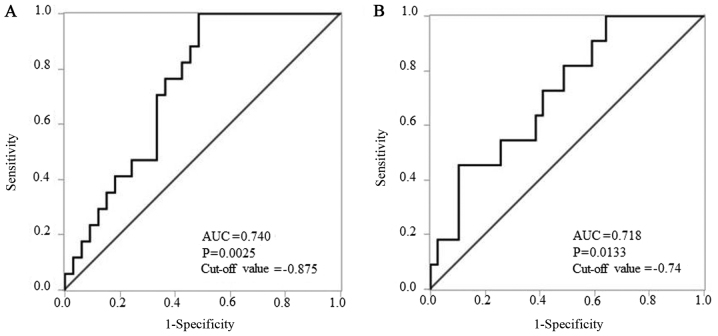
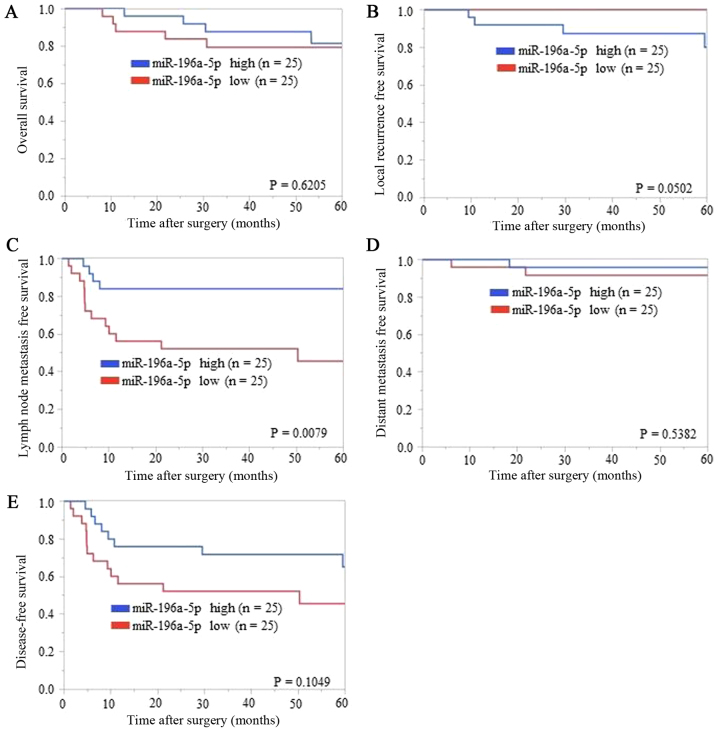
MicroRNAs (miRs) are expected to serve as prognostic tools for cancer. However, many miRs have been reported as prognostic markers of recurrence or metastasis in oral squamous cell carcinoma patients. We aimed to determine the prognostic markers in early-stage tongue squamous cell carcinoma (TSCC). Based on previous studies, we hypothesized that miR-10a, 10b, 196a-5p, 196a-3p, and 196b were prognostic markers and we retrospectively performed miR expression analyses using formalin-fixed paraffin-embedded sections of surgical specimens. Total RNA was isolated from cancer tissues and adjacent normal tissue as control, and samples were collected by laser-capture microdissection. After cDNA synthesis, reverse transcription-quantitative polymerase chain reaction was performed. Statistical analyses for patient clinicopathological characteristics, recurrence/metastasis, and survival rates were performed to discern their relationships with miR expression levels, and the 2 method was used. miR-196a-5p levels were significantly upregulated in early-stage TSCC, particularly in the lymph node metastasis (LNM) group. The LNM-free survival rate in the low miR-196a-5p ΔΔCq value regulation group was found to be lower than that in the high ΔΔCq value regulation group (P=0.0079). Receiver operating characteristic analysis of ΔΔCq values revealed that miR-196a-5p had a P-value=0.0025, area under the curve=0.740, and a cut-off value=-0.875 for distinguishing LNM. To our knowledge, this is the first study to examine LNM-related miRs in early-stage TSCC as well as miRs and 'delayed LNM' in head and neck cancer. miR-196a-5p upregulation may predict delayed LNM. Our data serve as a foundation for future studies to evaluate miR levels and facilitate the prediction of delayed LNM during early-stage TSCC, which prevent metastasis when combined with close follow-up and aggressive adjuvant therapy or elective neck dissection. Moreover, our data will serve as a foundation for future studies to evaluate whether miR-196a-5p can serve as a therapeutic marker for preventing metastasis.
微小RNA(miR)有望成为癌症的预后工具。然而,已有许多miR被报道为口腔鳞状细胞癌患者复发或转移的预后标志物。我们旨在确定早期舌鳞状细胞癌(TSCC)的预后标志物。基于先前的研究,我们假设miR-10a、10b、196a-5p、196a-3p和196b是预后标志物,并使用手术标本的福尔马林固定石蜡包埋切片进行了miR表达的回顾性分析。从癌组织和作为对照的相邻正常组织中分离总RNA,并通过激光捕获显微切割收集样本。合成cDNA后,进行逆转录定量聚合酶链反应。对患者的临床病理特征、复发/转移和生存率进行统计分析,以辨别它们与miR表达水平的关系,并使用2种方法。miR-196a-5p水平在早期TSCC中显著上调,尤其是在淋巴结转移(LNM)组。低miR-196a-5p ΔΔCq值调节组的无LNM生存率低于高ΔΔCq值调节组(P=0.0079)。对ΔΔCq值进行的受试者工作特征分析显示,miR-196a-5p的P值=0.0025,曲线下面积=0.740,区分LNM的截断值=-0.875。据我们所知,这是第一项研究早期TSCC中与LNM相关的miR以及头颈癌中miR和“延迟LNM”的研究。miR-196a-5p上调可能预示延迟LNM。我们的数据为未来评估miR水平以及促进早期TSCC期间延迟LNM的预测的研究奠定了基础,当与密切随访和积极的辅助治疗或选择性颈清扫相结合时可预防转移。此外,我们的数据将为未来评估miR-196a-5p是否可作为预防转移的治疗标志物的研究奠定基础。