Zhou Shan, Zhu Gaizhi, Xu Yaqi, Gao Ran, Li Huan, Han Gencheng, Su Wenting, Wang Renxi
Beijing Institute of Brain Disorders, Laboratory of Brain Disorders, Ministry of Science and Technology, Collaborative Innovation Center for Brain Disorders, Capital Medical University, Beijing, China.
Department of Neuroimmune and Antibody Engineering, Beijing Institute of Basic Medical Sciences, Beijing, China.
Front Nutr. 2022 Feb 14;9:819635. doi: 10.3389/fnut.2022.819635. eCollection 2022.
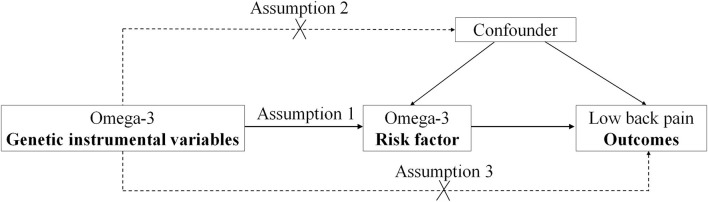
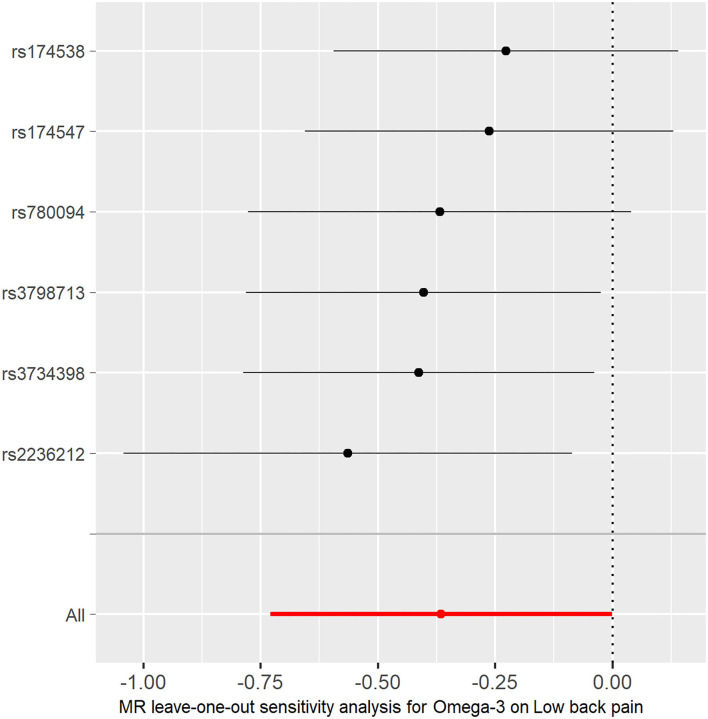
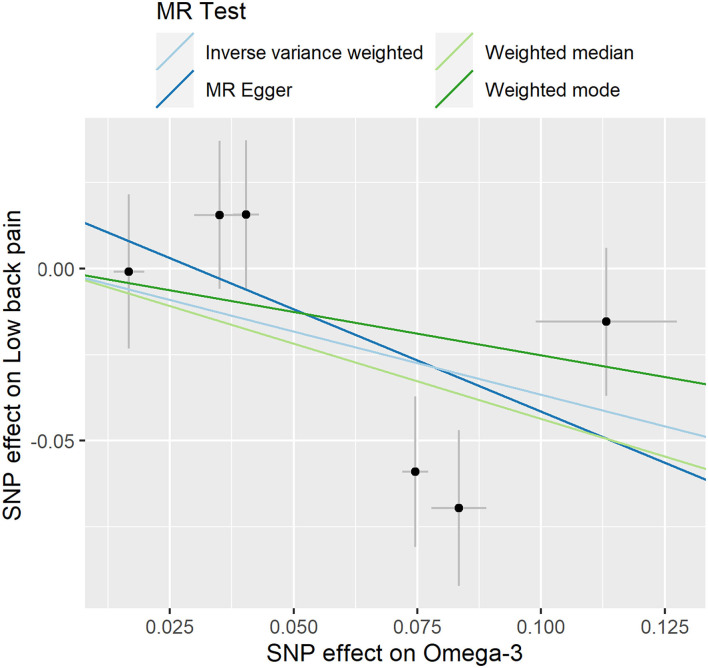
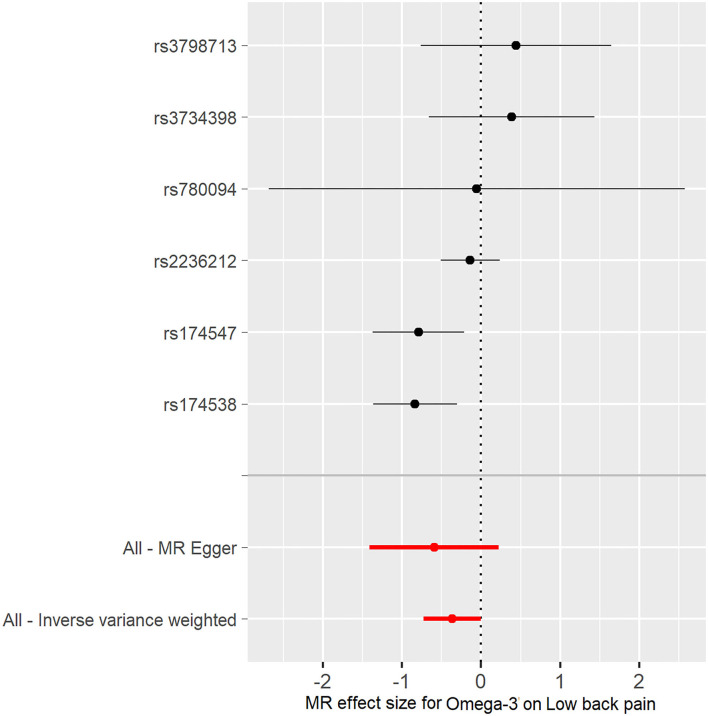
Previous observational studies have suggested an important role of omega-3 in low back pain. In the present study, we used a two-sample Mendelian randomization (MR) study to identify the putative causal link between omega-3 and low back pain. A broadly used genome-wide association study (GWAS) ( = 8,866 individuals from European ancestry) was used to select plasma omega-3 genetic instrumental variables (IVs). A previously reported GWAS (4,863 cases and 74,589 controls from European ancestry) for low back pain were used to assess the effect of plasma omega-3 levels on low back pain. MR-egger_intercept, MR-PRESSO, MR_egger, and inverse variance weighted (IVW) in Cochran's -test were used to determine the pleiotropy and heterogeneity, respectively. MR-egger, weighted median, IVW, and weighted mode were used to perform MR analysis. Finally, the effect of a single nucleotide polymorphism (SNP) was used to test the SNP bias. We did not find a significant pleiotropy or heterogeneity of all six selected plasma omega-3 genetic IVs in low back pain GWAS. Expectedly, we found that as plasma omega-3 levels genetically increased, the risk of low back pain had a decreased trend using MR-egger (Beta = -0.593, = 0.228; OR = 0.553) and weighted mode (Beta = -0.251, = 0.281; OR = 0.778). This reduced trend was further proven by weighted median (Beta = -0.436, = 0.025; OR = 0.646) and IVW (Beta = -0.366, = 0.049; OR = 0.694). Our analysis suggested a putative causal link between genetically increased plasma omega-3 levels and the reduced risk of low back pain in European ancestries. Thus, the supplementation of omega-3 may be important for the prevention and treatment of low back pain.
先前的观察性研究表明,ω-3在腰痛中起重要作用。在本研究中,我们使用两样本孟德尔随机化(MR)研究来确定ω-3与腰痛之间的假定因果关系。一项广泛使用的全基因组关联研究(GWAS)(来自欧洲血统的8866人)用于选择血浆ω-3基因工具变量(IVs)。一项先前报道的针对腰痛的GWAS(来自欧洲血统的4863例病例和74589例对照)用于评估血浆ω-3水平对腰痛的影响。Cochran's Q检验中的MR-egger截距、MR-PRESSO、MR_egger和逆方差加权(IVW)分别用于确定多效性和异质性。MR-egger、加权中位数、IVW和加权模式用于进行MR分析。最后,使用单核苷酸多态性(SNP)的效应来检验SNP偏差。我们在腰痛GWAS中未发现所有六个选定的血浆ω-3基因IVs存在显著的多效性或异质性。不出所料,我们发现,使用MR-egger(β=-0.593,P=0.228;OR=0.553)和加权模式(β=-0.251,P=0.281;OR=0.778)时,随着血浆ω-3水平的基因增加,腰痛风险呈下降趋势。加权中位数(β=-0.436,P=0.025;OR=0.646)和IVW(β=-0.366,P=0.049;OR=0.694)进一步证实了这种下降趋势。我们的分析表明,在欧洲血统人群中,血浆ω-3水平的基因增加与腰痛风险降低之间存在假定的因果关系。因此,补充ω-3可能对腰痛的预防和治疗很重要。