Klocker Eva Valentina, Barth Dominik Andreas, Riedl Jakob Michael, Prinz Felix, Szkandera Joanna, Schlick Konstantin, Kornprat Peter, Lackner Karoline, Lindenmann Jörg, Stöger Herbert, Stotz Michael, Gerger Armin, Pichler Martin
Division of Clinical Oncology, Department of Medicine, Comprehensive Cancer Center Graz, Medical University of Graz, 8010 Graz, Austria.
Research Unit "Non-coding RNAs and Genome Editing in Cancer", Medical University of Graz, 8010 Graz, Austria.
Cancers (Basel). 2020 May 4;12(5):1154. doi: 10.3390/cancers12051154.
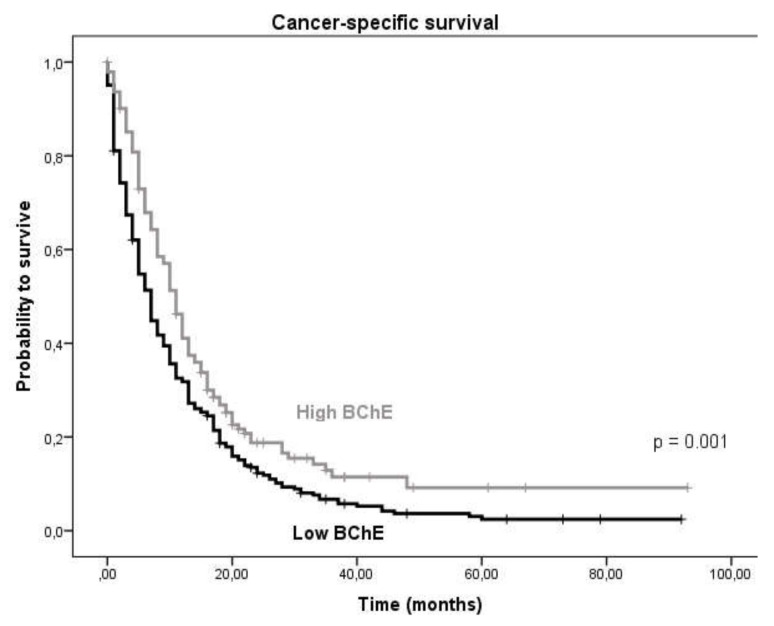
The activity of butyrylcholinesterase (BChE) in blood reflects liver function and has recently been associated with systemic inflammatory response and tumor cachexia. As these conditions have been previously linked with pancreatic cancer (PC), the purpose of the present study was to evaluate the prognostic impact of plasma BChE in PC. Data from 574 consecutive PC patients, treated between 2004 and 2018 at a single academic center, was evaluated. The primary endpoint was cancer-specific survival (CSS), analyzed by Kaplan-Meier curve, and both univariate and multivariate Cox proportional models. BChE activity negatively correlated with other liver parameters (bilirubin, gamma-glutamyl transferase (GGT), aspartate aminotransferase (AST), alkaline phosphatase (ALP), and C-reactive protein (CRP)), and positively correlated with albumin levels, respectively ( < 0.01). In univariate analysis, a low plasma BChE activity was a factor of poor CSS (hazard ratio: 1.4, 95% confidence interval: 1.129-1.754, = 0.002). In multivariate analysis, tumor stage, tumor grade, administration of chemotherapy, bilirubin levels and a low BChE activity (hazard ratio: 1.42, 95% confidence interval: 1.10-1.82; = 0.006) were identified as independent prognostic factors. : Decreased activity of BChE in blood plasma predicts shorter survival time in PC patients. Therefore, BChE might be helpful in additional stratification of patients into different prognostic risk groups.
血液中丁酰胆碱酯酶(BChE)的活性反映肝功能,最近还与全身炎症反应和肿瘤恶病质相关。由于这些情况此前已与胰腺癌(PC)相关联,本研究的目的是评估血浆BChE对PC的预后影响。对2004年至2018年在单一学术中心接受治疗的574例连续PC患者的数据进行了评估。主要终点是癌症特异性生存(CSS),通过Kaplan-Meier曲线以及单变量和多变量Cox比例模型进行分析。BChE活性分别与其他肝脏参数(胆红素、γ-谷氨酰转移酶(GGT)、天冬氨酸转氨酶(AST)、碱性磷酸酶(ALP)和C反应蛋白(CRP))呈负相关,与白蛋白水平呈正相关(<0.01)。在单变量分析中,低血浆BChE活性是CSS不良的一个因素(风险比:1.4,95%置信区间:1.129-1.754,=0.002)。在多变量分析中,肿瘤分期、肿瘤分级、化疗给药、胆红素水平和低BChE活性(风险比:1.42,95%置信区间:1.10-1.82;=0.006)被确定为独立的预后因素。结论:血浆中BChE活性降低预示着PC患者的生存时间缩短。因此,BChE可能有助于将患者进一步分层到不同的预后风险组。