Liu Jianming, Wang Xiaopei, Wang Zhiyue, Yang Yan, Tang Qinghu, Liu Hongchi, Huang Hanmin
Collaborative Innovation Center of Henan Province for Green Manufacturing of Fine Chemicals, Key Laboratory of Green Chemical Media and Reactions, Ministry of Education, School of Chemistry and Chemical Engineering, Henan Normal University, Xinxiang, Henan 453007, P. R. China.
Hefei National Laboratory for Physical Sciences at the Microscale and Department of Chemistry, Center for Excellence in Molecular Synthesis of CAS, University of Science and Technology of China, Hefei 230026, P. R. China.
iScience. 2022 Feb 12;25(3):103906. doi: 10.1016/j.isci.2022.103906. eCollection 2022 Mar 18.
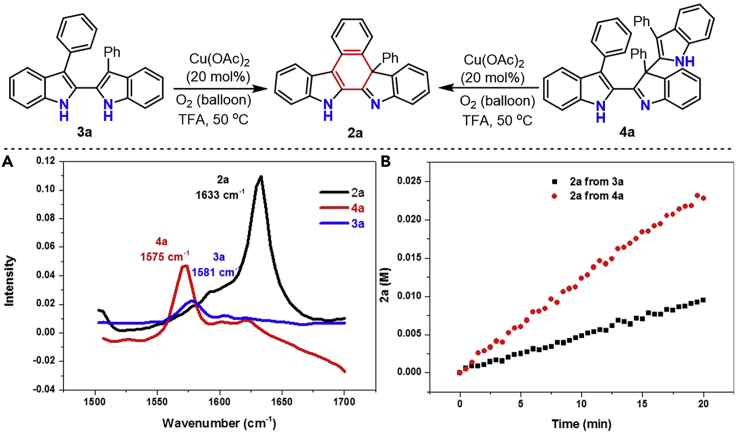
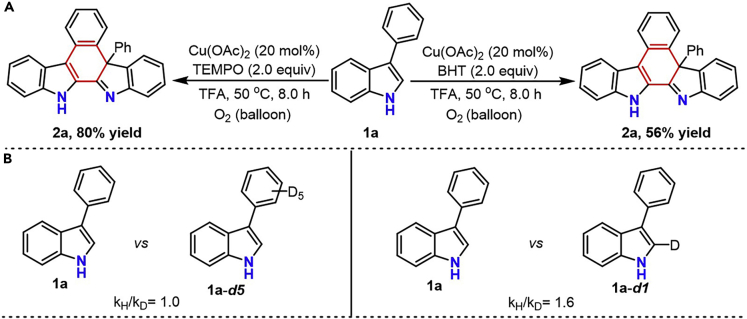
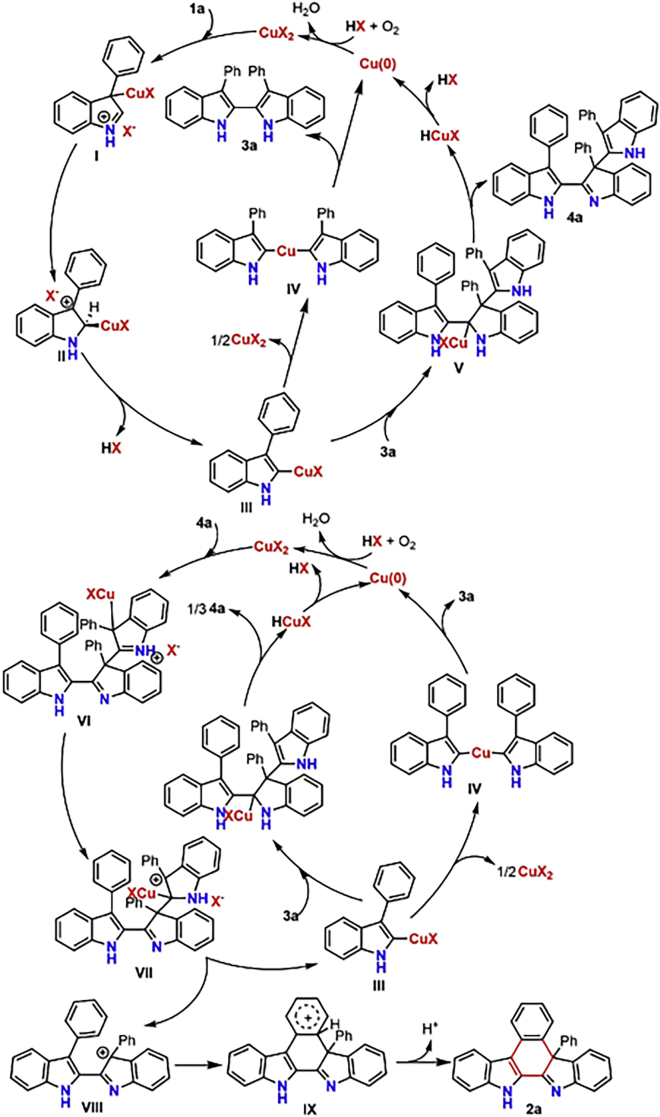
Presented here is a copper-catalyzed, aerobic oxidative C-H/C-H cyclization reaction, which occurs by cleaving the C-H and N-H bonds of 3-phenylindoles. A broad range of 3-phenylindoles can be well tolerated to produce the indole-containing polycyclic aromatic hydrocarbons (PAH) in good to excellent yields. An evaluation of the reaction mechanism is enabled by the isolation of the di- and tri-indole intermediates, highlighting the role of the substrate for this catalytic reaction. The results of these controlled experiments and kinetic studies provide solid experimental support for a self-catalysis reaction, which has rarely been observed in oxidative C-H activation reactions. Additional mechanistic studies indicate that the substrate for this reaction accelerates by the following mechanism: The substrate combines with the Cu catalyst to transform the less active di-indole intermediate into a tri-indole intermediate. This intermediate is quickly converted into the desired product along with regeneration of the substrate copper complex.
本文介绍了一种铜催化的需氧氧化C-H/C-H环化反应,该反应通过断裂3-苯基吲哚的C-H键和N-H键来发生。多种3-苯基吲哚对此反应具有良好的耐受性,能够以良好至优异的产率生成含吲哚的多环芳烃(PAH)。通过分离二吲哚和三吲哚中间体对反应机理进行了评估,突出了底物在该催化反应中的作用。这些对照实验和动力学研究的结果为自催化反应提供了坚实的实验支持,而自催化反应在氧化C-H活化反应中很少见。额外的机理研究表明,该反应的底物通过以下机理加速反应:底物与铜催化剂结合,将活性较低的二吲哚中间体转化为三吲哚中间体。该中间体与底物铜配合物的再生一起迅速转化为所需产物。