School of Nursing, Health Science Center of Xi'an Jiaotong University, Yanta West Road 76, Xi'an, 710061, Shaanxi, China.
Nethersole School of Nursing, The Chinese University of Hong Kong, Central Ave, Shatin, Hong Kong, SAR.
BMC Womens Health. 2022 Mar 4;22(1):61. doi: 10.1186/s12905-022-01635-y.
Breast cancer survivors experience altered body image and quality of life (QoL) due to the disease and its treatment. The multidimensional nature of body image and QoL makes their relationships complex. This study aimed to examine the associations between the two concepts in Chinese breast cancer survivors and test whether these associations are moderated by rural-urban residence.
A cross-sectional design was adopted. Breast cancer survivors were recruited via a convenience sampling method. Two validated questionnaires (the Body Image Self-Rating Questionnaire for Breast Cancer and 36-item Short-Form Health Survey) and questions assessing demographic and clinical covariates were administered. Multiple linear regressions were used to assess the relationship between body image and QoL domains and to examine the moderating effect of rural-urban residence.
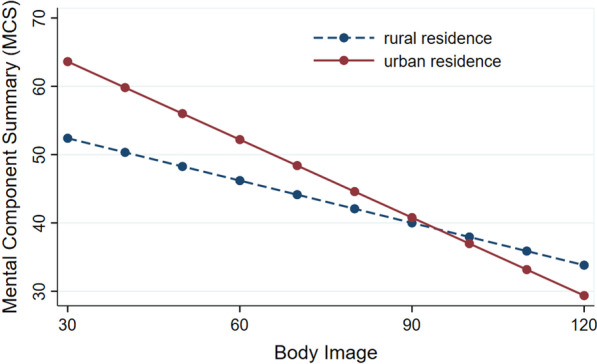
In our sample of 354 breast cancer survivors, half (50.28%) lived in rural areas. After adjusting for demographic and clinical variables, better perception of body image-related sexual activity change, role change, and psychological change was significantly associated with better physical (β ranged from - 0.15 to - 0.11, p < 0.05) and mental (β ranged from - 0.46 to - 0.34, p < 0.001) well-being. Better perception of body image-related social and behavior change was significantly associated only with better mental well-being (β ranged from - 0.40 to - 0.33, p < 0.001). The association between body image and mental well-being was much stronger in urban subjects (b = - 0.38, p < 0.001) than in rural subjects (b = - 0.20, p < 0.001).
Our findings suggest that multidimensional body image is associated with physical and mental well-being in Chinese breast cancer survivors. Body image appears to play a larger role in urban breast cancer survivors' mental well-being. Our results indicate that incorporating interventions that address body image issues would be advantageous for survivorship care to enhance QoL in breast cancer survivors. Furthermore, rural-urban differences should be considered in the strategic design of survivorship care programs in rural and urban settings.
乳腺癌患者由于疾病及其治疗会经历身体意象和生活质量(QoL)的改变。身体意象和 QoL 的多维性质使它们之间的关系变得复杂。本研究旨在探讨中国乳腺癌幸存者中这两个概念之间的关系,并检验这些关系是否受到城乡居住的调节。
采用横断面设计。通过便利抽样方法招募乳腺癌幸存者。使用两种经过验证的问卷(乳腺癌身体意象自我评估问卷和 36 项简短健康调查问卷)和评估人口统计学和临床协变量的问题进行评估。使用多元线性回归来评估身体意象和 QoL 各领域之间的关系,并检验城乡居住的调节作用。
在我们的 354 名乳腺癌幸存者样本中,有一半(50.28%)居住在农村地区。在调整人口统计学和临床变量后,身体意象相关的性活动变化、角色变化和心理变化的感知越好,与身体(β范围从-0.15 到-0.11,p<0.05)和心理(β范围从-0.46 到-0.34,p<0.001)健康状况的改善越显著。身体意象相关的社会和行为变化的感知越好,仅与心理幸福感的改善显著相关(β范围从-0.40 到-0.33,p<0.001)。城乡居民的身体意象与心理健康的关系强度差异很大,城市居民的关联强度更强(b=-0.38,p<0.001),而农村居民的关联强度较弱(b=-0.20,p<0.001)。
我们的研究结果表明,中国乳腺癌幸存者的多维身体意象与身体和心理健康有关。身体意象在城市乳腺癌幸存者的心理健康中起着更大的作用。我们的研究结果表明,将解决身体意象问题的干预措施纳入乳腺癌幸存者的护理中,将有利于提高生活质量。此外,在城乡环境中制定生存护理计划时,应考虑城乡差异。