Department of Ophthalmology, Peking University Third Hospital, 49 North Garden Road, Haidian District, Beijing, 100191, P.R. China.
Beijing key laboratory of restoration of damaged ocular nerve, Peking University Third Hospital, Beijing, China.
BMC Ophthalmol. 2022 Mar 5;22(1):106. doi: 10.1186/s12886-022-02335-9.
To assess dynamic visual acuity (DVA) under different defocus statuses and explore the assessment of dynamic vision accommodation.
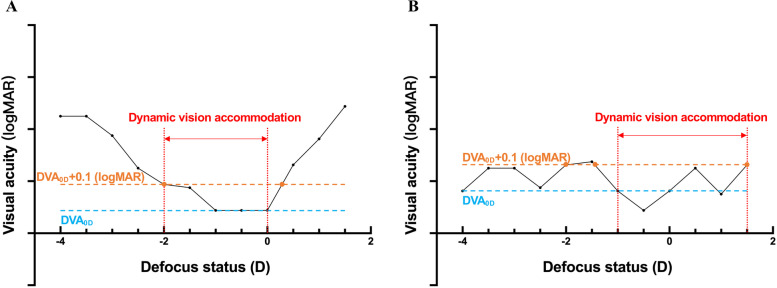
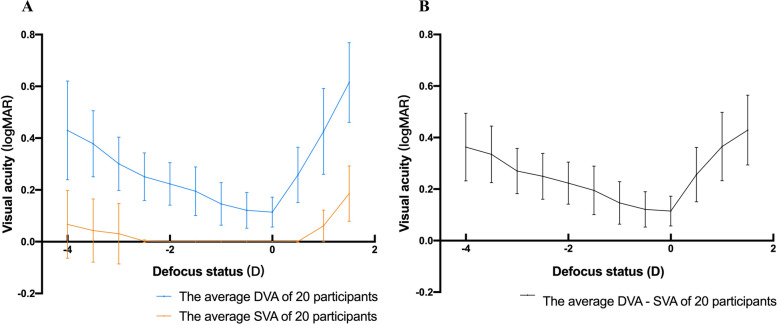
Twenty subjects (6 males and 14 females) aged 18 to 35 were recruited. Nonmydriatic subjective refraction (sphere and cylinder) and accommodative tests including negative relative accommodation (NRA), positive relative accommodation (PRA), binocular cross cylinder (BCC) and accommodative facility using a flipper were performed. Binocular static visual acuity (SVA) and DVA at 40 degrees per second (dps) were measured under different defocus statuses (+1.5D to -4D in -0.5D steps) based on the refractive error fully corrected. Static and dynamic defocus curves were plotted. The area under the curve (AUC) and corrected dynamic vision accommodation (CDVAc) were calculated.
The study showed that the dynamic defocus curve fitted the cubic curve properly (p<0.001). DVA was significantly worse than SVA at all defocused statuses (p<0.001), and the difference was more significant at greater defocus diopters. Single factor analysis indicated that CDVAc was significantly correlated with NRA-PRA (p=0.012) and AUC (p<0.001). Significant associations were observed between AUC and PRA (p=0.013) as well as NRA-PRA (p=0.021). Meanwhile, DVA was positively correlated with PRA at 0D, -1.0D, -1.5D, -2.5D and -3.0D (p<0.05) and with NRA-PRA at 0D, -1.0D, -1.5D, -2.0D and -2.5D (p<0.05). Multiple factor regression analysis indicated that CDVAc (0D ~ -3.5D) and SVA (+1.5D ~ +1.0D & -2.5D ~ -4.0D) were significant influential factors for defocused DVA (p<0.05).
Our study demonstrated that DVA had a defocus curve similar to that of SVA. CDVAc was feasible for the assessment of dynamic vision accommodative function. The dynamic defocus curve test could efficiently be applied in the evaluation of dynamic visual performance under different defocus statuses.
评估不同离焦状态下的动态视觉敏锐度(DVA),并探索动态视觉调节的评估方法。
招募 20 名年龄在 18 至 35 岁的受试者(6 名男性和 14 名女性)。进行非睫状肌主观屈光(球镜和柱镜)和调节测试,包括负相对调节(NRA)、正相对调节(PRA)、双眼交叉圆柱镜(BCC)和使用翻转器的调节灵活度。根据完全矫正的屈光不正,在不同离焦状态(-0.5D 步长,从+1.5D 到-4D)下测量双眼静态视觉敏锐度(SVA)和 40 度每秒(dps)的动态视觉敏锐度。绘制静态和动态离焦曲线。计算曲线下面积(AUC)和校正动态视觉调节(CDVAc)。
研究表明,动态离焦曲线与三次曲线拟合良好(p<0.001)。在所有离焦状态下,DVA 均明显差于 SVA(p<0.001),且在较大的离焦屈光度下差异更显著。单因素分析表明,CDVAc 与 NRA-PRA(p=0.012)和 AUC(p<0.001)显著相关。AUC 与 PRA(p=0.013)和 NRA-PRA(p=0.021)也有显著相关性。同时,DVA 与 0D、-1.0D、-1.5D、-2.5D 和-3.0D 的 PRA 呈正相关(p<0.05),与 0D、-1.0D、-1.5D、-2.0D 和-2.5D 的 NRA-PRA 呈正相关(p<0.05)。多元回归分析表明,CDVAc(0D-3.5D)和 SVA(+1.5D+1.0D 和-2.5D~-4.0D)是离焦 DVA 的显著影响因素(p<0.05)。
本研究表明,DVA 具有与 SVA 相似的离焦曲线。CDVAc 可用于评估动态视觉调节功能。动态离焦曲线测试可有效地用于评估不同离焦状态下的动态视觉性能。