Department of Medicine, Division of General Internal Medicine, Johns Hopkins University School of Medicine, 750 East Pratt Street 15th Floor, Baltimore, MD, 21202, USA.
Department of Health Policy and Management, Johns Hopkins Bloomberg School of Public Health, Baltimore, MD, USA.
Syst Rev. 2022 Mar 5;11(1):39. doi: 10.1186/s13643-021-01873-5.
Patient and family engagement (PFE) has been defined as a partnership between patients, families, and health care providers to achieve positive health care outcomes. There is evidence that PFE is critical to improving outcomes. We sought to systematically identify and map the evidence on PFE strategies for adults with chronic conditions and identify areas needing more research.
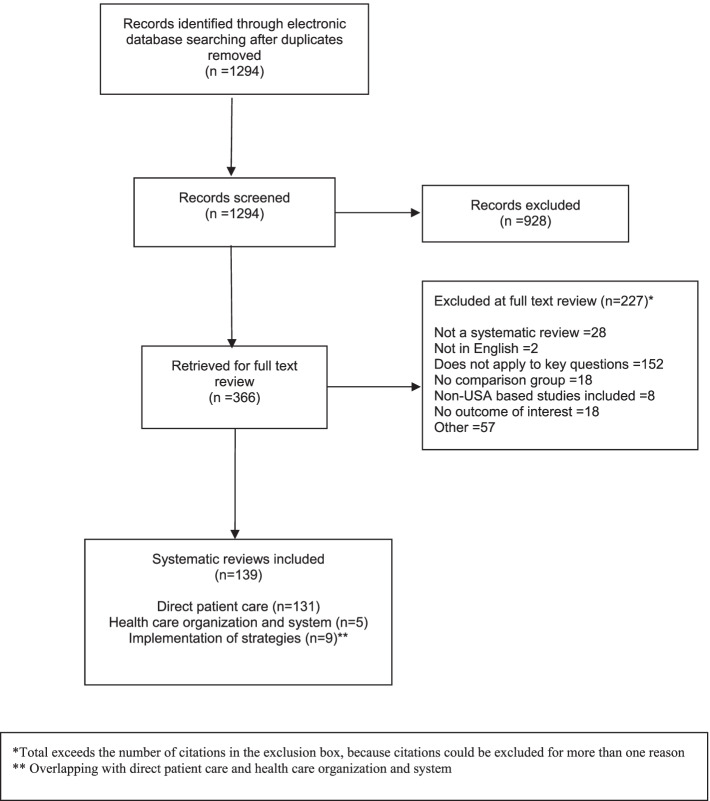
We searched PubMed, CINAHL, EMBASE, and Cochrane, January 2015 to September 2021 for systematic reviews on strategies for engaging patients with chronic conditions and their caregivers. From each review, we abstracted search dates, number and type of studies, populations, interventions, and outcomes. PFE strategies were categorized into direct patient care, health system, and community-policy level strategies. We found few systematic reviews on strategies at the health system, and none at the community-policy level. In view of this, we also searched for original studies that focused on PFE strategies at those two levels and reviewed the PFE strategies used and study findings.
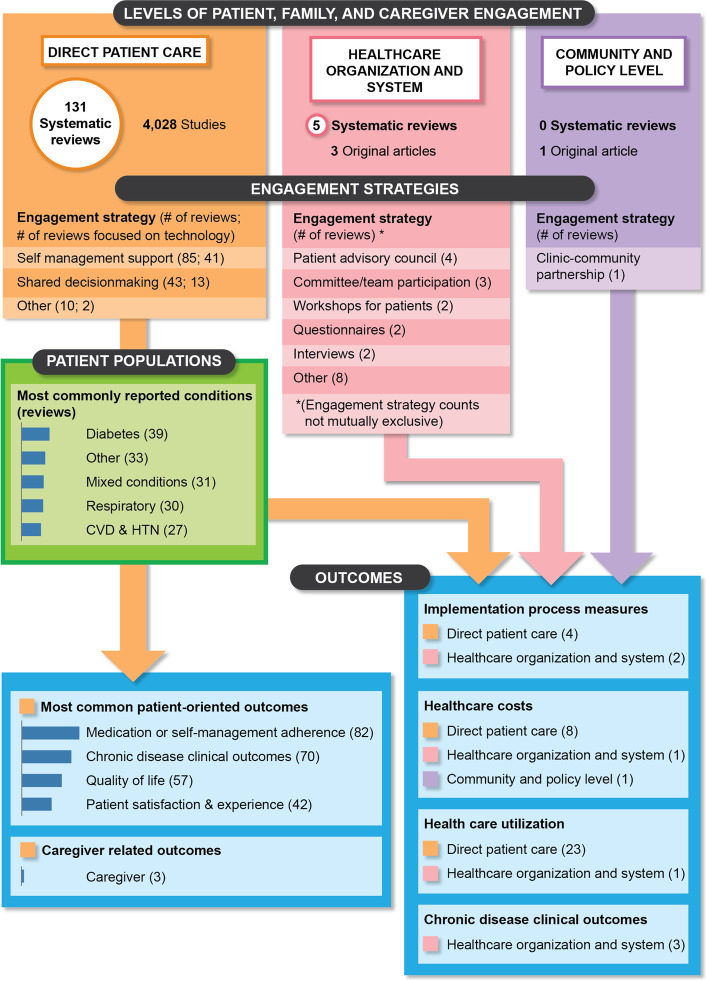
We found 131 reviews of direct patient care strategies, 5 reviews of health system strategies, and no reviews of community-policy strategies. Four original studies addressed PFE at the health system or community-policy levels. Most direct patient care reviews focused on self-management support (SMS) (n = 85) and shared decision-making (SDM) (n = 43). Forty-nine reviews reported positive effects, 35 reported potential benefits, 37 reported unclear benefits, and 4 reported no benefits. Health system level strategies mainly involved patients and caregivers serving on advisory councils. PFE strategies with the strongest evidence focused on SMS particularly for patients with diabetes. Many SDM reviews reported potential benefits especially for patients with cancer.
Much more evidence exists on the effects of direct patient care strategies on PFE than on the effects of health system or community-policy strategies. Most reviews indicated that direct patient care strategies had positive effects or potential benefits. A limitation of this evidence map is that due to its focus on reviews, which were plentiful, it did not capture details of individual interventions. Nevertheless, this evidence map should help to focus attention on gaps that require more research in efforts to improve PFE.
患者和家属参与(PFE)已被定义为患者、家属和医疗保健提供者之间的合作关系,以实现积极的医疗保健结果。有证据表明,PFE 对于改善结果至关重要。我们旨在系统地确定和绘制有关慢性疾病患者 PFE 策略的证据,并确定需要更多研究的领域。
我们检索了 PubMed、CINAHL、EMBASE 和 Cochrane 数据库,以获取 2015 年 1 月至 2021 年 9 月关于慢性疾病患者及其照护者参与策略的系统评价。从每篇综述中,我们提取了检索日期、研究数量和类型、人群、干预措施和结果。PFE 策略分为直接患者护理、卫生系统和社区-政策层面策略。我们发现很少有关于卫生系统层面策略的系统评价,也没有关于社区-政策层面策略的系统评价。鉴于此,我们还检索了关注这两个层面 PFE 策略的原始研究,并回顾了使用的 PFE 策略和研究结果。
我们发现了 131 篇直接患者护理策略的综述、5 篇卫生系统策略的综述和没有社区-政策策略的综述。四项原始研究涉及卫生系统或社区-政策层面的 PFE 策略。大多数直接患者护理综述主要关注自我管理支持(SMS)(n = 85)和共享决策制定(SDM)(n = 43)。49 篇综述报告了积极影响,35 篇报告了潜在益处,37 篇报告了益处不明确,4 篇报告了没有益处。卫生系统层面的策略主要涉及患者和照护者担任顾问委员会成员。具有最强证据的 PFE 策略主要集中在 SMS,特别是针对糖尿病患者。许多 SDM 综述报告了潜在益处,特别是针对癌症患者。
与卫生系统或社区-政策策略相比,直接患者护理策略对 PFE 的影响有更多的证据。大多数综述表明,直接患者护理策略具有积极影响或潜在益处。该证据图谱的一个局限性是,由于其重点是综述,综述很多,因此没有捕捉到个别干预措施的细节。尽管如此,该证据图谱应有助于关注需要更多研究以改善 PFE 的空白领域。