Department of Engineering for Innovation, University of Salento, 73100, Lecce, Italy.
Department of Veterinary Medicine, University of Bari, Valenzano, Italy.
Parasit Vectors. 2022 Mar 5;15(1):79. doi: 10.1186/s13071-022-05193-y.
Pest management has been facing the spread of invasive species, insecticide resistance phenomena, and concern for the impact of chemical pesticides on human health and the environment. It has tried to deal with them by developing technically efficient and economically sustainable solutions to complement/replace/improve traditional control methods. The renewal has been mainly directed towards less toxic pesticides or enhancing the precision of their delivery to reduce the volume employed and side effects through lure-and-kill approaches based on semiochemicals attractants. However, one of the main pest management problems is that efficacy depends on the effectiveness of the attractant system, limiting its successful employment to semiochemical stimuli-responsive insects. Biomaterial-based and bioinspired/biomimetic solutions that already guide other disciplines (e.g., medical sciences) in developing precision approaches could be a helpful tool to create attractive new strategies to liberate precision pest management from the need for semiochemical stimuli, simplify their integration with bioinsecticides, and foster the use of still underemployed solutions.
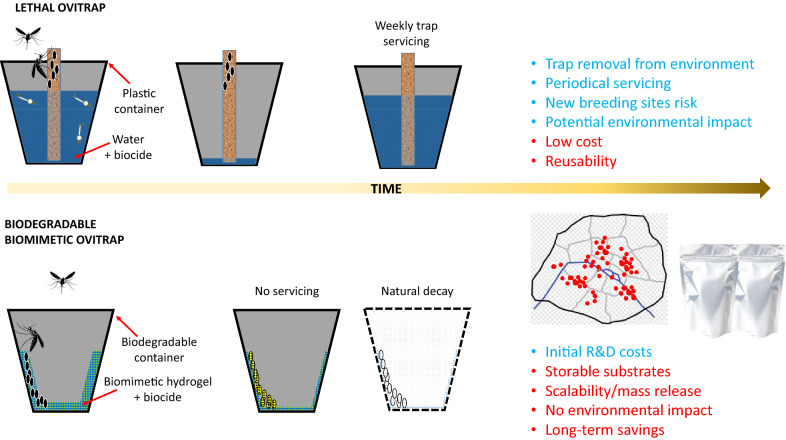
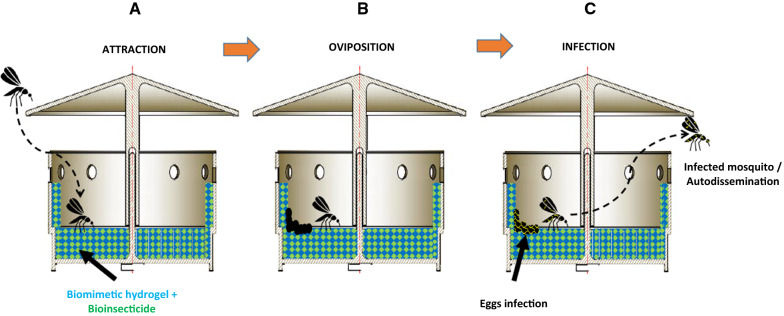
We propose an innovative approach, called "biomimetic lure-and-kill". It exploits biomimetic principles and biocompatible/biodegradable biopolymers (e.g., natural hydrogels) to develop new substrates that selectively attract insects by reproducing specific natural environmental conditions (biomimetic lure) and kill them by hosting and delivering a natural biopesticide or through mechanical action. Biomimetic lure-and-kill-designed substrates point to provide a new attractive system to develop/improve and make more cost-competitive new and conventional devices (e.g. traps). A first example application is proposed using the tiger mosquito Aedes albopictus as a model.
Biomaterials, particularly in the hydrogel form, can be a useful tool for developing the biomimetic lure-and-kill approach because they can satisfy multiple needs simultaneously (e.g., biomimetic lure, mechanical lethality, biocompatibility, and bioinsecticide growth). Such an approach might be cost-competitive, and with the potential for applicability to several pest species. Moreover, it is already technically feasible, since all the technologies necessary to design and configure materials with specific characteristics are already available on the market.
害虫管理一直面临着入侵物种的传播、杀虫剂抗性现象以及对化学农药对人类健康和环境影响的担忧。为了应对这些问题,人们一直在努力开发技术上高效、经济上可持续的解决方案,以补充/替代/改进传统的控制方法。这种更新主要针对毒性较低的杀虫剂,或者通过基于半化学引诱剂的诱捕和杀灭方法来提高其投放的精准度,从而减少使用量和副作用。然而,害虫管理的主要问题之一是,其效果取决于引诱系统的有效性,这限制了其在半化学刺激响应昆虫上的成功应用。基于生物材料的仿生/生物模拟解决方案已经在指导其他学科(例如医学科学)开发精准方法方面发挥了作用,它们可能是一个有用的工具,可以创造有吸引力的新策略,使精准害虫管理摆脱对半化学刺激的需求,简化其与生物杀虫剂的整合,并促进仍未充分利用的解决方案的使用。
我们提出了一种创新方法,称为“仿生诱捕和杀灭”。它利用仿生原理和生物相容/可生物降解的生物聚合物(例如天然水凝胶)来开发新的基质,通过复制特定的自然环境条件(仿生诱饵)来选择性地吸引昆虫,并通过容纳和输送天然生物农药或通过机械作用来杀死它们。仿生诱捕和杀灭设计的基质有望提供一种新的有吸引力的系统,用于开发/改进和使新的和传统的设备(例如诱捕器)更具成本竞争力。提出了第一个应用示例,使用白纹伊蚊作为模型。
生物材料,特别是水凝胶形式的生物材料,可以成为开发仿生诱捕和杀灭方法的有用工具,因为它们可以同时满足多种需求(例如,仿生诱饵、机械致死性、生物相容性和生物农药生长)。这种方法可能具有成本竞争力,并有可能适用于几种害虫物种。此外,它已经在技术上是可行的,因为设计和配置具有特定特性的材料所需的所有技术都已经在市场上可用。