Department of Oncology, University of Oxford, Oxford, United Kingdom.
Cambridge Institute for Therapeutic Immunology & Infectious Disease, Jeffrey Cheah Biomedical Centre, Cambridge, United Kingdom.
Front Immunol. 2022 Feb 18;13:821816. doi: 10.3389/fimmu.2022.821816. eCollection 2022.
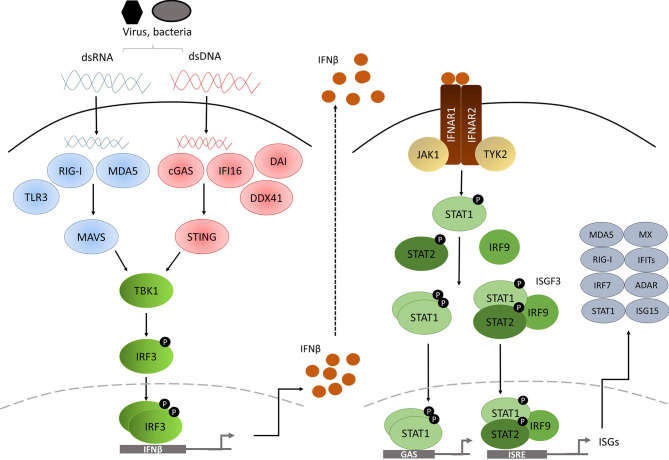
In solid tumors, as the tumor grows and the disease progresses, hypoxic regions are often generated, but in contrast to most normal cells which cannot survive under these conditions, tumour cells adapt to hypoxia by HIF-driven mechanisms. Hypoxia can further promote cancer development by generating an immunosuppressive environment within the tumour mass, which allows tumour cells to escape the immune system recognition. This is achieved by recruiting immunosuppressive cells and by upregulating molecules which block immune cell activation. Hypoxia can also confer resistance to antitumor therapies by inducing the expression of membrane proteins that increase drug efflux or by inhibiting the apoptosis of treated cells. In addition, tumor cells require an active interferon (IFN) signalling pathway for the success of many anticancer therapies, such as radiotherapy or chemotherapy. Therefore, hypoxic effects on this pathway needs to be addressed for a successful treatment.
在实体肿瘤中,随着肿瘤的生长和疾病的进展,往往会产生缺氧区域,但与大多数正常细胞在这些条件下无法存活不同,肿瘤细胞通过 HIF 驱动的机制适应缺氧。缺氧可以通过在肿瘤块内产生免疫抑制环境进一步促进癌症的发展,使肿瘤细胞逃避免疫系统的识别。这是通过招募免疫抑制细胞和上调阻断免疫细胞激活的分子来实现的。缺氧还可以通过诱导增加药物外排的膜蛋白的表达或抑制治疗细胞的凋亡来赋予肿瘤细胞对抗肿瘤治疗的耐药性。此外,肿瘤细胞需要一个活跃的干扰素(IFN)信号通路才能成功进行许多抗癌治疗,如放疗或化疗。因此,需要解决缺氧对该途径的影响,以实现成功的治疗。