Djamgoz Mustafa B A
Department of Life Sciences, Imperial College London, South Kensington Campus, London SW7 2AZ, UK.
Biotechnology Research Centre, Cyprus International University, Haspolat, Mersin 10, Turkey.
Cancers (Basel). 2022 May 30;14(11):2703. doi: 10.3390/cancers14112703.
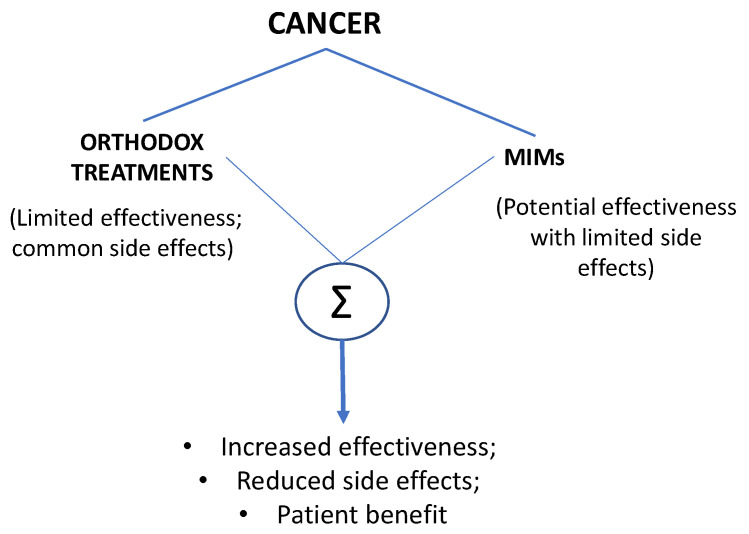
Cancer is a global health problem that 1 in 2-3 people can expect to experience during their lifetime. Several different modalities exist for cancer management, but all of these suffer from significant shortcomings in both diagnosis and therapy. Apart from developing completely new therapies, a viable way forward is to improve the efficacy of the existing modalities. One way is to combine these with each other or with other complementary approaches. An emerging latter approach is derived from ionic mechanisms, mainly ion channels and exchangers. We evaluate the evidence for this systematically for the main treatment methods: surgery, chemotherapy, radiotherapy and targeted therapies (including monoclonal antibodies, steroid hormones, tyrosine kinase inhibitors and immunotherapy). In surgery, the possible systemic use of local anesthetics to suppress subsequent relapse is still being discussed. For all the other methods, there is significant positive evidence for several cancers and a range of modulators of ionic mechanisms. This applies also to some of the undesirable side effects of the treatments. In chemotherapy, for example, there is evidence for co-treatment with modulators of the potassium channel (Kv11.1), pH regulation (sodium-hydrogen exchanger) and Na-K-ATPase (digoxin). Voltage-gated sodium channels, shown previously to promote metastasis, appear to be particularly useful for co-targeting with inhibitors of tyrosine kinases, especially epidermal growth factor. It is concluded that combining current orthodox treatment modalities with modulators of ionic mechanisms can produce beneficial effects including (i) making the treatment more effective, e.g., by lowering doses; (ii) avoiding the onset of resistance to therapy; (iii) reducing undesirable side effects. However, in many cases, prospective clinical trials are needed to put the findings firmly into clinical context.
癌症是一个全球性的健康问题,每2至3人中就有1人在其一生中可能会患上癌症。癌症治疗存在几种不同的方式,但所有这些方式在诊断和治疗方面都存在重大缺陷。除了开发全新的治疗方法外,一个可行的前进方向是提高现有治疗方式的疗效。一种方法是将这些方式相互结合,或与其他互补方法相结合。后一种新兴方法源自离子机制,主要是离子通道和离子交换器。我们系统地评估了主要治疗方法(手术、化疗、放疗和靶向治疗,包括单克隆抗体、类固醇激素、酪氨酸激酶抑制剂和免疫疗法)的相关证据。在手术方面,局部麻醉剂用于全身以抑制后续复发的可能性仍在讨论中。对于所有其他方法,有大量确凿证据表明几种癌症以及一系列离子机制调节剂与之相关。这也适用于治疗的一些不良副作用。例如,在化疗中,有证据表明可与钾通道(Kv11.1)调节剂、pH调节(钠氢交换器)和钠钾ATP酶(地高辛)联合治疗。先前显示可促进转移的电压门控钠通道,似乎特别适用于与酪氨酸激酶抑制剂(尤其是表皮生长因子)联合靶向治疗。得出的结论是,将当前的传统治疗方式与离子机制调节剂相结合可产生有益效果,包括:(i)使治疗更有效,例如通过降低剂量;(ii)避免产生治疗抗性;(iii)减少不良副作用。然而,在许多情况下,需要进行前瞻性临床试验,以便将这些发现切实应用于临床实践。