AlThuneyyan Danyah Abdullah, AlGhamdi Faten Fahad, AlZain Ragad Nasser, AlDhawyan Zainab Sami, Alhmly Haya Fahad, Purayidathil Tunny Sebastian, AlGindan Yasmin Yussuf, Abdullah Ahmed Amr
Department of Clinical Nutrition, Imam Abdulrahman Bin Faisal University, Dammam, Saudi Arabia.
The University Counseling Center at Imam Abdulrahman Bin Faisal University, Dammam, Saudi Arabia.
Front Nutr. 2022 Feb 18;9:726042. doi: 10.3389/fnut.2022.726042. eCollection 2022.
Breastfeeding is an optimal infant feeding method that provides adequate nutrients, achieves healthy growth and development, and enhances the health status of both infants and mothers. Breast milk contains a variety of substances that might positively affect cognition and the development of children's psychomotor abilities.
This study aimed to examine the variations in intelligence quotient (IQ), social intelligence (SI), and body mass index (BMI) among 7- to 9-year-old girls who were exclusively breastfed, exclusively bottle-fed, or mixed-fed during their first 6 months of life.
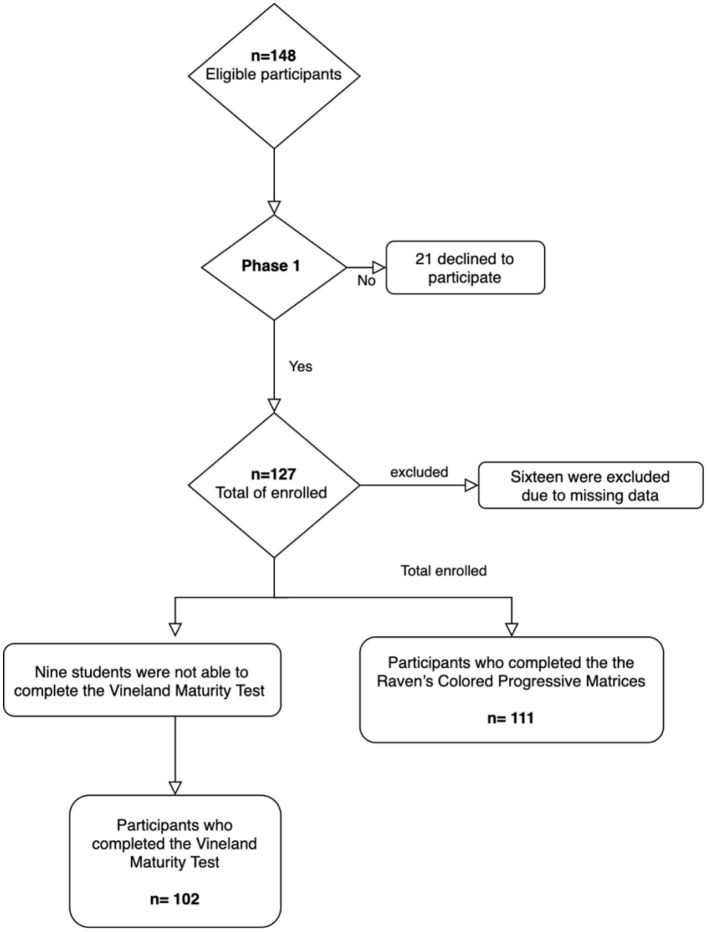
This study involved 111 healthy girls, aged 7 to 9 years, who were recruited from nine government and private schools in Dammam, Kingdom of Saudi Arabia. Raven's Coloured Progressive Matrices were used to measure the participants' IQs, and the Vineland Social Maturity Assessment was used to measure their SI through individual interviews. Anthropometric measurements were obtained using standard methods.
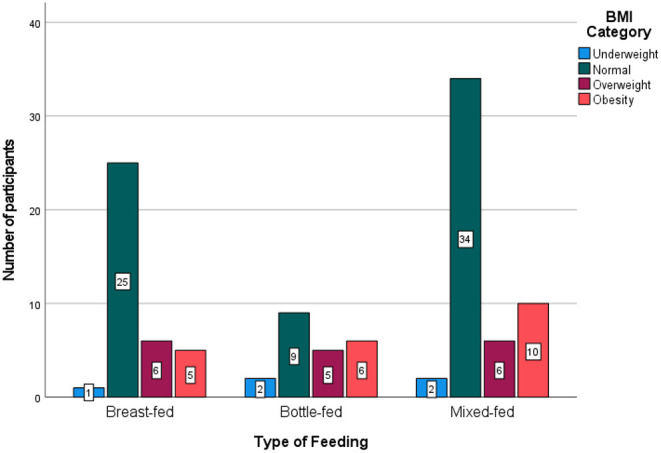
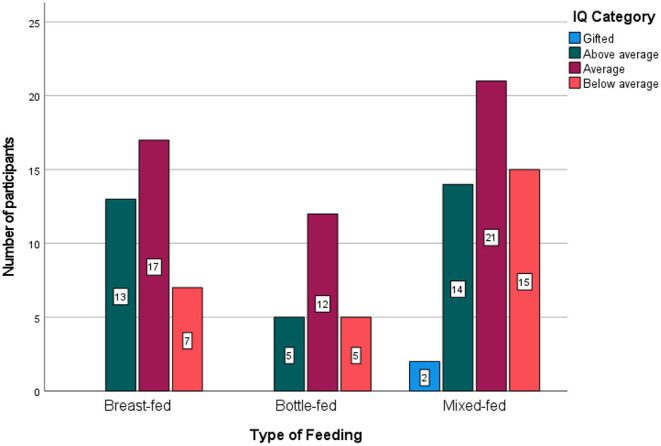
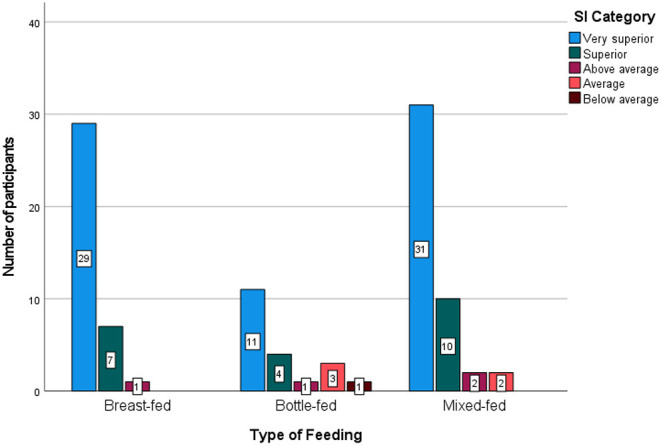
The breastfed group showed a greater number of above-average IQ test scores (35 vs. 23%; = 0.479) and better SI scores (78 vs. 55%; = 0.066) compared with the bottle-fed group. The number of girls with normal BMIs was significantly higher in the breastfed group than in the bottle-fed (68 vs. 41%; = 0.045) or mixed-fed groups.
Exclusively breastfed girls had higher IQ and SI results compared with bottle-fed girls. However, unlike the BMI differences, these results were not statistically significant. This study provides fundamental observational data and can be further modified for use on a larger national-scale level.
母乳喂养是一种最佳的婴儿喂养方式,能提供充足营养,实现健康生长发育,并提升婴儿和母亲的健康状况。母乳含有多种可能对儿童认知及心理运动能力发展产生积极影响的物质。
本研究旨在调查在出生后头6个月纯母乳喂养、纯奶瓶喂养或混合喂养的7至9岁女孩在智商(IQ)、社会智力(SI)和体重指数(BMI)方面的差异。
本研究纳入了111名7至9岁的健康女孩,她们来自沙特阿拉伯王国达曼的9所公立和私立学校。使用瑞文彩色渐进矩阵测验来测量参与者的智商,并通过个人访谈使用文兰社会成熟度评估来测量她们的社会智力。采用标准方法进行人体测量。
与奶瓶喂养组相比,母乳喂养组智商测试得分高于平均水平的人数更多(35%对23%;P = 0.479),社会智力得分也更高(78%对55%;P = 0.066)。母乳喂养组BMI正常的女孩人数显著高于奶瓶喂养组(68%对41%;P = 0.045)或混合喂养组。
与奶瓶喂养的女孩相比,纯母乳喂养的女孩智商和社会智力结果更高。然而,与BMI差异不同,这些结果在统计学上并不显著。本研究提供了基础观察数据,可进一步修改以用于更大规模的全国范围。