Institute for Translational Medicine, Szentágothai Research Centre, Medical School, University of Pécs, Pécs, Hungary.
Centre for Translational Medicine, Semmelweis University, Budapest, Hungary.
JAMA Netw Open. 2022 Mar 1;5(3):e220740. doi: 10.1001/jamanetworkopen.2022.0740.
The prevalence of overweight (body mass index [BMI] = 25-29.9 [calculated as weight in kilograms divided by height in meters squared]) and obesity (BMI ≥30) is increasing among patients with cystic fibrosis (CF). However, it is unclear whether there is a benefit associated with increasing weight compared with the reference range (ie, normal) in CF.
To evaluate the association of altered BMI or body composition and clinical outcomes in patients with CF.
For this systematic review and meta-analysis, the literature search was conducted November 2, 2020, of 3 databases: MEDLINE (via PubMed), Embase, and Cochrane Central Register of Controlled Trials.
Patients older than 2 years diagnosed with CF with altered body composition or BMI were compared with patients having the measured parameters within the reference ranges. Records were selected by title, abstract, and full text; disagreements were resolved by consensus. Cohort studies and conference abstracts were eligible; articles with no original data and case reports were excluded.
Two authors independently extracted data, which were validated by a third author. Studies containing insufficient poolable numerical data were included in the qualitative analysis. A random-effects model was applied in all analyses.
Pulmonary function, exocrine pancreatic insufficiency (PI), and CF-related diabetes (CFRD) were investigated as primary outcomes. Odds ratios (ORs) or weighted mean differences (WMDs) with 95% CIs were calculated. The hypothesis was formulated before data collection.
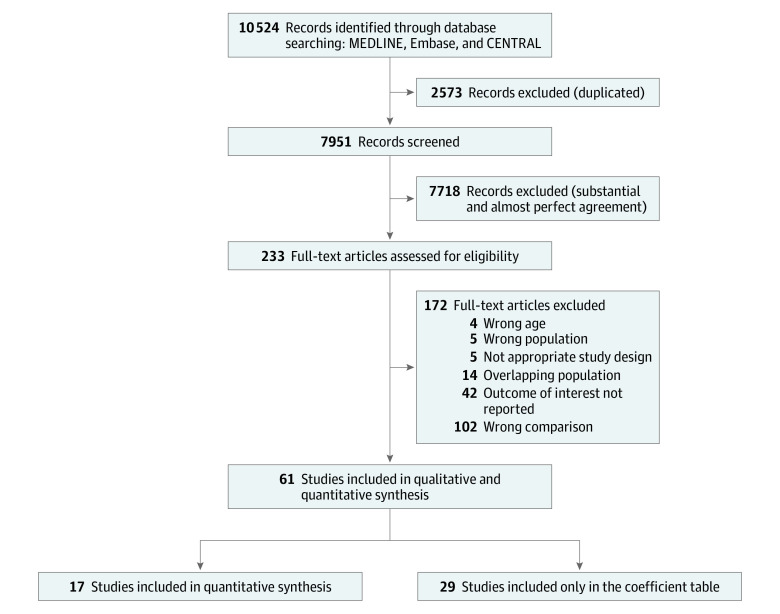
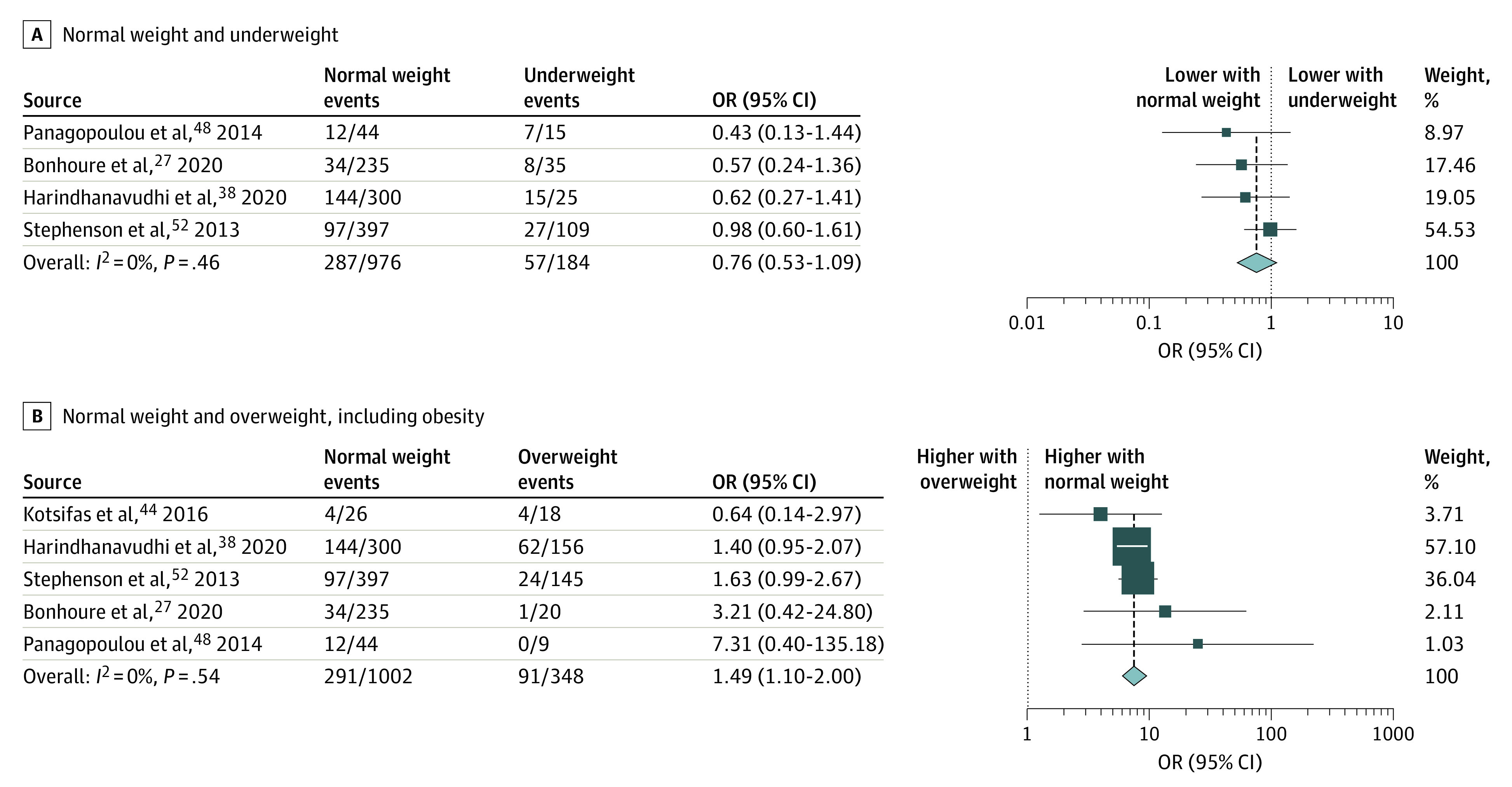
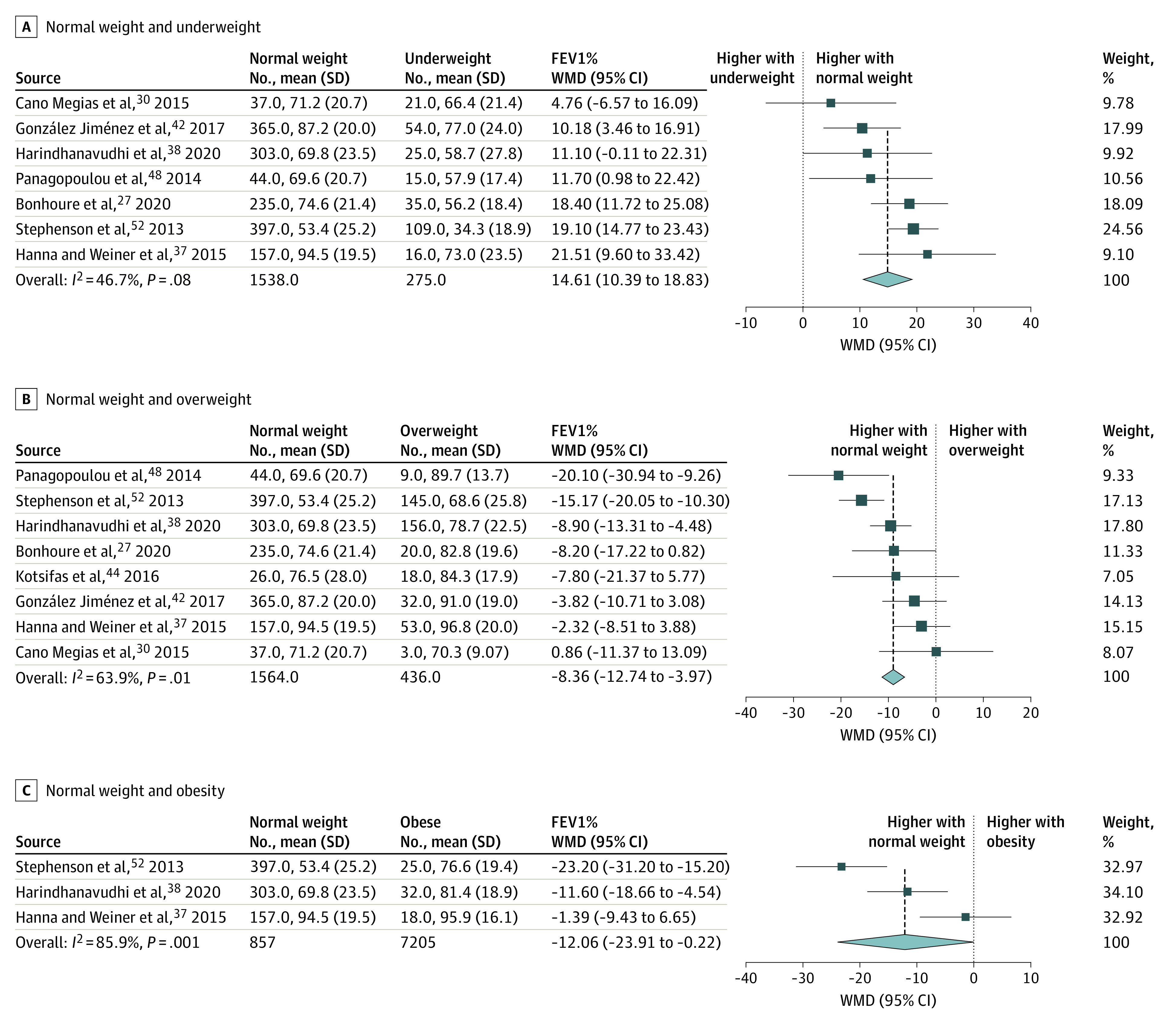
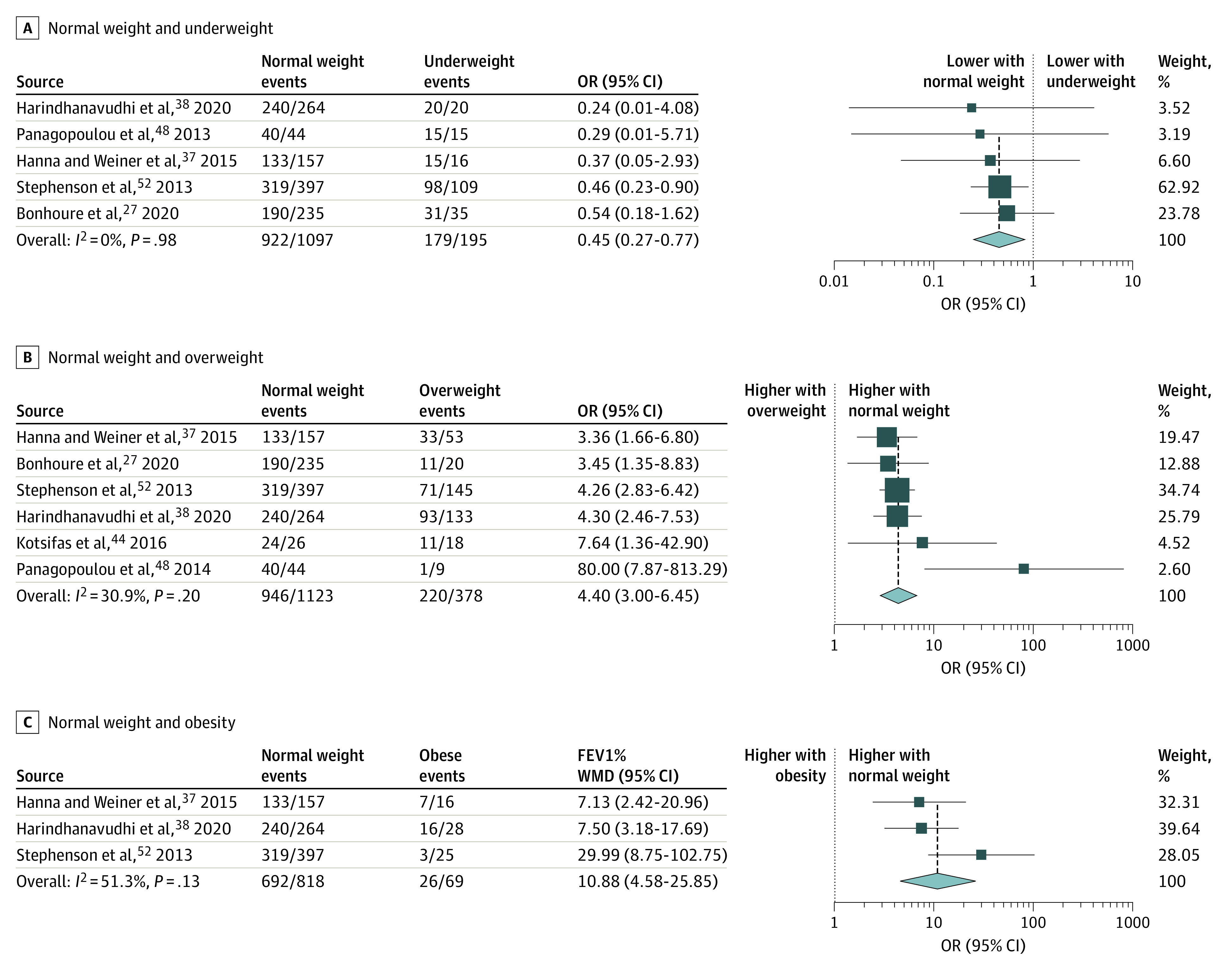
Of 10 524 records identified, 61 met the selection criteria and were included in the qualitative analysis. Of these, 17 studies were included in the quantitative synthesis. Altogether, 9114 patients were included in the systematic review and meta-analysis. Overweight (WMD, -8.36%; 95% CI, -12.74% to -3.97%) and obesity (WMD, -12.06%; 95% CI, -23.91% to -0.22%) were associated with higher forced expiratory volume in the first second of expiration compared with normal weight. The odds for CFRD and PI were more likely in patients of normal weight (OR, 1.49; 95% CI, 1.10 to 2.00) than in those who were overweight (OR, 4.40; 95% CI, 3.00 to 6.45). High heterogeneity was shown in the analysis of pulmonary function (I2 = 46.7%-85.9%).
The findings of this systematic review and meta-analysis suggest that the currently recommended target BMI in patients with CF should be reconsidered. Studies with long-term follow-up are necessary to assess the possible adverse effects of higher BMI or higher fat mass in patients with CF.
超重(体重指数 [BMI] = 25-29.9[按千克体重除以米的平方计算])和肥胖(BMI ≥30)在囊性纤维化(CF)患者中的患病率正在增加。然而,与 CF 中的参考范围(即正常)相比,体重增加是否与临床结局相关尚不清楚。
评估 CF 患者改变的 BMI 或身体成分与临床结局的关系。
本系统评价和荟萃分析的文献检索于 2020 年 11 月 2 日在 3 个数据库中进行:MEDLINE(通过 PubMed)、Embase 和 Cochrane 对照试验中心注册库。
与具有参考范围内测量参数的患者相比,对年龄大于 2 岁且身体成分或 BMI 改变的 CF 患者进行比较。记录通过标题、摘要和全文进行选择;分歧通过共识解决。队列研究和会议摘要符合入选标准;无原始数据和病例报告的文章被排除。
两名作者独立提取数据,由第三名作者验证。包含的汇总数据不足的研究被纳入定性分析。所有分析均应用随机效应模型。
将肺功能、外分泌胰腺功能不全(PI)和 CF 相关性糖尿病(CFRD)作为主要结局进行研究。计算比值比(OR)或加权均数差值(WMD)及其 95%置信区间。在数据收集之前就提出了假设。
从 10524 条记录中,有 61 条符合入选标准,并纳入定性分析。其中,有 17 项研究纳入定量综合分析。总共对 9114 名患者进行了系统评价和荟萃分析。超重(WMD,-8.36%;95%CI,-12.74%至-3.97%)和肥胖(WMD,-12.06%;95%CI,-23.91%至-0.22%)与正常体重相比,用力呼气量第一秒的比值更高。与超重患者相比,正常体重患者(OR,1.49;95%CI,1.10 至 2.00)发生 CFRD 和 PI 的可能性更高(OR,4.40;95%CI,3.00 至 6.45)。在肺功能分析中显示出高度异质性(I2=46.7%-85.9%)。
本系统评价和荟萃分析的结果表明,目前建议 CF 患者的目标 BMI 应重新考虑。需要进行长期随访的研究来评估 CF 患者更高 BMI 或更高脂肪量的可能不良影响。