
免疫遗传变异塑造了自然脊椎动物群体中的肠道微生物组。
Immunogenetic variation shapes the gut microbiome in a natural vertebrate population.
机构信息
School of Biological Sciences, University of East Anglia, Norwich Research Park, Norfolk, NR4 7TJ, UK.
NERC Biomolecular Analysis Facility, Department of Animal and Plant Sciences, University of Sheffield, Sheffield, S10 2TN, UK.
出版信息
Microbiome. 2022 Mar 8;10(1):41. doi: 10.1186/s40168-022-01233-y.
BACKGROUND
The gut microbiome (GM) can influence many biological processes in the host, impacting its health and survival, but the GM can also be influenced by the host's traits. In vertebrates, Major Histocompatibility Complex (MHC) genes play a pivotal role in combatting pathogens and are thought to shape the host's GM. Despite this-and the documented importance of both GM and MHC variation to individual fitness-few studies have investigated the association between the GM and MHC in the wild.
RESULTS
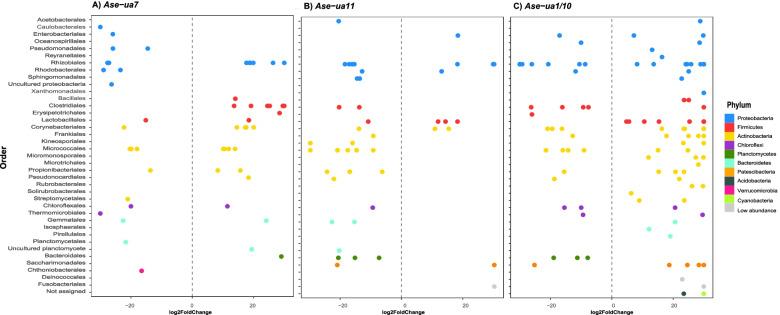
We characterised MHC class I (MHC-I), MHC class II (MHC-II) and GM variation in individuals within a natural population of the Seychelles warbler (Acrocephalus sechellensis). We determined how the diversity and composition of the GM varied with MHC characteristics, in addition to environmental factors and other host traits. Our results show that the presence of specific MHC alleles, but not MHC diversity, influences both the diversity and composition of the GM in this population. MHC-I alleles, rather than MHC-II alleles, had the greatest impact on the GM. GM diversity was negatively associated with the presence of three MHC-I alleles (Ase-ua3, Ase-ua4, Ase-ua5), and one MHC-II allele (Ase-dab4), while changes in GM composition were associated with the presence of four different MHC-I alleles (Ase-ua1, Ase-ua7, Ase-ua10, Ase-ua11). There were no associations between GM diversity and TLR3 genotype, but GM diversity was positively correlated with genome-wide heterozygosity and varied with host age and field period.
CONCLUSIONS
These results suggest that components of the host's immune system play a role in shaping the GM of wild animals. Host genotype-specifically MHC-I and to a lesser degree MHC-II variation-can modulate the GM, although whether this occurs directly, or indirectly through effects on host health, is unclear. Importantly, if immune genes can regulate host health through modulation of the microbiome, then it is plausible that the microbiome could also influence selection on immune genes. As such, host-microbiome coevolution may play a role in maintaining functional immunogenetic variation within natural vertebrate populations. Video abstract.
背景
肠道微生物组(GM)可以影响宿主的许多生物过程,从而影响其健康和生存,但 GM 也可以受到宿主特征的影响。在脊椎动物中,主要组织相容性复合体(MHC)基因在对抗病原体方面发挥着关键作用,并且被认为塑造了宿主的 GM。尽管如此,并且已经记录了 GM 和 MHC 变异对个体适应性的重要性,但很少有研究调查野生环境中 GM 和 MHC 之间的关联。
结果
我们在塞舌尔莺(Acrocephalus sechellensis)的自然种群中个体内描述了 MHC Ⅰ类(MHC-I)、MHC Ⅱ类(MHC-II)和 GM 变异。我们确定了 GM 的多样性和组成如何随 MHC 特征、环境因素和其他宿主特征而变化。我们的研究结果表明,特定 MHC 等位基因的存在,而不是 MHC 多样性,影响了该种群 GM 的多样性和组成。MHC-I 等位基因而不是 MHC-II 等位基因对 GM 的影响最大。GM 多样性与三种 MHC-I 等位基因(Ase-ua3、Ase-ua4、Ase-ua5)和一种 MHC-II 等位基因(Ase-dab4)的存在呈负相关,而 GM 组成的变化与四种不同的 MHC-I 等位基因(Ase-ua1、Ase-ua7、Ase-ua10、Ase-ua11)的存在相关。GM 多样性与 TLR3 基因型之间没有关联,但 GM 多样性与全基因组杂合度呈正相关,并且随宿主年龄和野外时间而变化。
结论
这些结果表明,宿主免疫系统的组成部分在塑造野生动物的 GM 方面发挥了作用。宿主基因型特异性 MHC-I,在较小程度上还有 MHC-II 变异,可以调节 GM,尽管这是直接发生的,还是通过对宿主健康的间接影响尚不清楚。重要的是,如果免疫基因可以通过调节微生物组来调节宿主健康,那么微生物组也可以影响免疫基因的选择。因此,宿主-微生物组共同进化可能在维持自然脊椎动物种群中功能性免疫遗传变异方面发挥作用。


 Zotero 插件