Department of Physiology, University of Toronto, Mount Sinai Hospital, Toronto, Ontario, Canada (Ms Zhang, Dr Murphy, Ms Foshay, and Drs Lye and Matthews).
Department of Obstetrics and Gynecology, Sinai Health System, New York City, NY (Mr Okeke and Drs Murphy, Lye, and Matthews).
Am J Obstet Gynecol MFM. 2022 May;4(3):100605. doi: 10.1016/j.ajogmf.2022.100605. Epub 2022 Mar 4.
The COVID-19 pandemic presents unique social, economic, and psychological challenges for individuals globally. Thus, women who are pregnant face unprecedented mental health challenges.
We sought to determine the impact of the pandemic on perinatal depression and anxiety in a longitudinal pregnancy cohort. We hypothesized increased depression and anxiety scores in women during pregnancy and after birth in the pandemic at all time points.
Participants were enrolled in the Ontario Birth Study, a pregnancy cohort embedded in clinical care at Mount Sinai Hospital, Toronto, Canada. Perinatal depression and anxiety were assessed using the 2-Item Patient Health Questionnaire and 2-Item Generalized Anxiety Disorder Questionnaire in early pregnancy, whereas the Edinburgh Postnatal Depression Scale and 2-Item Generalized Anxiety Disorder Questionnaire were used in late pregnancy and after birth. Logistic regression models were created to examine the association of the pandemic with clinically elevated mental health scores in the prepandemic group vs pandemic group while adjusting for covariates.
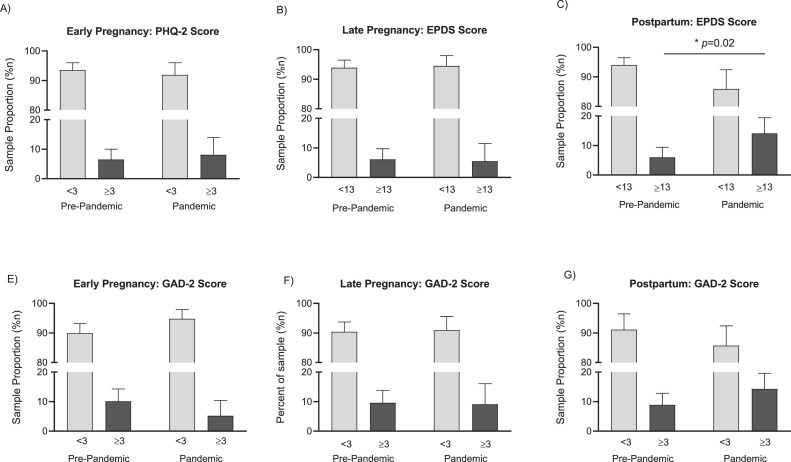
A total of 1159 survey responses from 649 participants between March 1, 2019, and February 28, 2021, were used to conduct this study. Participants were assessed in early pregnancy (n=416), in late pregnancy (n=373), and after birth (n=370). Responses received on or before February 29, 2020, were considered the "prepandemic" responses, whereas responses after the aforementioned date were considered the "pandemic" responses. Mean rank scores of depression and anxiety were significantly higher in the pandemic group (P=.02 and P=.003, respectively) in the postpartum period. There was no significant association between pandemic time and antenatal scores. However, postnatally, mothers were 2.6 times more likely to score ≥13 on the Edinburgh Postnatal Depression Scale during the pandemic than before the pandemic (95% confidence interval, 1.2-5.7; P=.02). Adjustment for ethnicity and income strengthened this association as the odds ratio increased to 3.3 (95% confidence interval, 1.4-8.0; P=.007).
Pandemic-associated increases in depression and anxiety scores were confined to the postpartum period, highlighting a need for increased screening and interventions for perinatal mood and anxiety disorders postnatally as this pandemic continues.
COVID-19 大流行给全球个人带来了独特的社会、经济和心理挑战。因此,孕妇面临前所未有的心理健康挑战。
我们旨在确定大流行对围产期抑郁和焦虑的影响在一个纵向妊娠队列中。我们假设在大流行期间,孕妇在所有时间点的抑郁和焦虑评分都会增加。
参与者参加了安大略省出生研究,这是一个嵌入在加拿大多伦多西奈山医院临床护理中的妊娠队列。在孕早期使用 2 项患者健康问卷和 2 项广泛性焦虑症问卷评估围产期抑郁和焦虑,而在孕晚期和产后使用爱丁堡产后抑郁量表和 2 项广泛性焦虑症问卷。创建逻辑回归模型,以检查大流行前组和大流行组中与临床升高的心理健康评分相关的关联,同时调整协变量。
共使用了 2019 年 3 月 1 日至 2021 年 2 月 28 日期间来自 649 名参与者的 1159 份调查回复进行了这项研究。参与者在孕早期(n=416)、孕晚期(n=373)和产后(n=370)接受评估。在 2020 年 2 月 29 日之前收到的回复被视为“大流行前”回复,而此后的回复则被视为“大流行”回复。在产后期间,大流行组的抑郁和焦虑平均秩评分明显更高(P=.02 和 P=.003)。大流行时间与产前评分之间没有显著关联。然而,产后,母亲在大流行期间更有可能在爱丁堡产后抑郁量表上得分为≥13(95%置信区间,1.2-5.7;P=.02)。调整种族和收入后,这种关联得到了加强,因为优势比增加到 3.3(95%置信区间,1.4-8.0;P=.007)。
与大流行相关的抑郁和焦虑评分增加仅限于产后期间,这突出表明,随着这种大流行的继续,需要在产后增加对围产期情绪和焦虑障碍的筛查和干预。