Moitra Panchali, Madan Jagmeet
Department of Food, Nutrition & Dietetics, Sir Vithaldas Thackersey College of Home Science (Autonomous), SNDT Women's University, Santacruz West, Mumbai, Maharashtra, India.
PLoS One. 2022 Mar 8;17(3):e0264951. doi: 10.1371/journal.pone.0264951. eCollection 2022.
This study attempted to address the limited knowledge regarding the impact of screen time (ST) on lifestyle behaviors in Indian adolescents during the ongoing COVID-19 pandemic. The objectives were to 1) evaluate frequency and duration of using screens, and screen addiction behaviors in 10-15 years old adolescents in Mumbai during the COVID-19 pandemic and 2) examine the association of ST with lifestyle behaviors- eating habits, snacking patterns, physical activity (PA) levels, sleep quality and depression symptoms.
An online survey was completed between January and March 2021. Eating habits, snacking patterns, time spent in different screen-based activities, and screen addiction behaviors were reported. The PA levels, sleep quality, and depression symptoms were evaluated using the Physical Activity Questionnaire for Children/Adolescents (PAQ C/A), Pittsburg Sleep Quality Index (PSQI), and Patient Health Questionnaire-2 (PHQ-2) respectively. Multiple linear regression analyses were performed to determine the impact of ST on lifestyle behaviors.
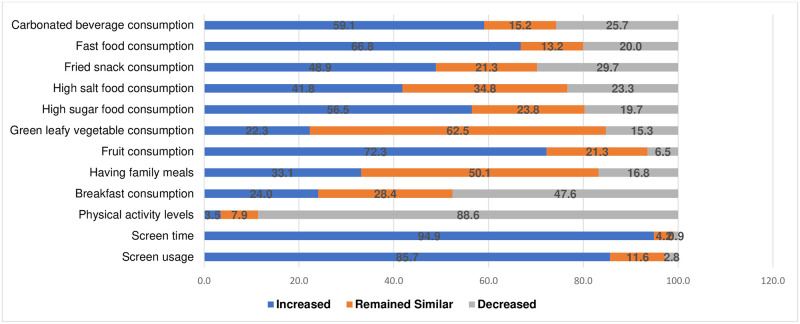
Adolescents (n = 1298, Mage 13.2(1.1), 53.3% boys) reported the mean weekday and weekend ST as 442.3 (201.5) minutes/d and 379.9 (178.2) minutes/d respectively. Overall, 33.4% spent > 6hours/d for studying or doing homework, 65.4% used social networking sites for at least 2-3 hours/d, and 70.7% agreed that ST had taken up the majority of their leisure time. Only 12% engaged in moderate to vigorous PA (PAQ C/A scores <2). More than half (52.5%) reported PSQI >5 indicating poor sleep quality and 8.6% scored ≥ 3 on PHQ-2 to suggest a risk of depression. A higher ST was associated with lower PA and increased sleep problems and a greater screen addiction was inversely associated with the eating habit, PA, and sleep-related variables.
The study draws attention to a high prevalence of excess ST and its impact on eating habits, PA levels, and sleep quality in Indian adolescents during the COVID-19 pandemic. Targeted health promotion interventions that encourage judicious use of screens for education and entertainment and emphasize the adverse health effects of excess ST are required.
本研究试图解决在当前新冠疫情期间,关于屏幕使用时间(ST)对印度青少年生活方式行为影响的认知有限的问题。目标是:1)评估新冠疫情期间孟买10至15岁青少年使用屏幕的频率和时长以及屏幕成瘾行为;2)研究屏幕使用时间与生活方式行为(饮食习惯、零食摄入模式、身体活动(PA)水平、睡眠质量和抑郁症状)之间的关联。
于2021年1月至3月完成了一项在线调查。调查内容包括饮食习惯、零食摄入模式、在不同基于屏幕的活动上花费的时间以及屏幕成瘾行为。分别使用儿童/青少年身体活动问卷(PAQ C/A)、匹兹堡睡眠质量指数(PSQI)和患者健康问卷 - 2(PHQ - 2)评估身体活动水平、睡眠质量和抑郁症状。进行多元线性回归分析以确定屏幕使用时间对生活方式行为的影响。
青少年(n = 1298,平均年龄13.2(1.1)岁,53.3%为男孩)报告工作日和周末的平均屏幕使用时间分别为442.3(201.5)分钟/天和379.9(178.2)分钟/天。总体而言,33.4%的人每天花>6小时学习或做作业,65.4%的人每天至少花2 - 3小时使用社交网站,70.7%的人认为屏幕使用时间占据了他们大部分休闲时间。只有12%的人进行中度至剧烈身体活动(PAQ C/A得分<2)。超过一半(52.5%)的人报告PSQI>5表明睡眠质量差,8.6%的人在PHQ - 2上得分≥3提示有抑郁风险。较高的屏幕使用时间与较低的身体活动水平以及睡眠问题增加相关,而更高的屏幕成瘾程度与饮食习惯、身体活动和睡眠相关变量呈负相关。
该研究提请注意在新冠疫情期间,印度青少年中屏幕使用时间过长的情况普遍存在,且其对饮食习惯、身体活动水平和睡眠质量有影响。需要有针对性的健康促进干预措施,鼓励明智地使用屏幕进行教育和娱乐,并强调屏幕使用时间过长对健康的不利影响。