COVID-19 Response Team, Centers for Disease Control and Prevention, Atlanta, GA, United States.
COVID-19 Response Team, Centers for Disease Control and Prevention, Atlanta, GA, United States.
Vaccine. 2022 Mar 25;40(14):2134-2139. doi: 10.1016/j.vaccine.2022.02.015. Epub 2022 Feb 7.
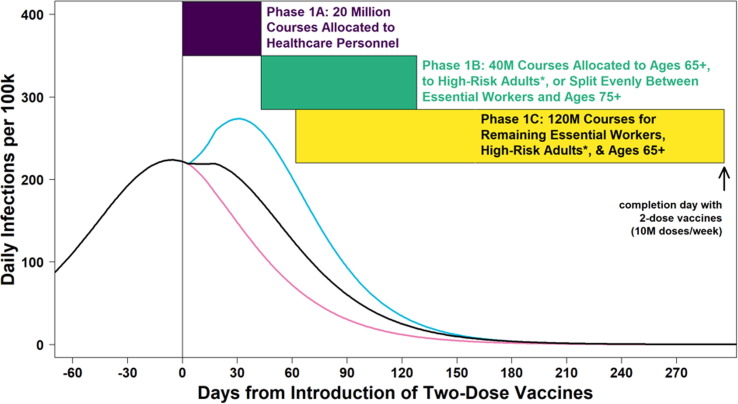
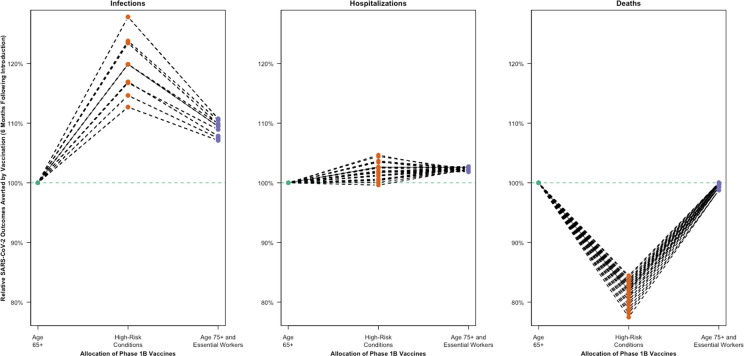
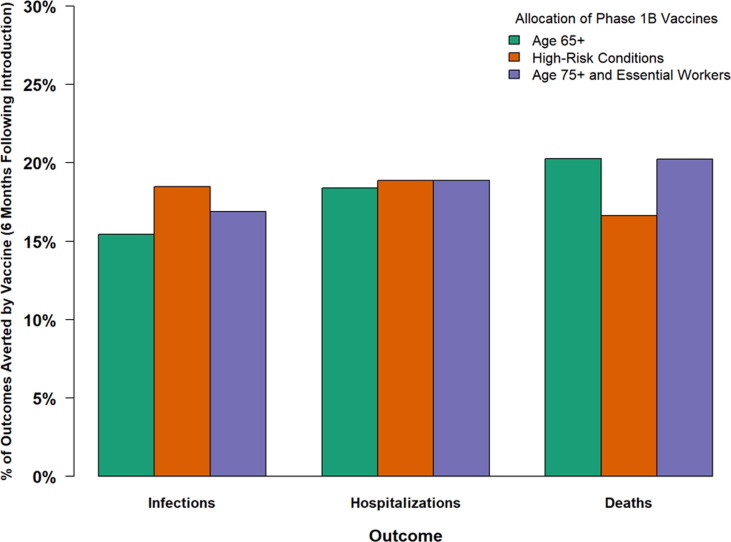
The Advisory Committee on Immunization Practices (ACIP) recommended phased allocation of SARS-CoV-2 vaccines in December 2020. To support the development of this guidance, we used a mathematical model of SARS-CoV-2 transmission to evaluate the relative impact of three vaccine allocation strategies on infections, hospitalizations, and deaths. All three strategies initially prioritized healthcare personnel (HCP) for vaccination. Strategies of subsequently prioritizing adults aged ≥65 years, or a combination of essential workers and adults aged ≥75 years, prevented the most deaths. Meanwhile, prioritizing adults with high-risk medical conditions immediately after HCP prevented the most infections. All three strategies prevented a similar fraction of hospitalizations. While no model is capable of fully capturing the complex social dynamics which shape epidemics, exercises such as this one can be a useful way for policy makers to formalize their assumptions and explore the key features of a problem before making decisions.
美国免疫实施咨询委员会(Advisory Committee on Immunization Practices,ACIP)于 2020 年 12 月建议分阶段分配 SARS-CoV-2 疫苗。为了支持这项指导意见的制定,我们使用了一种 SARS-CoV-2 传播的数学模型,来评估三种疫苗分配策略对感染、住院和死亡的相对影响。这三种策略最初都将医疗保健人员(Healthcare Personnel,HCP)作为疫苗接种的优先对象。随后将 65 岁及以上成年人或基本工作者和 75 岁及以上成年人作为优先对象的策略,可以预防最多的死亡。同时,在医疗保健人员之后立即优先考虑患有高危医疗条件的成年人,可以预防最多的感染。这三种策略都可以预防类似比例的住院。虽然没有任何模型能够完全捕捉塑造传染病的复杂社会动态,但此类练习可以成为决策者在做出决策之前,正式提出假设并探索问题关键特征的有用方法。