Napp Clotilde, Breda Thomas
Université Paris Dauphine, Paris, France.
CNRS, Paris, France.
Sci Adv. 2022 Mar 11;8(10):eabm3689. doi: 10.1126/sciadv.abm3689. Epub 2022 Mar 9.
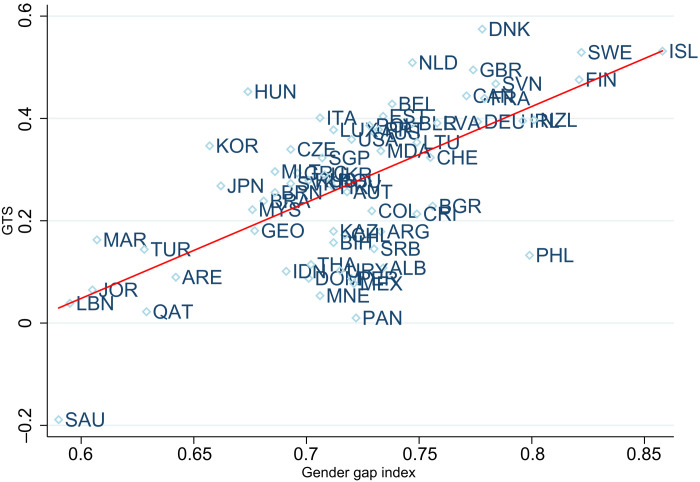
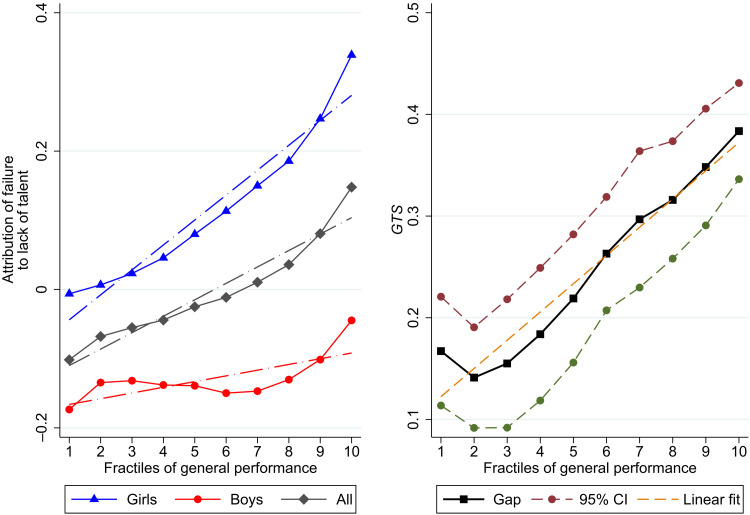
Recent research has shown that there exist gender stereotypes that portray men as more brilliant or inherently talented than women. We provide a large-scale multinational investigation of these stereotypes and their relationship with other gender gaps. Using a survey question asked to more than 500,000 students in 72 countries, we build a measure of the stereotypes associating talent with men and show that they are present in almost all studied countries. These stereotypes are stronger among high-achieving students and in more developed or more gender-egalitarian countries. Similar patterns are observed for gender gaps in competitiveness, self-confidence, and willingness to work in an ICT (Information and Communication Technology)-related occupation. Statistical analysis suggests that these three latter gender gaps could be related to stereotypes associating talent with men. We conclude that these stereotypes should be more systematically considered as a possible explanation for the glass ceiling.
最近的研究表明,存在一些性别刻板印象,将男性描绘得比女性更聪明或更具天赋。我们对这些刻板印象及其与其他性别差距的关系进行了大规模的跨国调查。通过对72个国家的50多万名学生提出的一个调查问题,我们构建了一种将天赋与男性联系起来的刻板印象衡量标准,并表明几乎在所有研究的国家都存在这种刻板印象。这些刻板印象在成绩优异的学生中以及在更发达或性别平等程度更高的国家更为强烈。在竞争力、自信心以及从事信息通信技术相关职业的意愿方面的性别差距也观察到了类似模式。统计分析表明,后三种性别差距可能与将天赋与男性联系起来的刻板印象有关。我们得出结论,这些刻板印象应更系统地被视为玻璃天花板的一种可能解释。