Department of Orthopaedics, The Affiliated Hospital of Chengde Medical College, No. 1 Nanyingzi Street, Chengde, 067000, Hebei, China.
Pathology Teaching and Research Section, Chengde Medical College, Chengde, 067000, Hebei, China.
J Orthop Surg Res. 2022 Mar 9;17(1):154. doi: 10.1186/s13018-022-03048-x.
Osteosarcoma (OS) is a malignant bone tumour of mesenchymal origin. These tumours are characterised by rich vascularisation, therefore promoting rapid proliferation and facilitating metastasis. CD44 has been reported to be involved in OS, but its role and molecular mechanisms in the pathogenesis of the disease are not fully determined.
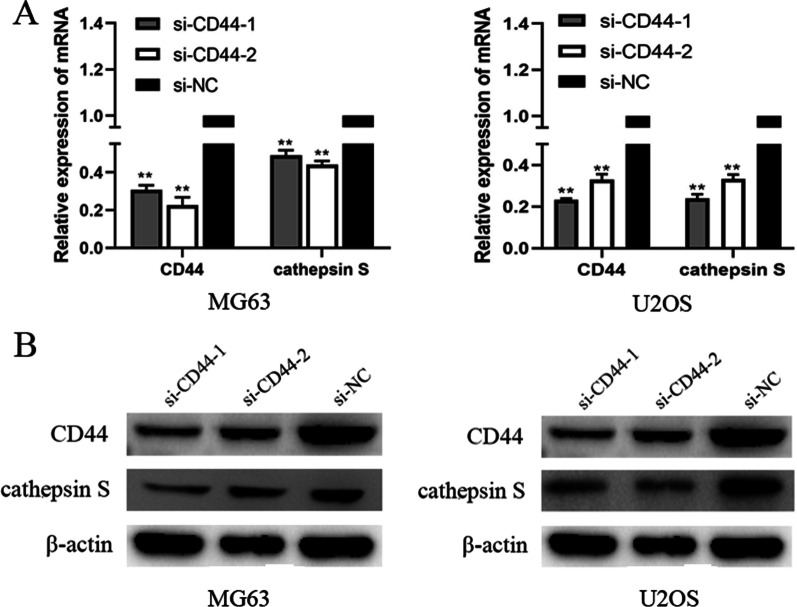
In this study, we investigated the antitumor effect of CD44 on the development of OS and further explored the molecular mechanisms. The expression of CD44, cathepsin S and MMP-9 was detected by Western blot (WB) and reverse transcription-polymerase chain reaction (RT-qPCR) in different cell lines (MG63, U2OS OS and hFOB 1.19). To elucidate the role of CD44 in OS, MG63 and U2OS cells were treated with small interference RNA (siRNA) to knock down CD44, and the knockdown efficiency was validated with GFP and RT-qPCR. Furthermore, cell proliferation was assayed using Cell Counting Kit‑8 (CCK-8) and colony formation assays, and cell migration and invasion were assayed by transwell and wound-healing assays.
We found that CD44 expression in the MG63 and U2OS OS cell lines was markedly increased compared to that of the human osteoblast hFOB 1.19 cell line. Knockdown of CD44 inhibited proliferation, migration and invasion of MG63 and U2OS cells. Cathepsin S expression in the MG63 and U2OS OS cell lines was increased compared to that of the human osteoblast hFOB 1.19 cell line. When CD44 was knocked down, its expression level went down.
Taken together, our data reinforced the evidence that CD44 knockdown inhibited cell proliferation, migration and invasion of OS cells accompanied by altered expression of cathepsin S. These findings offer new clues for OS development and progression, suggesting CD44 as a potential therapeutic target for OS.
骨肉瘤(OS)是一种源自间充质的恶性骨肿瘤。这些肿瘤的特点是富含血管,因此促进了快速增殖并有助于转移。已有报道称 CD44 参与了 OS,但它在疾病发病机制中的作用和分子机制尚未完全确定。
在这项研究中,我们研究了 CD44 对 OS 发展的抗肿瘤作用,并进一步探讨了其分子机制。通过 Western blot(WB)和逆转录聚合酶链反应(RT-qPCR)检测不同细胞系(MG63、U2OS OS 和 hFOB 1.19)中 CD44、组织蛋白酶 S 和 MMP-9 的表达。为了阐明 CD44 在 OS 中的作用,用小干扰 RNA(siRNA)处理 MG63 和 U2OS 细胞以敲低 CD44,并通过 GFP 和 RT-qPCR 验证敲低效率。此外,通过细胞计数试剂盒-8(CCK-8)和集落形成测定法检测细胞增殖,通过 Transwell 和划痕愈合测定法检测细胞迁移和侵袭。
我们发现 MG63 和 U2OS OS 细胞系中的 CD44 表达明显高于人成骨细胞 hFOB 1.19 细胞系。CD44 敲低抑制了 MG63 和 U2OS 细胞的增殖、迁移和侵袭。与 hFOB 1.19 细胞系相比,MG63 和 U2OS OS 细胞系中的组织蛋白酶 S 表达增加。当 CD44 被敲低时,其表达水平下降。
综上所述,我们的数据加强了证据表明,CD44 敲低抑制了 OS 细胞的增殖、迁移和侵袭,并伴有组织蛋白酶 S 的表达改变。这些发现为 OS 的发展和进展提供了新的线索,表明 CD44 可能是 OS 的一个潜在治疗靶点。