Cortis Dominic, Vella King Fiona
Department of Insurance, Faculty of Economics, Management and Finance, University of Malta, Msida, Malta.
Arch Public Health. 2022 Mar 9;80(1):76. doi: 10.1186/s13690-022-00830-5.
Following the emergence of the COVID-19 pandemic in Europe at the start of 2020, most countries had implemented various measures in an attempt to control the spread of the virus. This study analyses the main non-pharmaceutical interventions and their impact on the rate by which cumulative cases and deaths were growing in Europe during the first wave of this pandemic.
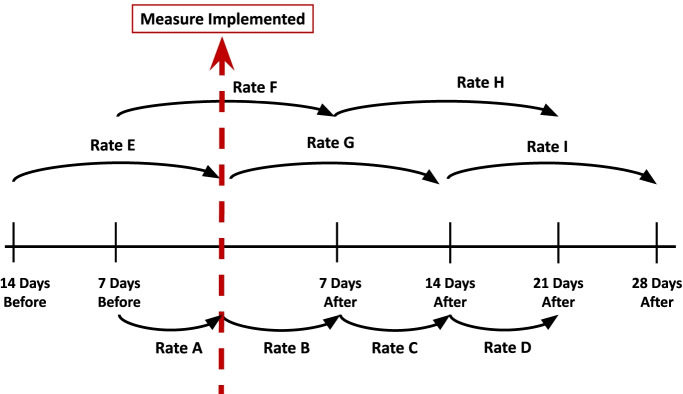
The interventions analysed are the school closures, restrictions on travel, cancellation of events, restrictions on gatherings, partial and full lockdowns. Data was collected on the implementation date of these interventions, and the number of daily cases and deaths during the first wave of the pandemic for every country and territory geographically located in Europe. The study uses growth rates to calculate the increase in cumulative cases and deaths in Europe before, during, and after these interventions were implemented.
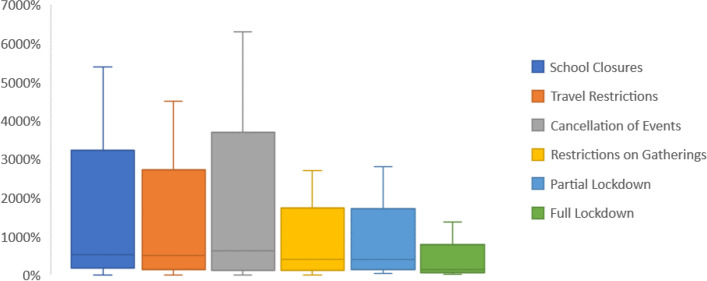
The results show that decisions to close schools, cancel events, and restrict travel were taken during the same time period, whereas the decisions for the other interventions were taken when the growth rates were similar. The most effective interventions at lowering the rate by which cumulative cases were increasing were the travel restrictions, school closures, and the partial lockdown, while most effective against cumulative deaths were the partial lockdown, travel restrictions, and full lockdown.
All the interventions reduced the rate by which cumulative cases and deaths were increasing with the partial lockdowns being the most effective from the other interventions, during the first wave of the pandemic in Europe.
自2020年初欧洲出现新冠疫情以来,大多数国家都实施了各种措施以控制病毒传播。本研究分析了主要的非药物干预措施及其对欧洲第一波疫情期间累计病例和死亡人数增长速度的影响。
所分析的干预措施包括学校关闭、旅行限制、活动取消、集会限制、部分和全面封锁。收集了这些干预措施的实施日期数据,以及位于欧洲的每个国家和地区在第一波疫情期间的每日病例数和死亡人数。该研究使用增长率来计算在这些干预措施实施之前、期间和之后欧洲累计病例和死亡人数的增加情况。
结果表明,关闭学校、取消活动和限制旅行的决定是在同一时期做出的,而其他干预措施的决定是在增长率相似时做出的。降低累计病例增加速度最有效的干预措施是旅行限制、学校关闭和部分封锁,而对累计死亡最有效的是部分封锁、旅行限制和全面封锁。
在欧洲第一波疫情期间,所有干预措施都降低了累计病例和死亡人数的增长速度,其中部分封锁是其他干预措施中最有效的。