Faculty of Physical Education and Sports Sciences, Kharazmi University, Tehran, Iran.
Sports Injury and Corrective Exercises, Kharazmi University, Tehran, Iran.
Sci Rep. 2022 Mar 9;12(1):4149. doi: 10.1038/s41598-022-08128-w.
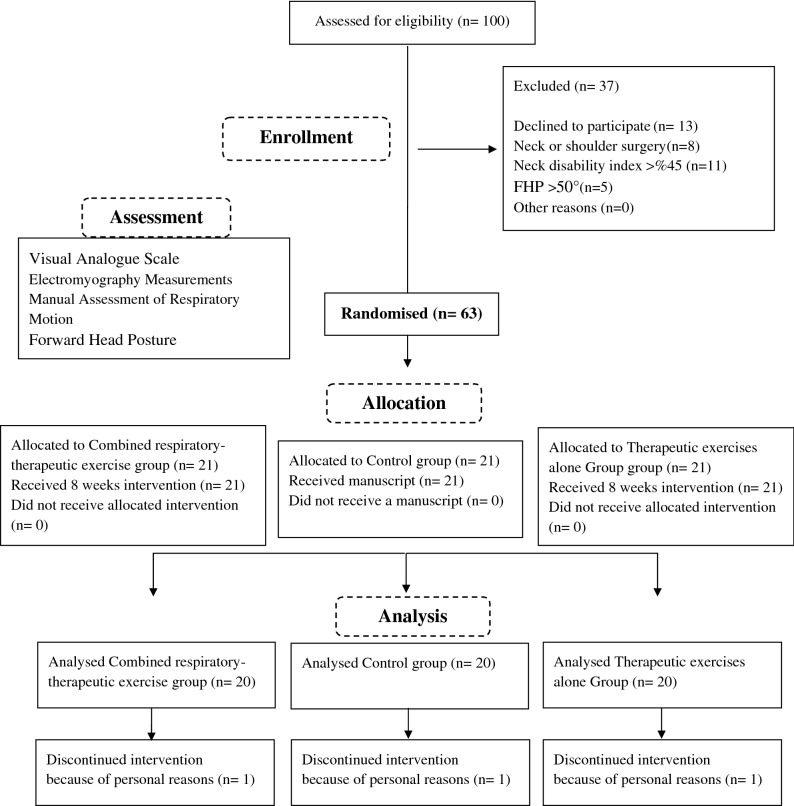
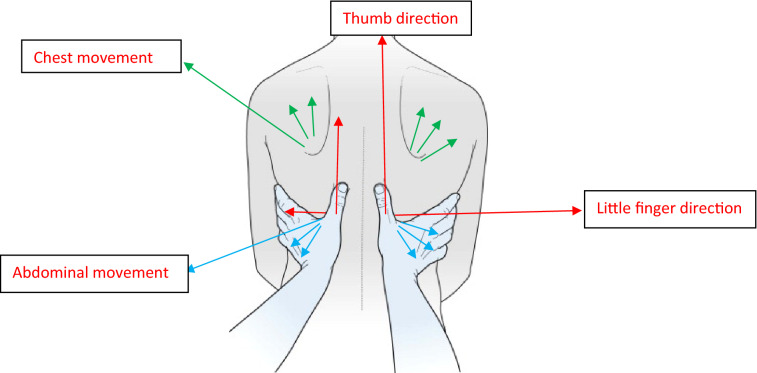
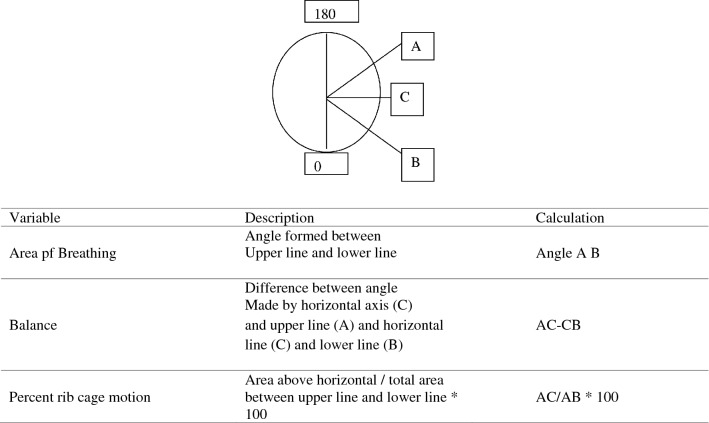
Neck pain and forward head posture (FHP) are typical in prolonged smartphone users and need to be targeted for treatment. We aimed to compare the effect of a routine therapeutic program with and without respiratory exercises on smartphone users with FHP and non-specific chronic neck pain (NSCNP). Sixty patients (aged 24.7 ± 2.1 years) with FHP and NSCNP were randomly assigned to the routine therapeutic program (n = 20), combined respiratory exercises with a routine therapeutic program (n = 20), or control (n = 20) groups. At baseline, there was no difference among groups at all variables. Each programme was implemented three times a week for eight weeks. Primary Outcome was pain measured by visual analogue scale (VAS), and secondary ones were forward head angle, the activity of specific muscles, and respiratory patterns, measured by photogrammetry, electromyography and manual, respectively. All outcomes were measured at baseline and eight weeks post-treatment. We used the repeated measures analysis of variance to examine the interaction between time and group, paired t-test for intragroup comparison, one-way analysis of variance for intergroup comparison, and Tukey post hoc test at a significant level 95% was used. There were significant differences in the combined group compared with the routine therapeutic group (P = 0.03) for diaphragm muscle activation, respiratory balance (P = 0.01), and the number of breaths (P = 0.02). There were significant within-group changes from baseline to post-treatment in the combined group for all outcomes above, but no changes in the therapeutic exercise routine group. Despite respiratory pattern, none of the secondary outcomes proved to be superior in the combination group compared to the routine therapeutic program in smartphone users with FHP and NSCNP. Future studies with longer follow-up assessments could strengthen these results.Trial registration: Current Controlled Trials using the IRCT website with ID number of, IRCT20200212046469N1 "Prospectively registered" at 04/03/2020.
颈部疼痛和头部前倾姿势(FHP)是长时间使用智能手机的人的典型症状,需要针对这些症状进行治疗。我们旨在比较常规治疗方案与结合呼吸练习对头部前倾姿势和非特异性慢性颈部疼痛(NSCNP)的智能手机使用者的治疗效果。60 名(年龄 24.7±2.1 岁)有头部前倾姿势和 NSCNP 的患者被随机分为常规治疗方案组(n=20)、结合呼吸练习的常规治疗方案组(n=20)和对照组(n=20)。在基线时,三组在所有变量上均无差异。每个方案每周实施三次,共进行八周。主要结局是使用视觉模拟量表(VAS)测量的疼痛,次要结局是使用摄影测量法、肌电图和手动测量法测量的头部前倾角度、特定肌肉的活动和呼吸模式。所有结果均在基线和治疗八周后进行测量。我们使用重复测量方差分析来检查时间和组之间的交互作用,使用配对 t 检验进行组内比较,使用单因素方差分析进行组间比较,Tukey 事后检验用于显著性水平为 95%。与常规治疗组相比,联合组在膈肌肌肉激活、呼吸平衡(P=0.01)和呼吸次数(P=0.02)方面存在显著差异。联合组在上述所有结果中从基线到治疗后均有显著的组内变化,但常规治疗组没有变化。尽管呼吸模式发生了变化,但在有头部前倾姿势和 NSCNP 的智能手机使用者中,联合组的所有次要结果均未优于常规治疗方案。未来的研究如果进行更长时间的随访评估,可能会加强这些结果。试验注册:使用 IRCT 网站进行的当前对照试验,注册号为 ,IRCT20200212046469N1“前瞻性注册”于 2020 年 3 月 4 日。