Ataeinosrat Ali, Haghighi Marjan Mosalman, Abednatanzi Hossein, Soltani Mohammad, Ghanbari-Niaki Abbass, Nouri-Habashi Akbar, Amani-Shalamzari Sadegh, Mossayebi Ali, Khademosharie Mitra, Johnson Kelly E, VanDusseldorp Trisha A, Saeidi Ayoub, Zouhal Hassane
Department of Physical Education and Sport Science, Science and Research Branch, Islamic Azad University, Tehran, Iran.
Faculty of Medicine and Health, The University of Sydney, Sydney, NSW, Australia.
Front Physiol. 2022 Feb 21;13:827335. doi: 10.3389/fphys.2022.827335. eCollection 2022.
This study explored the effect of three different modes of resistance training on appetite hormones [leptin, ghrelin, cholecystokinin (CCK), glucagon-like peptide-1 (GLP-1), and peptide tyrosine-tyrosine (PYY)], cardiometabolic and anthropometric measures in males with obesity.
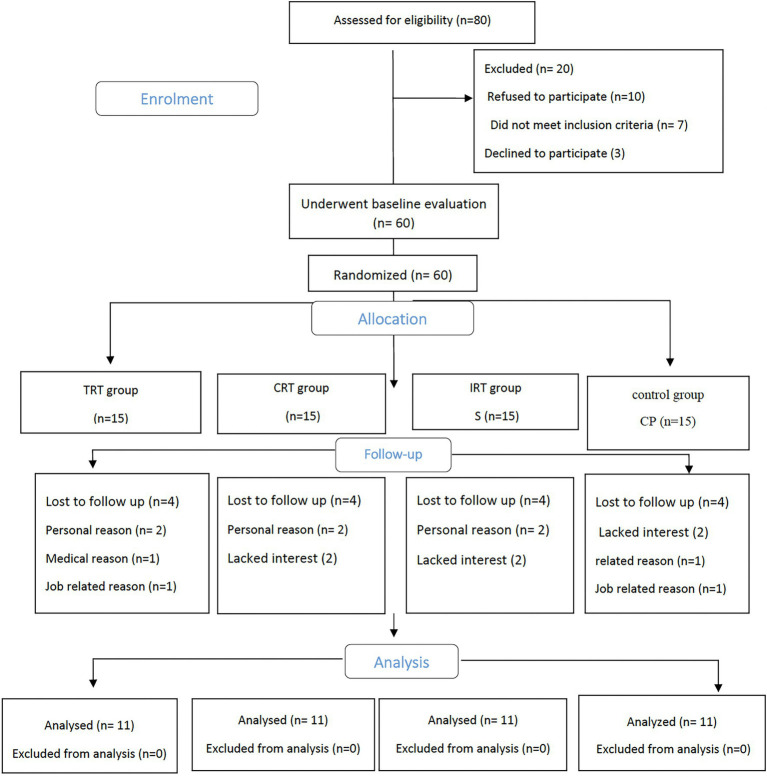
Forty-four males with obesity (age: 27.5 ± 9.4 yrs.; mean weight: 93.2 ± 2.2 kg, body mass index: 32.9 ± 1.2 kg/m) were randomized to traditional resistance training (TRT, = 11), circuit resistance training (CRT, = 11), interval resistance training (IRT, = 11) or control (C, = 11) groups. All resistance training groups received 50 min of supervised training per session, three days per week, for 12 weeks. Measurements were taken at baseline and after 12 weeks of training.
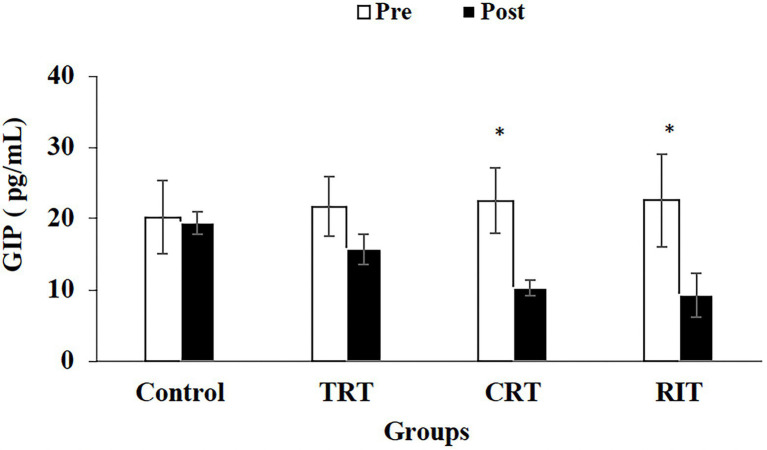
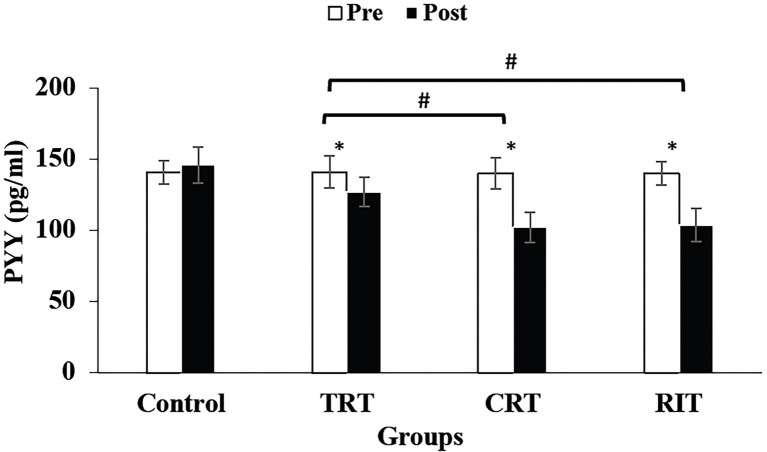
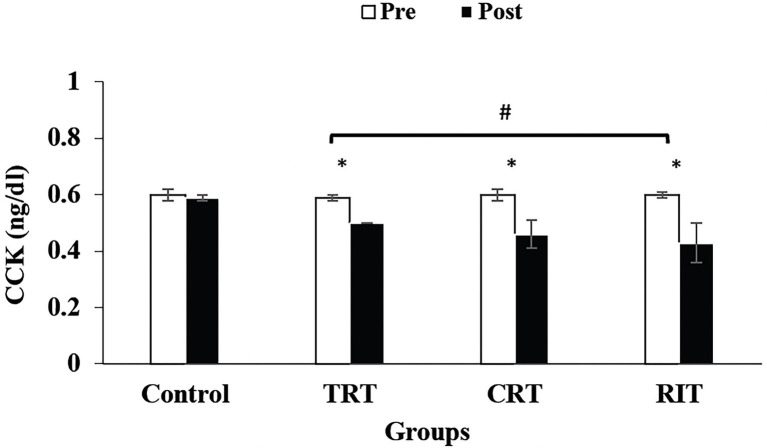
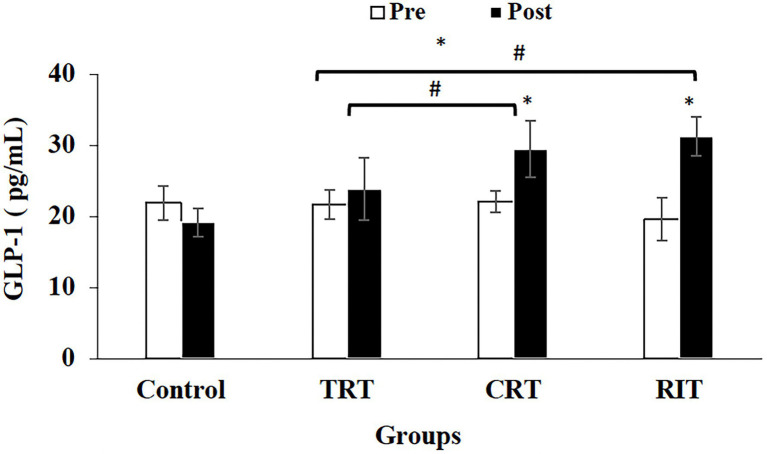
Plasma levels of leptin, ghrelin, CCK, and PYY decreased significantly in all three different modalities of resistance training groups when compared to the control group ( < 0.05). GLP-1 increased significantly in both CRT and IRT groups compared to TRT and C groups ( < 0.05). Glucose-dependent insulinotropic polypeptide decreased significantly in CRT and IRT groups compared to the C group ( < 0.05). Adiponectin levels increased significantly in all resistance training groups compared to the C group ( < 0.05).
Overall, CRT and IRT protocols had the greatest impact on appetite hormones compared to individuals who engaged in TRT or did not exercise (C).
本研究探讨了三种不同的抗阻训练模式对肥胖男性食欲激素[瘦素、胃饥饿素、胆囊收缩素(CCK)、胰高血糖素样肽-1(GLP-1)和酪酪肽(PYY)]、心脏代谢指标和人体测量指标的影响。
44名肥胖男性(年龄:27.5±9.4岁;平均体重:93.2±2.2千克,体重指数:32.9±1.2千克/米²)被随机分为传统抗阻训练组(TRT,n = 11)、循环抗阻训练组(CRT,n = 11)、间歇抗阻训练组(IRT,n = 11)或对照组(C,n = 11)。所有抗阻训练组每次训练接受50分钟的监督训练,每周三天,共12周。在基线和训练12周后进行测量。
与对照组相比,所有三种不同抗阻训练模式组的血浆瘦素、胃饥饿素、CCK和PYY水平均显著降低(P < 0.05)。与TRT组和C组相比,CRT组和IRT组的GLP-1显著升高(P < 0.05)。与C组相比,CRT组和IRT组的葡萄糖依赖性促胰岛素多肽显著降低(P < 0.05)。与C组相比,所有抗阻训练组的脂联素水平均显著升高(P < 0.05)。
总体而言,与进行TRT或不运动(C组)的个体相比,CRT和IRT方案对食欲激素的影响最大。