• 文献检索
  • 文档翻译
  • 深度研究
  • 学术资讯
  • Suppr Zotero 插件Zotero 插件
  • 邀请有礼
  • 套餐&价格
  • 历史记录
应用&插件
Suppr Zotero 插件Zotero 插件浏览器插件Mac 客户端Windows 客户端微信小程序
定价
高级版会员购买积分包购买API积分包
服务
文献检索文档翻译深度研究API 文档MCP 服务
关于我们
关于 Suppr公司介绍联系我们用户协议隐私条款
关注我们

Suppr 超能文献

核心技术专利:CN118964589B侵权必究
粤ICP备2023148730 号-1Suppr @ 2026

文献检索

告别复杂PubMed语法,用中文像聊天一样搜索,搜遍4000万医学文献。AI智能推荐,让科研检索更轻松。

立即免费搜索

文件翻译

保留排版,准确专业,支持PDF/Word/PPT等文件格式,支持 12+语言互译。

免费翻译文档

深度研究

AI帮你快速写综述,25分钟生成高质量综述,智能提取关键信息,辅助科研写作。

立即免费体验

儿童内感受促进的动作理解:一种发展模型。

Action Understanding Promoted by Interoception in Children: A Developmental Model.

作者信息

Zhou Hui, Gao Qiyang, Chen Wei, Wei Qiaobo

机构信息

Center for Brain, Mind and Education, Shaoxing University, Shaoxing, China.

Department of Psychology, Shaoxing University, Shaoxing, China.

出版信息

Front Psychol. 2022 Feb 21;13:724677. doi: 10.3389/fpsyg.2022.724677. eCollection 2022.

DOI:10.3389/fpsyg.2022.724677
PMID:35264994
原文链接:https://pmc.ncbi.nlm.nih.gov/articles/PMC8900726/
Abstract

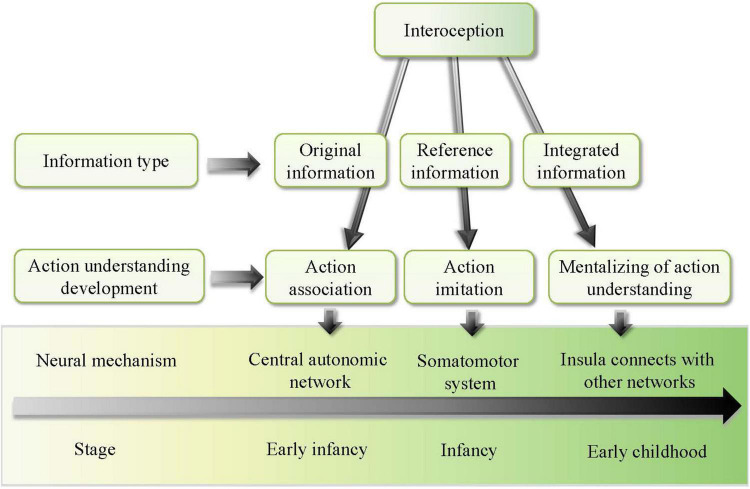
Action understanding of children develops from simple associative learning to mentalizing. With the rise of embodied cognition, the role of interoception in action observation and action understanding has received more attention. From a developmental perspective, this study proposes a novel developmental model that explores how interoception promotes action understanding of children across ages. In early infancy, most actions observed in infants come from interactions with their caregivers. Babies learn about action effects through automatic interoceptive processing and interoceptive feedback. Interoception in early infancy is not fully developed, such as the not fully developed gastrointestinal tract and intestinal nervous system. Therefore, in early infancy, action understanding is based on low-level and original interoceptive information. At this stage, after observing the actions of others, infants can create mental representations or even imitate actions without external visual feedback, which requires interoception to provide internal reference information. By early childhood, children begin to infer action intentions of other people by integrating various types of information to reach the mentalizing level. Interoception processing requires the integration of multiple internal signals, which promotes the information integration ability of children. Interoception also provides inner information for reasoning about action intention. This review also discussed the neural mechanisms of interoception and possible ways by which it could promote action understanding of children. In early infancy, the central autonomic neural network (CAN) automatically processes and responds to the actions of caregivers on infants, providing interoceptive information for action understanding of infants. In infancy, the growth of the somatomotor system provides important internal reference information for observing and imitating the actions of infants. In early childhood, the development of interoception of children facilitates the integration of internal and external information, which promotes the mentalization of action understanding of children. According to the proposed developmental model of action understanding of children promoted by interoception, there are multilevel and stage-dependent characteristics that impact the role of interoception in action understanding of children.

摘要

儿童的动作理解从简单的联想学习发展到心理理论。随着具身认知的兴起,内感受在动作观察和动作理解中的作用受到了更多关注。从发展的角度来看,本研究提出了一种新颖的发展模型,探讨内感受如何促进各年龄段儿童的动作理解。在婴儿早期,婴儿观察到的大多数动作都来自与照顾者的互动。婴儿通过自动的内感受处理和内感受反馈来了解动作效果。婴儿早期的内感受尚未完全发育,比如胃肠道和肠神经系统发育不完全。因此,在婴儿早期,动作理解基于低级和原始的内感受信息。在这个阶段,婴儿在观察他人的动作后,无需外部视觉反馈就能创建心理表征甚至模仿动作,这需要内感受提供内部参考信息。到幼儿期,儿童开始通过整合各种类型的信息来推断他人的动作意图,从而达到心理理论水平。内感受处理需要整合多个内部信号,这促进了儿童的信息整合能力。内感受也为动作意图推理提供内部信息。本综述还讨论了内感受的神经机制以及它促进儿童动作理解的可能方式。在婴儿早期,中枢自主神经网络(CAN)自动处理并对照顾者对婴儿的动作做出反应,为婴儿的动作理解提供内感受信息。在婴儿期,躯体运动系统的发育为观察和模仿婴儿动作提供重要的内部参考信息。在幼儿期,儿童内感受的发展促进了内部和外部信息的整合,这促进了儿童动作理解的心理理论化。根据所提出的由内感受促进儿童动作理解的发展模型,存在多层次和阶段依赖性特征,这些特征影响内感受在儿童动作理解中的作用。
https://cdn.ncbi.nlm.nih.gov/pmc/blobs/7a40/8900726/bfc09774705a/fpsyg-13-724677-g001.jpg

相似文献

1
Action Understanding Promoted by Interoception in Children: A Developmental Model.儿童内感受促进的动作理解:一种发展模型。
Front Psychol. 2022 Feb 21;13:724677. doi: 10.3389/fpsyg.2022.724677. eCollection 2022.
2
Neural Correlates of Cardiac Interoceptive Focus Across Development: Implications for Social Symptoms in Autism Spectrum Disorder.发展过程中心血管内感受焦点的神经关联:对自闭症谱系障碍社会症状的影响。
Autism Res. 2020 Jun;13(6):908-920. doi: 10.1002/aur.2289. Epub 2020 Mar 5.
3
The developmental origins of naïve psychology in infancy.婴儿期朴素心理学的发展起源。
Adv Child Dev Behav. 2009;37:55-104. doi: 10.1016/s0065-2407(09)03702-1.
4
Working With the Predictable Life of Patients: The Importance of "Mentalizing Interoception" to Meaningful Change in Psychotherapy.应对患者可预测的生活:“心理化内感受”对心理治疗中产生有意义改变的重要性。
Front Psychol. 2019 Sep 26;10:2173. doi: 10.3389/fpsyg.2019.02173. eCollection 2019.
5
Development and validation of the Interoceptive States Static Images (ISSI) database.内感受状态静态图像(ISSI)数据库的开发与验证。
Behav Res Methods. 2022 Aug;54(4):1744-1765. doi: 10.3758/s13428-021-01706-2. Epub 2021 Oct 14.
6
Interoceptive inference: From computational neuroscience to clinic.内感受推断:从计算神经科学到临床。
Neurosci Biobehav Rev. 2018 Jul;90:174-183. doi: 10.1016/j.neubiorev.2018.04.017. Epub 2018 Apr 22.
7
Theory of Motivated Cue-Integration and COVID-19: Between Interoception, Somatization, and Radicalization.动机性线索整合理论与COVID-19:在内感受、躯体化与激进化之间
Front Psychiatry. 2021 Jun 11;12:631758. doi: 10.3389/fpsyt.2021.631758. eCollection 2021.
8
Neurobehavioral evidence of interoceptive sensitivity in early infancy.婴儿早期内感受性敏感性的神经行为证据。
Elife. 2017 Aug 8;6:e25318. doi: 10.7554/eLife.25318.
9
Interactions between interoception and perspective-taking: Current state of research and future directions.躯体感知与换位思考的相互作用:当前研究状况与未来方向。
Neurosci Biobehav Rev. 2021 Nov;130:252-262. doi: 10.1016/j.neubiorev.2021.08.007. Epub 2021 Aug 13.
10
Actions of a shaken heart: Interoception interacts with action processing.颤动之心的行动:内感受与行动处理相互作用。
Biol Psychol. 2022 Mar;169:108288. doi: 10.1016/j.biopsycho.2022.108288. Epub 2022 Feb 8.

引用本文的文献

1
Interoception in Autism: A Narrative Review of Behavioral and Neurobiological Data.自闭症中的内感受:行为和神经生物学数据的叙述性综述
Psychol Res Behav Manag. 2024 May 3;17:1841-1853. doi: 10.2147/PRBM.S410605. eCollection 2024.

本文引用的文献

1
The Development of Negative Event-Emotion Matching in Infancy: Implications for Theories in Affective Science.婴儿期负面事件-情绪匹配的发展:对情感科学理论的启示
Affect Sci. 2020 Apr 16;1(1):4-19. doi: 10.1007/s42761-020-00005-x. eCollection 2020 Mar.
2
Exploring developmental changes in infant anticipation and perceptual processing: EEG responses to tactile stimulation.探究婴儿预期和感知加工的发展变化:触觉刺激的 EEG 反应。
Infancy. 2022 Jan;27(1):97-114. doi: 10.1111/infa.12438. Epub 2021 Oct 7.
3
The critical role of mental imagery in human emotion: insights from fear-based imagery and aphantasia.
心理意象在人类情感中的关键作用:基于恐惧的意象和心盲症的见解。
Proc Biol Sci. 2021 Mar 10;288(1946):20210267. doi: 10.1098/rspb.2021.0267.
4
Computational Models of Interoception and Body Regulation.内感受与身体调节的计算模型
Trends Neurosci. 2021 Jan;44(1):63-76. doi: 10.1016/j.tins.2020.09.012.
5
Interventions and Manipulations of Interoception.内脏感知的干预和操作。
Trends Neurosci. 2021 Jan;44(1):52-62. doi: 10.1016/j.tins.2020.09.010.
6
Diseases, Disorders, and Comorbidities of Interoception.内感受的疾病、紊乱及共病。
Trends Neurosci. 2021 Jan;44(1):39-51. doi: 10.1016/j.tins.2020.09.009.
7
Functions of Interoception: From Energy Regulation to Experience of the Self.内感受的功能:从能量调节到自我体验
Trends Neurosci. 2021 Jan;44(1):29-38. doi: 10.1016/j.tins.2020.09.008.
8
Neural Circuits of Interoception.内脏感知的神经回路。
Trends Neurosci. 2021 Jan;44(1):17-28. doi: 10.1016/j.tins.2020.09.011.
9
A whole-brain connectivity map of mouse insular cortex.小鼠脑岛的全脑连接图谱。
Elife. 2020 Sep 17;9:e55585. doi: 10.7554/eLife.55585.
10
Importance of body representations in social-cognitive development: New insights from infant brain science.身体表象在社会认知发展中的重要性:婴儿脑科学的新见解。
Prog Brain Res. 2020;254:25-48. doi: 10.1016/bs.pbr.2020.07.009. Epub 2020 Aug 14.