Department of Urology, Affiliated Hospital of North Sichuan Medical College, Nanchong, China.
Front Endocrinol (Lausanne). 2022 Feb 21;13:810242. doi: 10.3389/fendo.2022.810242. eCollection 2022.
Male infertility is a global public health issue recognized by the WHO. Recently, antioxidants are increasingly used to treat idiopathic male infertility. However, the lack of available evidence has led to the inability to rank the effects of antioxidants on the sperm quality parameters and pregnancy rate of infertile men. This network meta-analysis studied the effects of different antioxidants on the sperm quality and pregnancy rate of idiopathic male infertility.
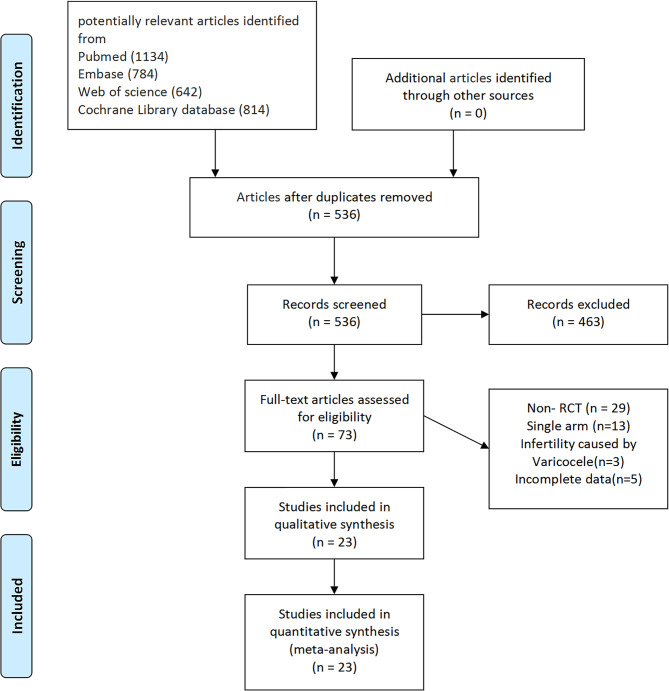
We searched PubMed, Embase, Web of Science, and Cochrane Library databases for randomized controlled trials (RCTs). The weighted mean difference (WMD) and odds ratio (OR) were applied for the comparison of continuous and dichotomous variables, respectively, with 95% CIs. The outcomes were sperm motility, sperm concentration, sperm morphology, and pregnancy rate.
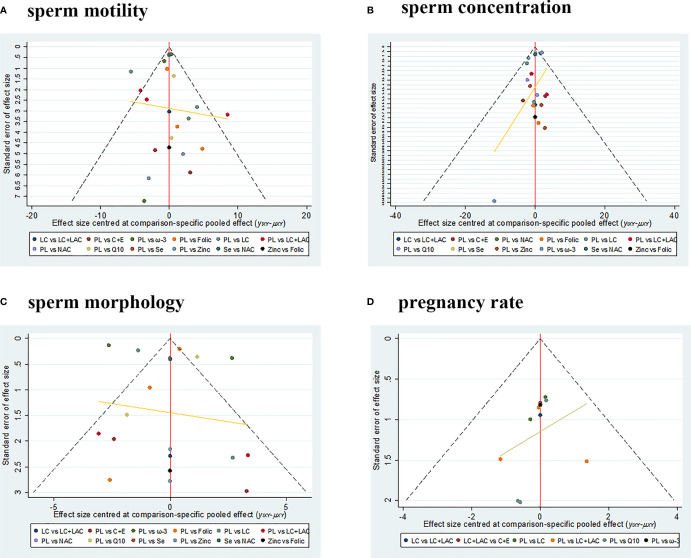
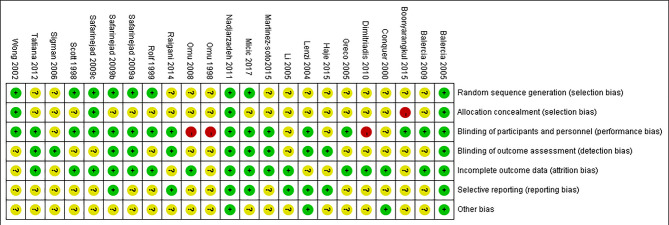
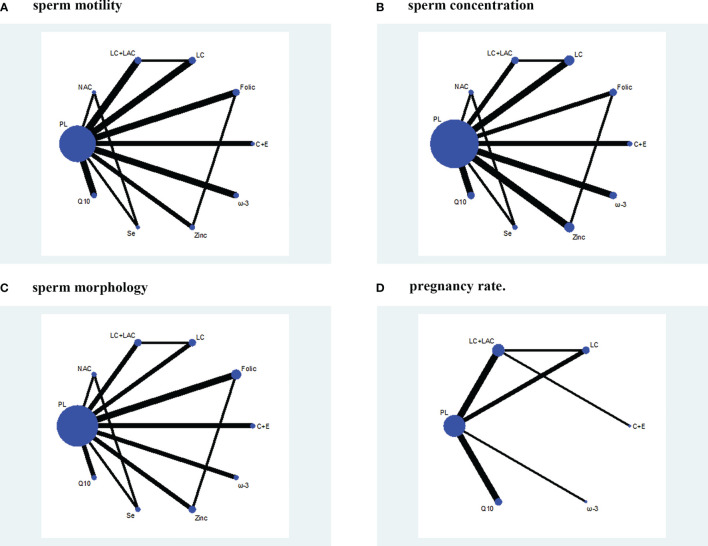
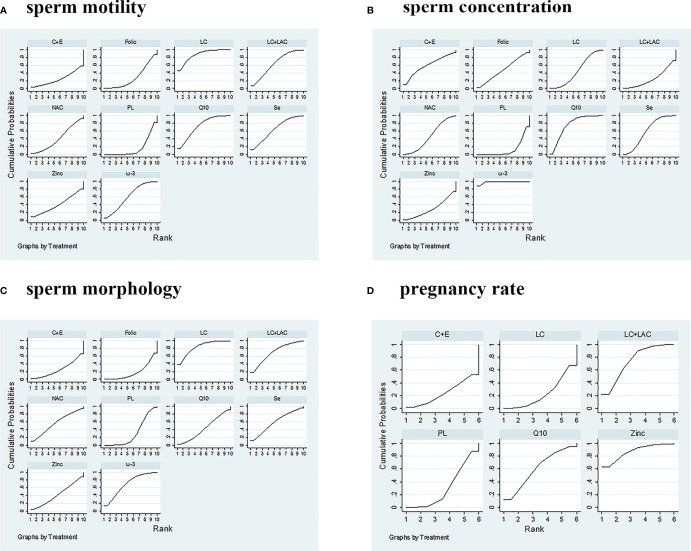
A total of 23 RCTs with 1,917 patients and 10 kids of antioxidants were included. l-Carnitine, l-carnitine+l-acetylcarnitine, coenzyme-Q10, ω-3 fatty acid, and selenium were more efficacious than placebo in sperm quality parameters. l-Carnitine was ranked first in sperm motility and sperm morphology (WMD 6.52% [95% CI: 2.55% to 10.05%], WMD 4.96% [0.20% to 9.73%]). ω-3 fatty acid was ranked first in sperm concentration (WMD 9.89 × 10/ml, [95% CI: 7.01 to 12.77 × 10/ml]). In terms of pregnancy rate, there was no significant effect as compared with placebo.
l-Carnitine was ranked first in sperm motility and sperm morphology. ω-3 fatty acid was ranked first in sperm concentration. Coenzyme-Q10 had better effective treatment on sperm motility and concentration. Furthermore, high-quality RCTs with adequate sample sizes should be conducted to compare the outcomes of different antioxidants.
男性不育是世界卫生组织(WHO)认定的全球性公共卫生问题。最近,抗氧化剂越来越多地被用于治疗特发性男性不育症。然而,由于缺乏可用证据,无法对抗氧化剂对不育男性精子质量参数和妊娠率的影响进行排序。本网络荟萃分析研究了不同抗氧化剂对特发性男性不育症患者精子质量和妊娠率的影响。
我们检索了 PubMed、Embase、Web of Science 和 Cochrane Library 数据库中的随机对照试验(RCTs)。应用加权均数差(WMD)和比值比(OR)分别比较连续和二分类变量,置信区间(CI)为 95%。结局指标为精子活力、精子浓度、精子形态和妊娠率。
共纳入 23 项 RCTs,包含 1917 名患者和 10 名接受抗氧化剂治疗的儿童。左卡尼汀、左卡尼汀+乙酰左卡尼汀、辅酶 Q10、ω-3 脂肪酸和硒在精子质量参数方面优于安慰剂。左卡尼汀在精子活力和精子形态方面排名第一(WMD 6.52%[95%CI:2.55%10.05%],WMD 4.96%[0.20%9.73%])。ω-3 脂肪酸在精子浓度方面排名第一(WMD 9.89×10/ml[95%CI:7.01~12.77×10/ml])。在妊娠率方面,与安慰剂相比无显著效果。
左卡尼汀在精子活力和精子形态方面排名第一。ω-3 脂肪酸在精子浓度方面排名第一。辅酶 Q10 在精子活力和浓度方面有更好的治疗效果。此外,应开展高质量、大样本量的 RCT,以比较不同抗氧化剂的结局。