Zhu Jiang, Huang Rui, Yu Ping, Ren Haoyu, Su Xinliang
Department of Endocrine and Breast Surgery, The First Affiliated Hospital of Chongqing Medical University, Chongqing, China.
Department of Liver Surgery, Liver Transplantation Division, West China Hospital, Sichuan University, Chengdu, China.
Int J Endocrinol. 2022 Feb 28;2022:3534783. doi: 10.1155/2022/3534783. eCollection 2022.
The incidence of papillary thyroid carcinoma (PTC) is higher in females than in males, but it remains unclear whether gender is associated with the aggressiveness of this disease. We aimed to clarify the influence of gender on the risk of developing lymph node metastasis (LNM) and on the prognosis of PTC patients. Retrospective cohort study. . Academic tertiary care center.
Clinical data of PTC patients who were admitted to the Department of Endocrine and Breast Surgery, the First Affiliated Hospital of Chongqing Medical University, between January 2013 and December 2018 were retrospectively reviewed. The differences in clinical features and outcomes between female and male patients were compared. Univariate and multivariate logistic regression analyses were conducted to assess the impact of gender on LNM. Kaplan-Meier curves were used to estimate recurrence-free survival (RFS).
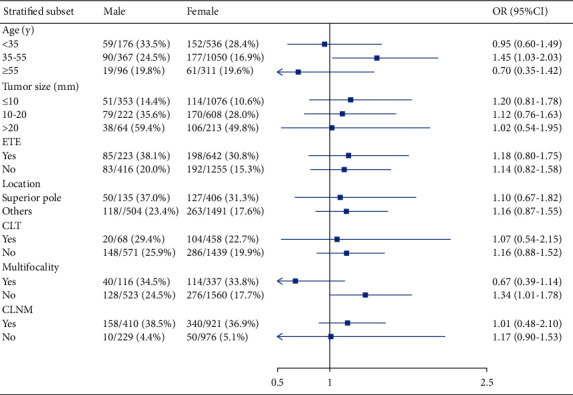
A total of consecutive 2536 patients were enrolled in this study. Males accounted for 25.2% (639 cases) of all patients. Central lymph node metastasis (CLNM) and lateral lymph node metastasis (LLNM) rates were 52.5% (1346/2536) and 22.0% (558/2536), respectively. Male presented with higher LNM rates than female patients (65.7% vs. 51.2%; < 0.001). Male gender was independently associated with LNM (OR = 1.93, 95% CI: 1.59-2.35; < 0.001). After full adjustment, male gender still remained significantly associated with CLNM in all subgroups; however, subgroup analyses indicated no significant relationship between gender and LLNM. In addition, after a median follow-up period of 30 months, no significant difference was found in RFS between female and male patients (=0.15).
This observational cohort study revealed that male gender was significantly associated with CLNM; whereas, LLNM was not different between female and male PTC patients in southwestern China. Moreover, currently, there is insufficient evidence to justify that male gender is an independent prognostic factor for recurrence.
甲状腺乳头状癌(PTC)的发病率女性高于男性,但性别是否与该疾病的侵袭性相关仍不清楚。我们旨在阐明性别对甲状腺乳头状癌患者发生淋巴结转移(LNM)风险及预后的影响。回顾性队列研究。学术三级医疗中心。
回顾性分析2013年1月至2018年12月期间重庆医科大学附属第一医院内分泌与乳腺外科收治的PTC患者的临床资料。比较女性和男性患者的临床特征和结局差异。进行单因素和多因素逻辑回归分析以评估性别对LNM的影响。采用Kaplan-Meier曲线估计无复发生存期(RFS)。
本研究共纳入2536例连续患者。男性占所有患者的25.2%(639例)。中央淋巴结转移(CLNM)率和侧方淋巴结转移(LLNM)率分别为52.5%(1346/2536)和22.0%(558/2536)。男性的LNM率高于女性患者(65.7%对51.2%;P<0.001)。男性性别与LNM独立相关(OR = 1.93,95%CI:1.59 - 2.35;P<0.001)。经过全面调整后,男性性别在所有亚组中仍与CLNM显著相关;然而,亚组分析表明性别与LLNM之间无显著关系。此外,在中位随访期30个月后,女性和男性患者的RFS无显著差异(P = 0.15)。
这项观察性队列研究表明,男性性别与CLNM显著相关;而在中国西南部,女性和男性PTC患者的LLNM无差异。此外,目前尚无足够证据证明男性性别是复发的独立预后因素。