Brunmair Julia, Bileck Andrea, Schmidl Doreen, Hagn Gerhard, Meier-Menches Samuel M, Hommer Nikolaus, Schlatter Andreas, Gerner Christopher, Garhöfer Gerhard
Department of Analytical Chemistry, Faculty of Chemistry, University of Vienna, Währinger Straße 38, 1090 Vienna, Austria.
Joint Metabolome Facility, University and Medical University Vienna, Vienna, Austria.
EPMA J. 2022 Jan 29;13(1):107-123. doi: 10.1007/s13167-022-00272-7. eCollection 2022 Mar.
BACKGROUND/AIMS: Concerning healthcare approaches, a paradigm change from reactive medicine to predictive approaches, targeted prevention, and personalisation of medical services is highly desirable. This raises demand for biomarker signatures that support the prediction and diagnosis of diseases, as well as monitoring strategies regarding therapeutic efficacy and supporting individualised treatments. New methodological developments should preferably rely on non-invasively sampled biofluids like sweat and tears in order to provide optimal compliance, reduce costs, and ensure availability of the biomaterial. Here, we have thus investigated the metabolic composition of human tears in comparison to finger sweat in order to find biofluid-specific marker molecules derived from distinct secretory glands. The comprehensive investigation of numerous biofluids may lead to the identification of novel biomarker signatures. Moreover, tear fluid analysis may not only provide insight into eye pathologies but may also be relevant for the prediction and monitoring of disease progression and/ or treatment of systemic disorders such as type 2 diabetes mellitus.
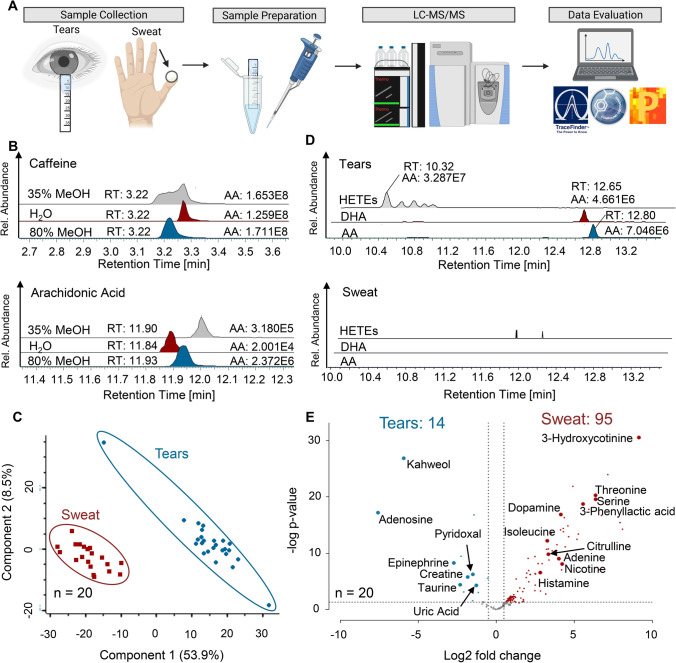
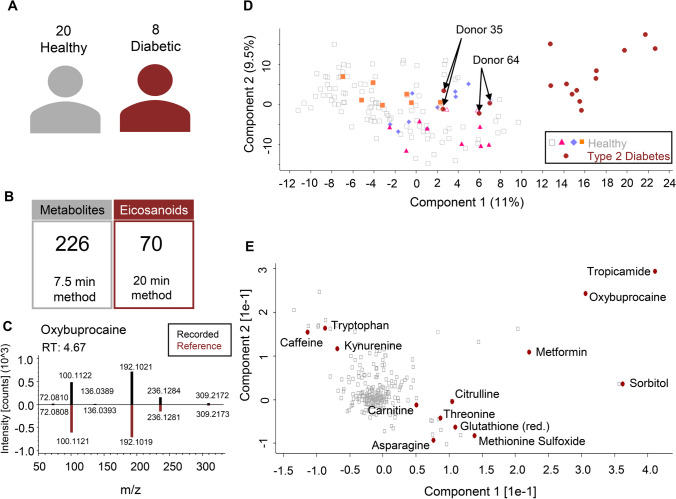
Sweat and tear fluid were sampled from 20 healthy volunteers using filter paper and commercially available Schirmer strips, respectively. Finger sweat analysis has already been successfully established in our laboratory. In this study, we set up and evaluated methods for tear fluid extraction and analysis using high-resolution mass spectrometry hyphenated with liquid chromatography, using optimised gradients each for metabolites and eicosanoids. Sweat and tears were systematically compared using statistical analysis. As second approach, we performed a clinical pilot study with 8 diabetic patients and compared them to 19 healthy subjects.
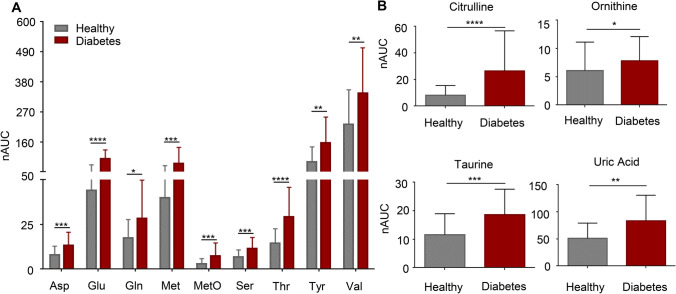
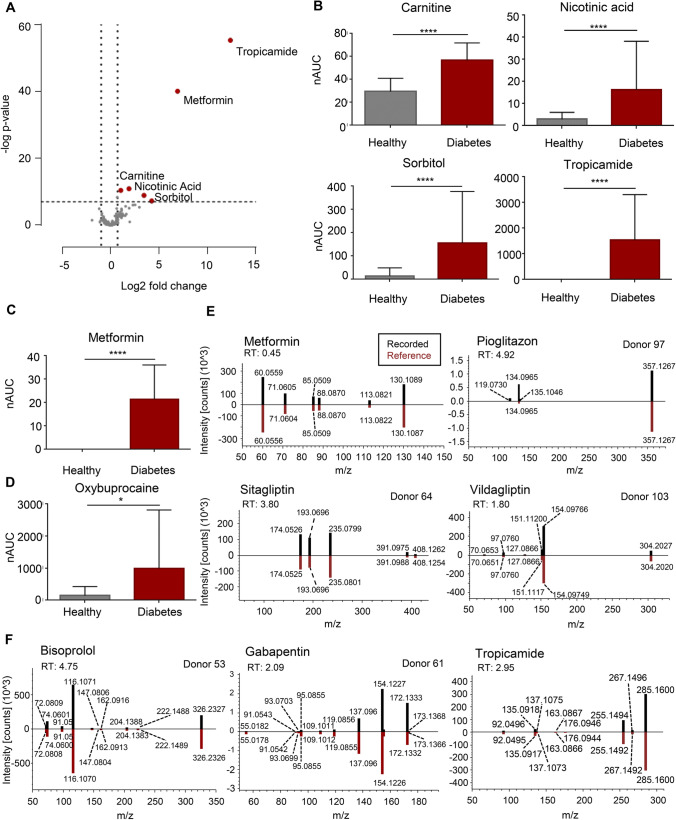
Tear fluid was found to be a rich source for metabolic phenotyping. Remarkably, several molecules previously identified by us in sweat were found significantly enriched in tear fluid, including creatine or taurine. Furthermore, other metabolites such as kahweol and various eicosanoids were exclusively detectable in tears, demonstrating the orthogonal power for biofluid analysis in order to gain information on individual health states. The clinical pilot study revealed that many endogenous metabolites that have previously been linked to type 2 diabetes such as carnitine, tyrosine, uric acid, and valine were indeed found significantly up-regulated in tears of diabetic patients. Nicotinic acid and taurine were elevated in the diabetic cohort as well and may represent new biomarkers for diabetes specifically identified in tear fluid. Additionally, systemic medications, like metformin, bisoprolol, and gabapentin, were readily detectable in tears of patients.
The high number of identified marker molecules found in tear fluid apparently supports disease development prediction, developing preventive approaches as well as tailoring individual patients' treatments and monitoring treatment efficacy. Tear fluid analysis may also support pharmacokinetic studies and patient compliance control.
The online version contains supplementary material available at 10.1007/s13167-022-00272-7.
背景/目的:在医疗保健方法方面,从反应性医学向预测性方法、靶向预防和医疗服务个性化的范式转变非常必要。这增加了对生物标志物特征的需求,以支持疾病的预测和诊断,以及治疗效果监测策略和支持个性化治疗。新的方法发展最好依赖于如汗液和泪液等非侵入性采集的生物流体,以提供最佳的依从性、降低成本并确保生物材料的可获得性。在此,我们比较了人类泪液与手指汗液的代谢组成,以寻找源自不同分泌腺的生物流体特异性标记分子。对多种生物流体的全面研究可能会导致新型生物标志物特征的识别。此外,泪液分析不仅可以深入了解眼部病理,还可能与疾病进展的预测和监测以及/或2型糖尿病等全身性疾病的治疗相关。
分别使用滤纸和市售的泪液试纸从20名健康志愿者中采集汗液和泪液。手指汗液分析已在我们实验室成功建立。在本研究中,我们建立并评估了使用液相色谱联用高分辨率质谱进行泪液提取和分析的方法,分别针对代谢物和类二十烷酸使用优化的梯度。使用统计分析系统地比较汗液和泪液。作为第二种方法,我们对8名糖尿病患者进行了临床初步研究,并将他们与19名健康受试者进行比较。
发现泪液是代谢表型分析的丰富来源。值得注意的是,我们之前在汗液中鉴定出的几种分子在泪液中显著富集,包括肌酸或牛磺酸。此外,其他代谢物如咖啡豆醇和各种类二十烷酸仅在泪液中可检测到,这证明了生物流体分析在获取个体健康状态信息方面的正交能力。临床初步研究表明,许多先前与2型糖尿病相关的内源性代谢物,如肉碱、酪氨酸、尿酸和缬氨酸,在糖尿病患者的泪液中确实显著上调。烟酸和牛磺酸在糖尿病队列中也升高,可能代表在泪液中特异性鉴定出的糖尿病新生物标志物。此外,患者泪液中很容易检测到全身性药物,如二甲双胍、比索洛尔和加巴喷丁。
在泪液中发现的大量已鉴定标记分子显然支持疾病发展预测、制定预防方法以及为个体患者量身定制治疗和监测治疗效果。泪液分析还可能支持药代动力学研究和患者依从性控制。
在线版本包含可在10.1007/s13167 - 022 - 00272 - 7获取的补充材料。