Institute of Reproductive and Child Health, National Health Commission Key Laboratory of Reproductive Health, Peking University Health Science Center, Beijing, China.
Department of Epidemiology and Biostatistics, School of Public Health, Peking University Health Science Center, Beijing, China.
J Glob Health. 2022 Feb 26;12:11001. doi: 10.7189/jogh.12.11001. eCollection 2022.
Cesarean delivery vs vaginal delivery was reported to increase the risks of childhood obesity, pneumonia, anemia, and neurobehavioral disorders, but few studies were able to deal with the confounding biases associated with medical conditions indicating cesareans. This prospective cohort study aims to investigate the associations of non-medically indicated cesarean delivery on maternal request (CDMR) with these child health outcomes.
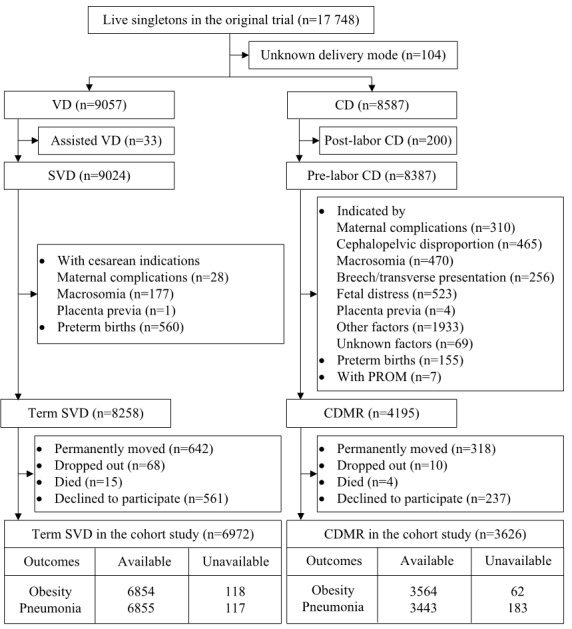
Among 17 748 liveborn infants whose mothers (primiparas) participated in a randomized controlled trial on micronutrient supplementation and pregnancy outcomes during 2006-2009 in 5 rural counties in Hebei Province, China, 6972 singletons born by full-term spontaneous vaginal delivery (SVD) and 3626 by CDMR were extracted for the assessments of obesity (weight-for-height z-score >3) and pneumonia (self-reported) at 1.5-5 years in 2011. Some children were further randomly selected from these two groups for the assessments of anemia (hemoglobin <110 g/L, 2341 SVD and 2417 CDMR) and neurobehavioral disorders (raw score of Child Behavior Checklist larger than the 90th percentile of the normative sample, 1257 SVD and 1060 CDMR).
Compared with SVD, CDMR was associated with increased risks of obesity (adjusted odds ratio (aOR) = 1.41, 95% confidence interval (CI) = 1.14-1.75, = 0.002) and anemia (aOR = 1.65, 95% CI = 1.28-2.12, < 0.001), but not with the risk of pneumonia (aOR = 1.16, 95% CI = 0.94-1.45, = 0.17) or neurobehavioral disorders (aORs varied from 0.82 to 0.91, > 0.05) in childhood.
Cesarean delivery, independent of cesarean indications, is likely associated with childhood obesity and anemia, indicating a need to keep pregnant women informed, especially those seeking CDMR, a need to explore possible improvement on obstetric service, and even a need for main stakeholders to reach a compromise in making a cesarean decision.
ClinicalTrials.gov: NCT00133744 and NCT01404416.
剖宫产分娩与阴道分娩相比,据报道会增加儿童肥胖、肺炎、贫血和神经行为障碍的风险,但很少有研究能够解决与剖宫产指征相关的混杂偏倚。本前瞻性队列研究旨在调查非医学指征剖宫产(产妇要求剖宫产,CDMR)与这些儿童健康结局之间的关系。
在中国河北省 5 个农村县的 2006-2009 年期间进行的一项微量营养素补充和妊娠结局的随机对照试验中,纳入了 17748 例活产婴儿,其母亲(初产妇)参与了该试验。从这些婴儿中提取了 6972 例足月自然阴道分娩(SVD)和 3626 例 CDMR 的单胎婴儿,以评估其在 2011 年 1.5-5 岁时的肥胖(体重身高 z 评分>3)和肺炎(自述)情况。从这两组中,进一步随机选择了一些儿童以评估其贫血(血红蛋白<110g/L,2341 例 SVD 和 2417 例 CDMR)和神经行为障碍(儿童行为检查表的原始分数大于正常样本第 90 百分位数,1257 例 SVD 和 1060 例 CDMR)。
与 SVD 相比,CDMR 与肥胖的风险增加相关(调整后的优势比(aOR)=1.41,95%置信区间(CI)=1.14-1.75,=0.002)和贫血(aOR=1.65,95%CI=1.28-2.12,<0.001),但与肺炎的风险(aOR=1.16,95%CI=0.94-1.45,=0.17)或神经行为障碍的风险无关(aOR 范围为 0.82 至 0.91,>0.05)。
剖宫产分娩,与剖宫产指征无关,可能与儿童肥胖和贫血有关,这表明需要让孕妇知情,特别是那些寻求 CDMR 的孕妇知情,需要探索可能改善产科服务的方法,甚至需要主要利益相关者在做出剖宫产决定时达成妥协。
ClinicalTrials.gov:NCT00133744 和 NCT01404416。