Modarelli Rachel, Sarah Salma, Ramaker Megan E, Bolobiongo Mboli, Benjamin Robert, Gumus Balikcioglu Pinar
Department of Pediatrics, Duke University Medical Center, Durham, NC 27710, USA.
Division of Pediatric Endocrinology and Diabetes, Duke University Medical Center, Durham, NC 27705, USA.
J Endocr Soc. 2022 Feb 16;6(4):bvac024. doi: 10.1210/jendso/bvac024. eCollection 2022 Apr 1.
The effects of the coronavirus disease 2019 (COVID-19) pandemic on the incident cases of pediatric type 1 diabetes (T1D) and type 2 diabetes (T2D) are not clear.
To identify trends in incidence and presentation of pediatric new-onset T1D and T2D during the COVID-19 pandemic.
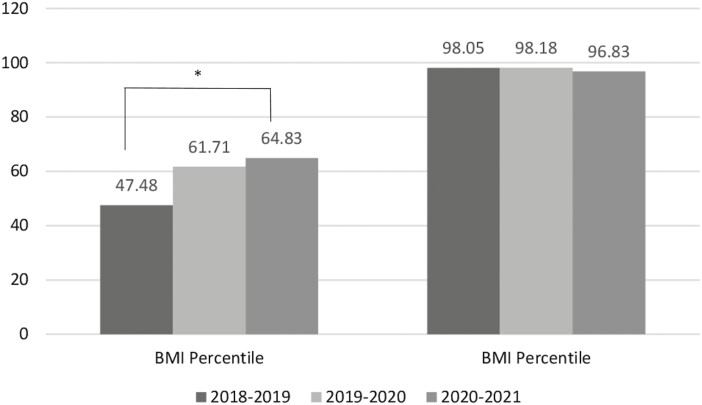
A retrospective chart review was conducted. Demographics, anthropometrics, and initial laboratory results from patients ages 0 through 21 years who presented with new-onset diabetes to a pediatric tertiary care center were recorded.
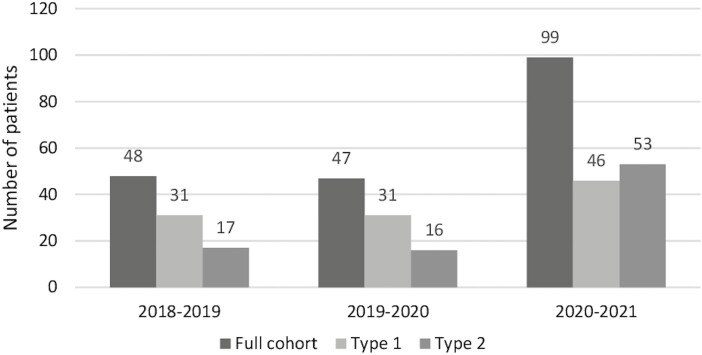
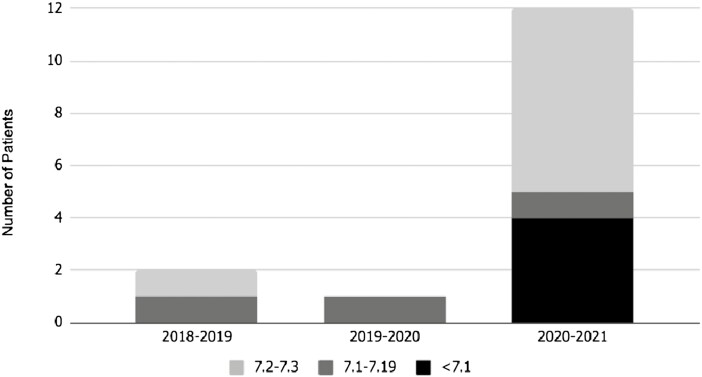
During the pandemic, incident cases of pediatric T1D increased from 31 in each of the prior 2 years to 46; an increase of 48%. Incident cases of pediatric T2D increased by 231% from 2019 to 2020. The number of incident cases of pediatric T2D increased significantly more than the number of incident cases of pediatric T1D ( = 0.009). Patients with T2D were more likely to present in diabetic ketoacidosis (DKA), though this was not statistically significant ( = 0.093). Severe DKA was higher compared with moderate DKA ( = 0.036) in incident cases of pediatric T2D. During the pandemic, for the first time, incident cases of T2D accounted for more than one-half of all newly diagnosed pediatric diabetes cases (53%).
There were more incident pediatric T1D and T2D cases as well as an increase in DKA severity in T2D at presentation during the COVID-19 pandemic. More importantly, incident T2D cases were higher than the incident T1D during the pandemic. This clearly suggests a disruption and change in the pediatric diabetes trends with profound individual and community health consequences.
2019年冠状病毒病(COVID-19)大流行对儿童1型糖尿病(T1D)和2型糖尿病(T2D)的发病病例的影响尚不清楚。
确定COVID-19大流行期间儿童新发T1D和T2D的发病率及临床表现趋势。
进行回顾性病历审查。记录了0至21岁新发糖尿病的儿科三级护理中心患者的人口统计学、人体测量学和初始实验室检查结果。
在大流行期间,儿童T1D的发病病例从之前两年的每年31例增加到46例;增长了48%。儿童T2D的发病病例从2019年到2020年增加了231%。儿童T2D的发病病例数显著高于儿童T1D的发病病例数(P = 0.009)。T2D患者更易出现糖尿病酮症酸中毒(DKA),尽管这在统计学上无显著差异(P = 0.093)。在儿童T2D的发病病例中,重度DKA高于中度DKA(P = 0.036)。在大流行期间,T2D的发病病例首次占所有新诊断儿童糖尿病病例的一半以上(53%)。
在COVID-19大流行期间,儿童T1D和T2D的发病病例增多,且T2D患者就诊时DKA严重程度增加。更重要的是,大流行期间T2D的发病病例高于T1D。这清楚地表明儿童糖尿病趋势受到干扰并发生变化,对个人和社区健康产生深远影响。